The Vratya
Prose on the Vratya, a wandering holy man who stands for a year and becomes the cosmos.
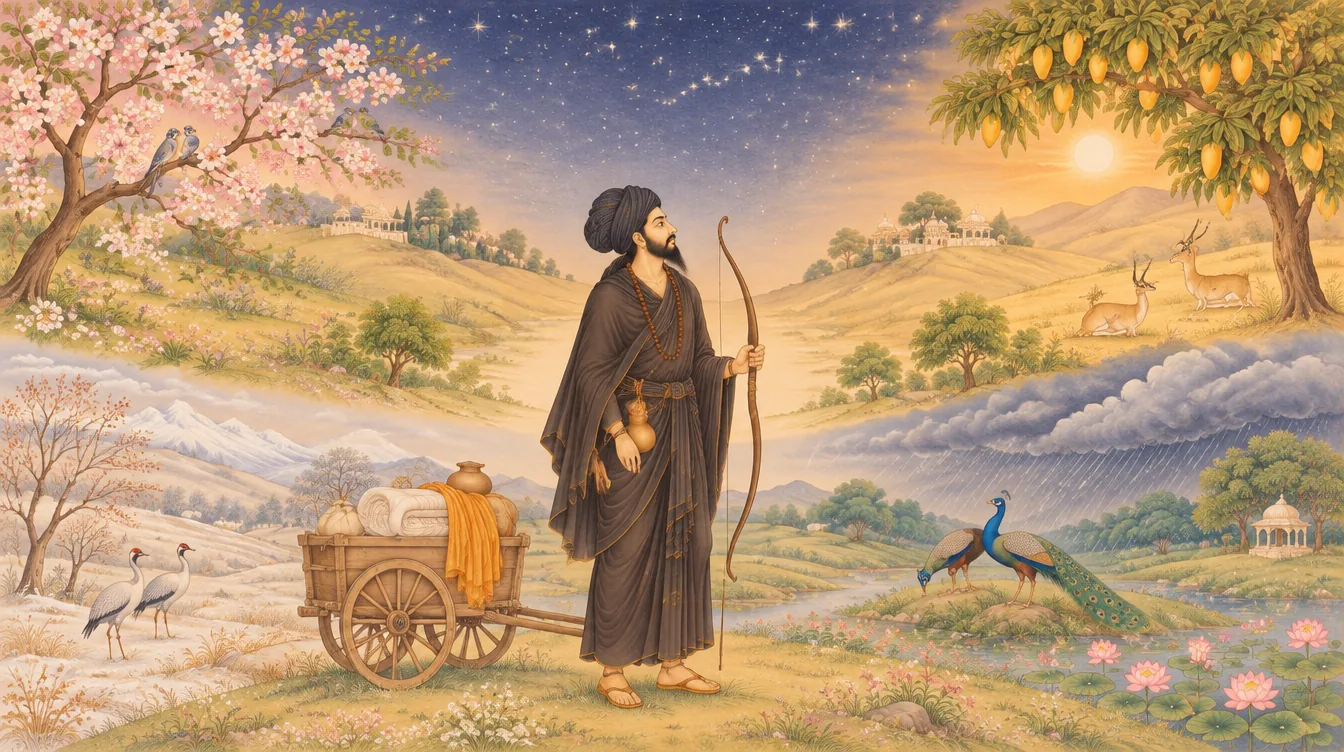
Book 15 is prose. It tells of the Vratya, a wanderer outside the usual rites, who stood upright for a year and became the great god.
It also says how a household should receive a Vratya who comes as a guest. Scholars still debate who the Vratyas were.
Hymns to read first
Read
book 15.
Sanskrit and English side by side, verse by verse. Choose what to show and how large.
Hymn 15.1The hyperbolical glorification of the Vrātya or Aryan Non-conformist
1व्रात्य आसीदीयमान एव स प्रजापतिं समैरयत् ॥
1There was a roaming Vrātya. He roused Prajāpati to action.
2स प्रजापतिः सुवर्णमात्मन्न् अपश्यत्तत्प्राजनयत् ॥
2Prajāpati beheld gold in himself and engendered it.
3तदेकमभवत्तल्ललाममभवत्तन् महदभवत्तज्ज्येष्ठमभवत्तद्ब्रह्माभवत्तत्तपोऽभवत्तत्सत्यमभवत्तेन प्राजायत ॥
3That became unique, that became distinguished, that became great, that became excellent, that became Devotion, that became holy Fervour, that became Truth: through that he was born.
4सोऽवर्धत स महान् अभवत्स महादेवोऽभवत् ॥
4He grew, he became great, he became Mahādeva.
5स देवानामीशां पर्यैत्स ईशानोऽभवत् ॥
5He gained the lordship of the Gods. He became Lord.
6स एकव्रात्योऽभवत्स धनुरादत्त तदेवेन्द्रधनुः ॥
6He became Chief Vrātya. He held a bow, even that Bow of Indra.
7नीलमस्योदरं लोहितं पृष्ठम् ॥
7His belly is dark-blue, his back is red.
8नीलेनैवाप्रियं भ्रातृव्यं प्रोर्णोति लोहितेन द्विषन्तं विध्यतीति ब्रह्मवादिनो वदन्ति ॥
8With dark-blue he envelops a detested rival, with red he pierces the man who hates him: so the theologians say.
Hymn 15.2The same, continued
1स उदतिष्ठत्स प्राचीं दिशमनु व्यचलत्। तं बृहच्च रथन्तरं चादित्याश्च विश्वे च देवा अनुव्यचलन् । बृहते च वै स रथन्तराय चादित्येभ्यश्च विश्वेभ्यश्च देवेभ्य आ वृश्चते य एवं विद्वांसं व्रात्यमुपवदति । बृहतश्च वै स रथन्तरस्य चादित्यानां च विश्वेषां च देवानां प्रियं धाम भवति य एवं वेद । तस्य प्राच्यां दिशि श्रद्धा पुंश्चली मित्रो मागधो विज्ञानं वासोऽहरुष्णीषं रात्री केशा हरितौ प्रवर्तौ कल्मलिर्मणिः । भूतं च भविष्यच्च परिष्कन्दौ मनो विपथं । मातरिश्वा च पवमानश्च विपथवाहौ वातः सारथी रेष्मा प्रतोदः । कीर्तिश्च यशश्च पुरःसरौ ऐनं कीर्तिर्गच्छत्या यशो गच्छति य एवं वेद ॥
1He arose and went his way to the eastern region. The Brihat, the Rathantara, the Ādityas and all the Gods followed him. That man is alienated from the Brihat, the Rathantara, the Ādityas, and all Gods who reviles the Vrātya who possesses this knowledge. He who hath this knowledge becomes the beloved home of the Brihat, the Rathantara the Ādityas, and all the Gods. In the eastern region Faith is his leman, the hymn his panegyrist, knowledge his vesture, day his turban, night his hair, Indra's two Bays his circular ornaments, the splendour of the stars his jewel. Present and Future are his running footmen, mind is his war-chariot, Mātarisvan and Pavamāna are they who draw it, Vita is his charioteer, Storm his goad, Fame and Glory are his harbingers. Fame and Glory come to him who hath this knowledge.
2स उदतिष्ठत्स दक्षिणां दिशमनु व्यचलत्। तं यज्ञायज्ञियं च वामदेव्यं च यज्ञश्च यजमानश्च पशवश्चानुव्यचलन् । यज्ञायज्ञियाय च वै स वामदेव्याय च यज्ञाय च यजमानाय च पशुभ्यश्चा वृश्चते य एवं विद्वांसं व्रात्यमुपवदति । यज्ञायज्ञियस्य च वै स वामदेव्यस्य च यज्ञस्य च यजमानस्य च पशूनां च प्रियं धाम भवति य एवं वेद । तस्य दक्षिणायां दिश्युषाः पुंश्चली मन्त्रो मागधो विज्ञानं वासोऽहरुष्णीषं रात्री केशा हरितौ प्रवर्तौ कल्मलिर्मणिः । अमावास्या च पौर्णमासी च परिष्कन्दौ मनो विपथं मातरिश्वा च पवमानश्च विपथवाहौ वातः सारथी रेष्मा प्रतोदः कीर्तिश्च यशश्च पुरःसरौ । ऐनं कीर्तिर्गच्छत्या यशो गच्छति य एवं वेद ॥
2He arose and went away to the southern region. Yajnāyajniya and Vāmadevya and Sacrifice and Sacrificer and sacrificial victims followed him. The man who reviles the Vrātya possessing this knowledge is alienated from Yajnāyajniya and Vāmadevya, Sacrifice, Sacrificer and sacrificial victims. He who hath this knowledge becomes the beloved home of Yajnāyajniya,Vāmadevya, Sacrifice, Sacrificer, and sacrificial victims. In the southern region Dawn is his leman, Mitra his panegyrist, knowledge his vesture, day his turban, night his hair, Indra's two Bays are his circular ornaments, New Moon Night and Full Moon Night are his running attendants, Mind, etc. as in stanza 1.
3स उदतिष्ठत्स प्रतीचीं दिशमनु व्यचलत्। तं वैरूपं च वैराजं चापश्च वरुणश्च राजानुव्यचलन् । वैरूपाय च वै स वैराजाय चाद्भ्यश्च वरुणाय च राज्ञ आ वृश्चते य एवं विद्वांसं व्रात्यमुपवदति । वैरूपस्य च वै स वैराजस्य चापां च वरुणस्य च राज्ञः प्रियं धाम भवति य एवं वेद । तस्य प्रतीच्यां दिशीरा पुंश्चली हसो मागधो विज्ञानं वासोऽहरुष्णीषं रात्री केशा हरितौ प्रवर्तौ कल्मलिर्मणिः । अहश्च रात्री च परिष्कन्दौ मनो विपथं मातरिश्वा च पवमानश्च विपथवाहौ वातः सारथी रेष्मा प्रतोदः कीर्तिश्च यशश्च पुरःसरौ । ऐनं कीर्तिर्गच्छत्या यशो गच्छति य एवं वेद ॥
3He arose and went away to the western region. Vairūpa and Vairāja, the Waters, and King Varuna followed him. He who reviles the Vrātya possessing this knowledge is alienated from Vairūpa and Vairāja, the Waters and Varuna the King. He who possesses this knowledge becomes the dear home of Vairūpa and Vairāja, the Waters and King Varuna. In the western region Irā is his leman, Laughter his panegyrist, knowledge, etc., as above. Day and Night are his running attendants, Mind, etc., as above.
4स उदतिष्ठत्स उदीचीं दिशमनु व्यचलत्। तं श्यैतं च नौधसं च सप्तर्षयश्च सोमश्च राजानुव्यचलन् । श्यैताय च वै स नौधसाय च सप्तर्षिभ्यश्च सोमाय च राज्ञ आ वृश्चते य एवं विद्वांसं व्रात्यमुपवदति । श्यैतस्य च वै स नौधसस्य च सप्तर्षीणां च सोमस्य च राज्ञः प्रियं धाम भवति य एवं वेद । तस्योदीच्यां दिशि विद्युत्पुंश्चली स्तनयित्नुर्मागधो विज्ञानं वासोऽहरुष्णीषं रात्री केशा हरितौ प्रवर्तौ कल्मलिर्मणिः । श्रुतं च विश्रुतं च परिष्कन्दौ मनो विपथं मातरिश्वा च पवमानश्च विपथवाहौ वातः सारथी रेष्मा प्रतोदः कीर्तिश्च यशश्च पुरःसरौ । ऐनं कीर्तिर्गच्छत्या यशो गच्छति य एवं वेद ॥
4He arose and went away to the northern region. Syaita and Naudhasa, the Seven Rishis, and King Soma followed him. He who reviles the Vrātya possessing this knowledge is alienated from Syaita, etc. He who hath this knowledge becomes the dear home of Syaita, etc. In the northern region Lightning is his leman, thunder his panegyrist, etc. as above. Revelation and Tradition are his running attendants, Mind, etc., as above.
Hymn 15.3
The Sanskrit has 11 verses and Griffith 10, so the two are shown as whole columns. Griffith's own verse numbers for the English verses: 1, 3, 4, 5, 6, 7, 8, 9, 10, 11 (he condenses or omits the verses in between).
1स संवत्सरमूर्ध्वोऽतिष्ठत्तं देवा अब्रुवन् व्रात्य किं नु तिष्ठसीति ॥
2सोऽब्रवीदासन्दीं मे सं भरन्त्विति ॥
3तस्मै व्रात्यायासन्दीं समभरन् ॥
4तस्या ग्रीष्मश्च वसन्तश्च द्वौ पादावास्तां शरच्च वर्षाश्च द्वौ ॥
5बृहच्च रथन्तरं चानूच्ये आस्तां यज्ञायज्ञियं च वामदेव्यं च तिरश्च्ये ॥
6ऋचः प्राञ्चस्तन्तवो यजूंषि तिर्यञ्चः ॥
7वेद आस्तरणं ब्रह्मोपबर्हणम् ॥
8सामासाद उद्गीथोऽपश्रयः ॥
9तामासन्दीं व्रात्य आरोहत् ॥
10तस्य देवजनाः परिष्कन्दा आसन्त्संकल्पाः प्रहाय्या विश्वानि भूतान्युपसदः ॥
11विश्वान्येवास्य भूतान्युपसदो भवन्ति य एवं वेद ॥
1For a whole year he stood erect. The Gods said unto him, Why standest thou, O Vrātya? He answered and said, Let them bring my couch.
2They brought the couch for that Vrātya.
3Two of its feet were Summer and Spring, and two were Autumn and the Rains.
4Brihat and Rathantara were the two long boards, Yajnāyajniya and Vāmadevya the two cross-boards.
5Holy verses were the strings lengthwise, and Yajus formulas the cross-tapes.
6Sacred lore was the blanket, Devotion the coverlet.
7The Sāman was the Cushion, and chanting the bolster.
8The Vrātya ascended that couch.
9The hosts of Gods were his attendants, solemn vows his messengers, and all creatures his worshippers.
10All creatures become the worshippers of him who possesses this knowledge.
Hymn 15.4
Verse division restored for this edition: the paragraph on the Summer months is stanza 2 (Griffith's numbering runs 1, 3, 4 ... and the number 2 is not printed); split there so the six paragraphs match the six Sanskrit sections
1तस्मै प्राच्या दिशः । वासन्तौ मासौ गोप्तारावकुर्वन् बृहच्च रथन्तरं चानुष्ठातारौ । वासन्तावेनं मासौ प्राच्या दिशो गोपायतो बृहच्च रथन्तरं चानु तिष्ठतो य एवं वेद ॥
1For him they made the two Spring months protectors from the eastern region, and Brihat and Rathantara superintendents. The two Spring months protect from the eastern region, and Brihat and Rathantara superintend, the man who possesses this knowledge.
2तस्मै दक्षिणाया दिशः । ग्रैष्मौ मासौ गोप्तारावकुर्वन् यज्ञायज्ञियं च वामदेव्यं चानुष्ठातारौ । ग्रैष्मावेनं मासौ दक्षिणाया दिशो गोपायतो यज्ञायज्ञियं च वामदेव्यं चानु तिष्ठतो य एवं वेद ॥
2For him they made the two Summer months protectors from the southern region, and Yajnāyajniya and Vāmadevya superintendents. The two Summer months, etc. as in Verse 1, mutatis mutandis.
3तस्मै प्रतीच्या दिशः । वार्षिकौ मासौ गोप्तारावकुर्वन् वैरूपं च वैराजं चानुष्ठातारौ । वार्षिकावेनं मासौ प्रतीच्या दिशो गोपायतो वैरूपं च वैराजं चानु तिष्ठतो य एवं वेद ॥
3They made the two Rain months, his protectors from the western region, and Vairūpa and Vairaja superintendents. The two Rain months, etc. as above.
4तस्मा उदीच्या दिशः । शारदौ मासौ गोप्तारावकुर्वं छ्यैतं च नौधसं चानुष्ठातारौ । शारदावेनं मासावुदीच्या दिशो गोपायतः श्यैतं च नौधसं चानु तिष्ठतो य एवं वेद ॥
4They made the two Autumn months his protectors from the northern region, and Syaita and Naudhasa superintendents. The two Autumn months. etc. as above.
5तस्मै ध्रुवाया दिशः । हैमनौ मासौ गोप्तारावकुर्वन् भूमिं चाग्निं चानुष्ठातारौ । हैमनावेनं मासौ ध्रुवाया दिशो गोपायतो भूमिश्चाग्निश्चानु तिष्ठतो य एवं वेद ॥
5They made the two Winter months his protectors from the region of the nadir, and earth and Agni superintendents. The two Winter months, etc.
6तस्मा ऊर्ध्वाया दिशः । शैशिरौ मासौ गोप्तारावकुर्वन् दिवं चादित्यं चानुष्ठातारौ । शैशिरावेनं मासावूर्ध्वाया दिशो गोपायतो द्यौश्चादित्यश्चानु तिष्ठतो य एवं वेद ॥
6They made the two Dewy months his protectors from the region of the zenith, and Heaven and the Ādityas superintendents. The two Dewy months, etc.
Hymn 15.5
1तस्मै प्राच्या दिशो अन्तर्देशाद्भवमिष्वासमनुष्ठातारमकुर्वन् । भव एनमिष्वासः प्राच्या दिशो अन्तर्देशादनुष्ठातानु तिष्ठति नैनं शर्वो न भवो नेशानः।। नास्य पशून् न समानान् हिनस्ति य एवं वेद ॥
1For him they made the Archer Bhava a deliverer from the intermediate space of the eastern region. Bhava the Archer, a deliverer, delivers him from the intermediate space of the eastern region. Neither Sarva nor Bhava nor Isāna slays him who possesses this knowledge, or his cattle, or his kinsmen.
2तस्मै दक्षिणाया दिशो अन्तर्देशाच्छर्वमिष्वासमनुष्ठातारमकुर्वन् । शर्व एनमिश्वासो दक्षिणाया दिशो अन्तर्देशादनुष्ठातानु तिष्ठति नैनं शर्वो न भवो नेशानः।। नास्य पशून् न समानान् हिनस्ति य एवं वेद ॥
2They made Sarva the Archer his deliverer from the intermediate space of the southern region, etc, as in verse 1.
3तस्मै प्रतीच्या दिशो अन्तर्देशात्पशुपतिमिष्वासमनुष्ठातारमकुर्वन् । पशुपतिरेनमिष्वासः प्रतीच्या दिशो अन्तर्देशादनुष्ठातानु तिष्ठति नैनं शर्वो न भवो नेशानः।। नास्य पशून् न समानान् हिनस्ति य एवं वेद ॥
3They made Pasupati the Archer his deliverer from the intermediate space of the western region, etc.
4तस्मा उदीच्या दिशो अन्तर्देशादुग्रं देवमिष्वासमनुष्ठातारमकुर्वन् । उग्र एनं देव इष्वास उदीच्या दिशो अन्तर्देशादनुष्ठातानु तिष्ठति नैनं शर्वो न भवो नेशानः।। नास्य पशून् न समानान् हिनस्ति य एवं वेद ॥
4They made the Awful God, the Archer, his deliverer from the intermediate space of the northern region, etc, as above.
5तस्मै ध्रुवाया दिशो अन्तर्देशाद्रुद्रमिष्वासमनुष्ठातारमकुर्वन् । रुद्र एनमिष्वासो ध्रुवाया दिशो अन्तर्देशादनुष्ठातानु तिष्ठति नैनं शर्वो न भवो नेशानः।। नास्य पशून् न समानान् हिनस्ति य एवं वेद ॥
5They made Rudra the Archer his deliverer from the intermediate space of the region of the nadir etc.
6तस्मा ऊर्ध्वाया दिशो अन्तर्देशान् महादेवमिष्वासमनुष्ठातारमकुर्वन् । महादेव एनमिष्वास ऊर्ध्वाया दिशो अन्तर्देशादनुष्ठातानु तिष्ठति नैनं शर्वो न भवो नेशानः।। नास्य पशून् न समानान् हिनस्ति य एवं वेद ॥
6They made Mahādeva his deliverer from the intermediate space of the region of the zenith, etc.
7तस्मै सर्वेभ्यो अन्तर्देशेभ्य ईशानमिष्वासमनुष्ठातारमकुर्वन् । ईशान एनमिष्वासः सर्वेभ्यो अन्तर्देशेभ्योऽनुष्ठातानु तिष्ठति नैनं शर्वो न भवो नेशानः।। नास्य पशून् न समानान् हिनस्ति य एवं वेद ॥
7They made Isana the Archer his deliverer from all the intermediate regions. Isāna the Archer, a deliverer, delivers him from all the intermediate regions. Neither Sarva nor Bhava, nor Isana slays him who possesses this knowledge, or his cattle, or his kinsmen.
Hymn 15.6
1स ध्रुवां दिशमनु व्यचलत्। तं भूमिश्चाग्निश्चौषधयश्च वनस्पतयश्च वानस्पत्याश्च वीरुधश्चानुव्यचलन् । भूमेश्च वै सोऽग्नेश्चौषधीनां च वनस्पतीनां च वानस्पत्यानां च वीरुधां च प्रियं धाम भवति य एवं वेद ॥
1He went his way to the region of the nadir. Earth and Agni and herbs and trees and shrubs and plants followed him. He who possesses this knowledge becomes the dear home of Earth and Agni and herbs and trees and shrubs and plants.
2स ऊर्ध्वां दिशमनु व्यचलत्। तमृतं च सत्यं च सूर्यश्च चन्द्रश्च नक्षत्राणि चानुव्यचलन् । ऋतस्य च वै स सत्यस्य च सूर्यस्य च चन्द्रस्य च नक्षत्राणां च प्रियं धाम भवति य एवं वेद ॥
2He went his way to the region of the zenith. Right and Truth and Sun and Moon and Stars followed him. He who possesses this knowledge becomes, etc., as in verse 1. mutatis mutandis.
3स उत्तमां दिशमनु व्यचलत्। तमृचश्च सामानि च यजूंषि च ब्रह्म चानुव्यचलन् । ऋचां च वै स साम्नां च यजुषां च ब्रह्मणश्च प्रियं धाम भवति य एवं वेद ॥
3He went away to the last region. Richas, Sāmans Yajus formulas and Devotion followed him. He who, etc., as above.
4स बृहतीं दिशमनु व्यचलत्। तमितिहासश्च पुराणं च गाथाश्च नाराशंसीश्चानुव्यचलन् । इतिहासस्य च वै स पुराणस्य च गाथानां च नाराशंसीनां च प्रियं धाम भवति य एवं वेद ॥
4He went away to the great region. Itihāsa and Purāna and Gāthās and Nārāsansis followed him. He who, etc.
5स परमां दिशमनु व्यचलत्। तमाहवनीयश्च गार्हपत्यश्च दक्षिणाग्निश्च यज्ञश्च यजमानश्च पशवश्चानुव्यचलन्।। आहवनीयस्य च वै स गार्हपत्यस्य च दक्षिणाग्नेश्च यज्ञस्य च यजमानस्य च पशूनां च प्रियं धाम भवति य एवं वेद ॥
5He went away to the supreme region. The Ēhavaniya, Gārhapatya, and Southern Fires, and Sacrifice, and Sacrificer, and sacrificial victims followed him. He who, etc.
6सोऽनादिष्टां दिशमनु व्यचलत्। तमृतवश्चार्तवाश्च लोकाश्च लौक्याश्च मासाश्चार्धमासाश्चाहोरात्रे चानुव्यचलन्।। ऋतूनां च वै स आर्तवानां च लोकानां च लौक्यानां च मासानां चार्धमासानां चाहोरात्रयोश्च प्रियं धाम भवति य एवं वेद ॥
6He went away to the unindicated region. The Seasons, groups of seasons, the worlds and their inhabitants, the months and half-months, and Day and Night followed him. He who, etc.
7सोऽनावृत्तां दिशमनु व्यचलत्ततो नावर्त्स्यन्न् अमन्यत । तं दितिश्चादितिश्चेडा चेन्द्राणी चानुव्यचलन् । दितेश्च वै सोऽदितेश्चेडायाश्चेन्द्राण्याश्च प्रियं धाम भवति य एवं वेद ॥
7He went away to the unfrequented region. Thence he thought that he should not return. Diti and Aditi and Idā and Indrāni followed him. He who, etc.
8स दिशोऽनु व्यचलत्तं विराडनु व्यचलत्सर्वे च देवाः सर्वाश्च देवताः । विराजश्च वै स सर्वेषां च देवानां सर्वासां च देवतानां प्रियं धाम भवति य एवं वेद ॥
8He went away to the regions. Virāj and all the Gods and all the Deities followed him. He who, etc.
9स सर्वान् अन्तर्देशान् अनु व्यचलत्। तं प्रजापतिश्च परमेष्ठी च पिता च पितामहश्चानुव्यचलन् । प्रजापतेश्च वै स परमेष्ठिनश्च पितुश्च पितामहस्य च प्रियं धाम भवति य एवं वेद ॥
9He went away to all the intermediate spaces. Prajāpati and Parameshthin and the Father and the Great Father followed him. He who possesses this knowledge becomes the beloved home of Prajāpati and Parameshthin and the Father and the Great Father.
Hymn 15.7
1स महिमा सद्रुर्भूत्वान्तं पृथिव्या अगच्छत्समुद्रोऽभवत् ॥
1He, having become moving majesty, went to the ends of the earth. He became the sea.
2तं प्रजापतिश्च परमेष्ठी च पिता च पितामहश्चापश्च श्रद्धा च वर्षं भूत्वानुव्यवर्तयन्त ॥
2Prajāpati and Parameshthin and the Father and the Great Father and the Waters and Faith, turned into rain, followed him.
3ऐनमापो गच्छन्त्यैनं श्रद्धा गच्छत्यैनं वर्षं गच्छति य एवं वेद ॥
3The Waters, Faith, and rain approach him who possesses this knowledge.
4तं श्रद्धा च यज्ञश्च लोकश्चान्नं चान्नाद्यं च भूत्वाभिपर्यावर्तन्त ॥
4Faith, and Sacrifice and the world, having become food and nourishment, turned toward him.
5ऐनं श्रद्धा गच्छत्यैनं यज्ञो गच्छत्यैनं लोको गच्छत्यैनमन्नं गच्छत्यैनमन्नाद्यं गच्छति य एवं वेद।।
5Faith Sacrifice, the world, food and nourishment approach him who possesses this knowledge.
Hymn 15.8
1सोऽरज्यत ततो राजन्योऽजायत ॥
1He was filled with passion: from him sprang the Rājanya.
2स विशः सबन्धून् अन्नमन्नाद्यमभ्युदतिष्ठत् ॥
2He came to the people, to kinsmen, food and nourishment.
3विशां च वै स सबन्धूनां चान्नस्य चान्नाद्यस्य च प्रियं धाम भवति य एवं वेद ॥
3He who possesses this knowledge becomes the dear home of the people, kinsmen, food and nourishment.
Hymn 15.9
1स विशोऽनु व्यचलत् ॥
1He went away to the people.
2तं सभा च समितिश्च सेना च सुरा चानुव्यचलन् ॥
2Meeting and Assembly and Army and Wine followed him.
3सभायाश्च वै स समितेश्च सेनायाश्च सुरायाश्च प्रियं धाम भवति य एवं वेद ॥
3He who hath this knowledge becomes the dear home of Meeting, Assembly, Army, and Wine.
Hymn 15.10
1तद्यस्यैवं विद्वान् व्रात्यो राज्ञोऽतिथिर्गृहान् आगच्छेत् ॥
1So let the King, to whose house the Vrātya who possesses this knowledge comes as a guest.
2श्रेयांसमेनमात्मनो मानयेत्तथा क्षत्राय ना वृश्चते तथा राष्ट्राय ना वृश्चते ॥
2Honour him as superior to himself. So he Both not act against the interests of his princely rank or his kingdom.
3अतो वै ब्रह्म च क्षत्रं चोदतिष्ठतां ते अब्रूतां कं प्र विशावेति ॥
3From him, verily, sprang Priesthood and Royalty. They said, Into whom shall we enter?
4बृहस्पतिमेव ब्रह्म प्रविशत्विन्द्रं क्षत्रं तथा वा इति ॥
4Let Priesthood enter into Brihaspati, and Royalty into Indra, was the answer.
5अतो वै बृहस्पतिमेव ब्रह्म प्राविशदिन्द्रं क्षत्रम् ॥
5Hence Priesthood entered into Brihaspati and Royalty into Indra.
6इयं वा उ पृथिवी बृहस्पतिर्द्यौरेवेन्द्रः ॥
6Now this Earth is Brihaspati, and Heaven is Indra.
7अयं वा उ अग्निर्ब्रह्मासावादित्यः क्षत्रम् ॥
7Now this Agni is Priesthood, and yonder Sun is Royalty.
8ऐनं ब्रह्म गच्छति ब्रह्मवर्चसी भवति ॥
8Priesthood comes to him, and he becomes endowed with priestly lustre.
9यः पृथिवीं बृहस्पतिमग्निं ब्रह्म वेद ॥
9Who knows that Earth is Brihaspati and Agni Priesthood.
10ऐनमिन्द्रियं गच्छतीन्द्रियवान् भवति ॥
10Great power comes to him and he becomes endowed with great power.
11य आदित्यं क्षत्रं दिवमिन्द्रं वेद ॥
11Who knows that Āditya is Royalty and that Heaven is Indra.
Hymn 15.11
1तद्यस्यैवं विद्वान् व्रात्योऽतिथिर्गृहान् आगच्छेत् ॥
1Let him to whose house the Vrātya who possesses this knowledge comes as a guest.
2स्वयमेनमभ्युदेत्य ब्रूयाद्व्रात्य क्वावात्सीर्व्रात्योदकं व्रात्य तर्पयन्तु व्रात्य यथा ते प्रियं तथास्तु व्रात्य यथा ते वशस्तथास्तु व्रात्य यथा ते निकामस्तथास्त्विति ॥
2Rise up of his own accord to meet him, and say, Vrātya, where didst thou pass the night? Vratya, here is water, Let them refresh thee. Vrātya, let it be as thou pleasest. Vrātya, as thy wish is so let it be. Vrātya, as thy desire is so be it.
3यदेनमाह व्रात्य क्वावात्सीरिति पथ एव तेन देवयानान् अव रुन्धे ॥
3When he says to his guest, Where didst thou pass the night? he reserves for himself thereby the paths that lead to the Gods.
4यदेनमाह व्रात्योदकमित्यप एव तेनाव रुन्धे ॥
4When he says to him, Here is water, he secures thereby water for himself.
5यदेनमाह व्रात्य तर्पयन्त्विति प्राणमेव तेन वर्षीयांसं कुरुते ॥
5When he says to him, Let them refresh thee, he thereby wins vital breath to exceeding old age.
6यदेनमाह व्रात्य यथा ते प्रियं तथास्त्विति प्रियमेव तेनाव रुन्धे ॥
6When he says to him, Vrātya, let it be as thou pleasest, he secures to himself thereby what is pleasant.
7ऐनं प्रियं गच्छति प्रियः प्रियस्य भवति य एवं वेद ॥
7That which is pleasant comes to him, and he is the beloved of the beloved, who is possessed of this knowledge.
8यदेनमाह व्रात्य यथा ते वशस्तथास्त्विति वशमेव तेनाव रुन्धे ॥
8When he says to him, Vrātya, as thy will is so let it be, he secures to himself thereby the fulfilment of his will.
9ऐनं वशो गच्छति वशी वशिनां भवति य एवं वेद ॥
9Authority comes to him who possesses this knowledge, and he becomes the controller of the powerful.
10यदेनमाह व्रात्य यथा ते निकामस्तथास्त्विति निकाममेव तेनाव रुन्धे ॥
10When he says to him, Vrātya, as thy desire is so be it, he secures to himself thereby the attainment of his desire.
11ऐनं निकामो गच्छति निकामे निकामस्य भवति य एवं वेद ॥
11His desire comes to him who possesses this knowledge and he gains the complete satisfaction of his wish.
Hymn 15.12
1तद्यस्यैवं विद्वान् व्रात्य उद्धृतेष्वग्निष्वधिश्रितेऽग्निहोत्रेऽतिथिर्गृहान् आगच्छेत् ॥
1The man, to whose house, when the fires have been taken up from the hearth and the oblation to Agni placed therein, the Vrātya possessing this knowledge comes as a guest.
2स्वयमेनमभ्युदेत्य ब्रूयाद्व्रात्याति सृज होष्यामीति ॥
2Should of his own accord rise to meet him and say, Vrātya, give me permission. I will sacrifice.
3स चातिसृजेज्जुहुयान् न चातिसृजेन् न जुहुयात् ॥
3And if he gives permission he should sacrifice, if he does not permit him he should not sacrifice.
4स य एवं विदुषा व्रात्येनातिसृष्टो जुहोति ॥
4He who sacrifices when permitted by the Vrātya who possesses this knowledge.
5प्र पितृयाणं पन्थां जानाति प्र देवयानम् ॥
5Well knows the path that leads to the Fathers and the way that. leads to the Gods.
6न देवेष्वा वृश्चते हुतमस्य भवति ॥
6He does not act in opposition to the Gods. It becomes his sacrifice.
7पर्यस्यास्मिंल्लोक आयतनं शिष्यते य एवं विदुषा व्रात्येनातिसृष्टो जुहोति ॥
7The abode of the man who sacrifices when permitted by the Vrātya who possesses this knowledge is long left remaining in this world.
8अथ य एवं विदुषा व्रात्येनानतिसृष्टो जुहोति ॥
8But he who sacrifices without the permission of the Vrātya who possesses this knowledge.
9न पितृयाणं पन्थां जानाति न देवयानम् ॥
9Knows not the path that leads to the Fathers nor the way that leads to the Gods.
10आ देवेषु वृश्चते अहुतमस्य भवति ॥
10He is at variance with the Gods. He hath offered no accepted. sacrifice.
11नास्यास्मिंल्लोक आयतनं शिष्यते य एवं विदुषा व्रात्येनानतिसृष्टो जुहोति ॥
11The abode of the man who sacrifices without the permission of the Vrātya who possesses this knowledge is not left remaining in this world.
Hymn 15.13
1तद्यस्यैवं विद्वान् व्रात्य एकां रात्रिमतिथिर्गृहे वसति । ये पृथिव्यां पुण्या लोकास्तान् एव तेनाव रुन्धे ॥
1He in whose house the Vrātya who possesses this knowledge abides one night secures for himself thereby the holy realms that are on earth.
2तद्यस्यैवं विद्वान् व्रात्यो द्वितीयां रात्रिमतिथिर्गृहे वसति । येऽन्तरिक्षे पुण्या लोकास्तान् एव तेनाव रुन्धे ॥
2A second night.... the holy realms that are in the firmament (the rest as in verse 1).
3तद्यस्यैवं विद्वान् व्रात्यस्तृतीयां रात्रिमतिथिर्गृहे वसति । ये दिवि पुण्या लोकास्तान् एव तेनाव रुन्धे ॥
3A third night... the holy realms that are in heaven.
4तद्यस्यैवं विद्वान् व्रात्यश्चतुर्थीं रात्रिमतिथिर्गृहे वसति । ये पुण्यानां पुण्या लोकास्तान् एव तेनाव रुन्धे ॥
4A fourth night.... the holy realms of the Holy.
5तद्यस्यैवं विद्वान् व्रात्योऽपरिमिता रात्रीरतिथिर्गृहे वसति । य एवापरिमिताः पुण्या लोकास्तान् एव तेनाव रुन्धे ॥
5Unlimited nights.... unlimited holy realms.
6अथ यस्याव्रात्यो व्रात्यब्रुवो नामबिभ्रत्यतिथिर्गृहान् आगछेत् ॥
6Now he to whose house a non-Vrātya, calling himself a Vrātya, and one in name only, comes as a guest.
7कर्षेदेनं न चैनं कर्षेत् ॥
7Should punish him and not punish him.
8अस्यै देवताया उदकं याचामीमां देवतां वासय इमामिमां देवतां परि वेवेष्मी परि वेविष्यात् ॥
8He should serve him with food saying to himself, To this Deity I offer water: I lodge this Deity; I wait upon this, this Deity.
9तस्यामेवास्य तद्देवतायां हुतं भवति य एवं वेद ॥
9To that Deity the sacrifice of him who has this knowledge is acceptable.
Hymn 15.14
1स यत्प्राचीं दिशमनु व्यचलन् मारुतं शर्धो भूत्वानुव्यचलन् मनोऽन्नादं कृत्वा । मनसान्नादेनान्नमत्ति य एवं वेद ॥
1He when he went away to the eastern region, went away having become the Marut host, and having made Mind an eater of food. He who hath this knowledge eats food with Mind as food-eater.
2स यद्दक्षिणां दिशमनु व्यचलदिन्द्रो भूत्वानुव्यचलद्बलमन्नादं कृत्वा । बलेनान्नादेनान्नमत्ति य एवं वेद ॥
2He, when he went away to the southern region, went away having become Indra, and having made Strength an eater of food. He who hath this knowledge eats food with strength as food-eater.
3स यत्प्रतीचीं दिशमनु व्यचलद्वरुणो राजा भूत्वानुव्यचलदपोऽन्नादीः कृत्वा अद्भिरन्नादीभिरन्नमत्ति य एवं वेद ॥
3He, when he went away to the western region, went away having become King Varuna, and having made the Waters eaters of food. He who hath this knowledge eats food with the Waters as food-eaters.
4स यदुदीचीं दिशमनु व्यचलत्सोमो राजा भूत्वानुव्यचलत्सप्तर्षिभिर्हुत आहुतिमन्नादीं कृत्वा । आहुत्यान्नाद्यान्नमत्ति य एवं वेद ॥
4He, when he went away to the northern region, went away having become King Soma and having made the Seven Rishis' oblation an eater of food. He who hath this knowledge eats food with oblation as food-eater.
5स यद्ध्रुवां दिशमनु व्यचलद्विष्णुर्भूत्वानुव्यचलद्विराजमन्नादीं कृत्वा विराजान्नाद्यान्नमत्ति य एवं वेद ॥
5He, when he went away to the stedfast region, went away having become Vishnu and having made Virāj an eater of food. He who hath this knowledge eats food with Virāj as food-eater.
6स यत्पशून् अनु व्यचलद्रुद्रो भूत्वानुव्यचलदोषधीरन्नादीः कृत्वा । ओषधीभिरन्नादीभिरन्नमत्ति य एवं वेद ॥
6He, when he went away to animals, went away having become Rudra and having made herbs eaters of food. He who hath this knowledge eats food with herbs as food-eaters.
7स यत्पितॄन् अनु व्यचलद्यमो राजा भूत्वानुव्यचलत्स्वधाकारमन्नादं कृत्वा स्वधाकारेणान्नादेनान्नमत्ति य एवं वेद ॥
7He, when he went away to the Fathers, went away having become King Yama and having made the exclamation Svadhā an eater of food. He who hath this knowledge eats food with the exclamation Svadhā as food-eater.
8स यन् मनुष्यान् अनु व्यचलदग्निर्भूत्वानुव्यचलत्स्वाहाकारमन्नादं कृत्वा स्वाहाकारेणान्नादेनान्नमत्ति य एवं वेद ॥
8He, when he went away to men, went away having become Agni and having made the exclamation Svāhā an eater of food. He who hath this knowledge eats food with the exclamation Svahā as food-eater.
9स यदूर्ध्वां दिशमनु व्यचलद्बृहस्पतिर्भूत्वानुव्यचलद्वषट्कारमन्नादं कृत्वा वषट्कारेणान्नादेनान्नमत्ति य एवं वेद ॥
9He, when he went away to the upper region, went away having become Brihaspati and having made the exclamation Vashat an eater of food. He who hath this knowledge eats food with the exclamation Vashat as food-eater.
10स यद्देवान् अनु व्यचलदीशानो भूत्वानुव्यचलन् मन्युमन्नादं कृत्वा । मन्युनान्नादेनान्नमत्ति य एवं वेद ॥
10He, when he went away to the Gods, went away having become Isana and having made Passion an eater of food. He who hath this knowledge eats food with Passion as food-eater.
11स यत्प्रजा अनु व्यचलत्प्रजापतिर्भूत्वानुव्यचलत्प्राणमन्नादं कृत्वा । प्राणेनान्नादेनान्नमत्ति य एवं वेद ॥
11He, when he went away to creatures, went away having become Prajāpati and having made vital breath an eater of food. He who hath this knowledge eats food with vital breath as foodeater.
12स यत्सर्वान् अन्तर्देशान् अनु व्यचलत्परमेष्ठी भूत्वानुव्यचलद्ब्रह्मान्नादं कृत्वा । ब्रह्मणान्नादेनान्नमत्ति य एवं वेद ॥
12He, when he went away to all the intermediate spaces, went away having become Parameshthin and having made Devotion an eater of food. He who hath this knowledge eats food with Devotion as food-eater.
Hymn 15.15
1तस्य व्रात्यस्य ॥
1Of that Vrātya.
2सप्त प्राणाः सप्तापानाः सप्त व्यानाः ॥
2There are seven vital airs, seven downward breaths, seven diffused breaths.
3योऽस्य प्रथमः प्राण ऊर्ध्वो नामायं सो अग्निः ॥
3His first vital breath, called Upward, is this Agni.
4योऽस्य द्वितीयः प्राणः प्रौढो नामासौ स आदित्यः ॥
4His second vital breath, called Mature, is that Āditya.
5योऽस्य तृतीयः प्राणोऽभ्यूढो नामासौ स चन्द्रमाः ॥
5His third vital breath, called Approached, is that Moon.
6योऽस्य चतुर्थः प्राणो विभूर्नामायं स पवमानः ॥
6His fourth vital breath, called Pervading is this Pavamāna.
7योऽस्य पञ्चमः प्राणो योनिर्नाम ता इमा आपः ॥
7His fifth vital breath, called Source, are these Waters.
8योऽस्य षष्ठः प्राणः प्रियो नाम त इमे पशवः ॥
8His sixth vital breath, called Dear, are these domestic animals.
9योऽस्य सप्तमः प्राणोऽपरिमितो नाम ता इमाः प्रजाः ॥
9His seventh vital breath, called Unlimited, are these creatures.
Hymn 15.16
1योऽस्य प्रथमोऽपानः सा पौर्णमासी ॥
1His first downward breath is the time of Full Moon.
2योऽस्य द्वितीयोऽपानः साष्टका ॥
2His second downward breath is the eighth day after Full Moon.
3योऽस्य तृतीयोऽपानः सामावास्या ॥
3His third downward breath is the night of New Moon.
4योऽस्य चतुर्थोऽपानः सा श्रद्धा ॥
4His fourth downward breath is Faith.
5योऽस्य पञ्चमोऽपानः सा दीक्षा ॥
5His fifth downward breath is Consecration.
6योऽस्य षष्ठोऽपानः स यज्ञः ॥
6His sixth downward breath is Sacrifice.
7योऽस्य सप्तमोऽपानस्ता इमा दक्षिणाः ॥
7His seventh downward breath are these sacrificial fees.
Hymn 15.17
1योऽस्य प्रथमो व्यानः सेयं भूमिः ॥
1His first diffused breath is this Earth.
2योऽस्य द्वितीयो व्यानस्तदन्तरिक्षम् ॥
2His second diffused breath is that Firmament.
3योऽस्य तृतीयो व्यानः सा द्यौः ॥
3His third diffused breath is that Heaven.
4योऽस्य चतुर्थो व्यानस्तानि नक्षत्राणि ॥
4His fourth diffused breath are those Constellations.
5योऽस्य पञ्चमो व्यानस्त ऋतवः ॥
5His fifth diffused breath are the Seasons.
6योऽस्य षष्ठो व्यानस्त आर्तवाः ॥
6His sixth diffused breath are the Season-groups.
7योऽस्य सप्तमो व्यानः स संवत्सरः ॥
7His seventh diffused breath is the year.
8समानमर्थं परि यन्ति देवाः संवत्सरं वा एतदृतवोऽनुपरियन्ति व्रात्यं च ॥
8With one and the same object the Gods go round the Year and the Seasons follow round the Vrātya.
9यदादित्यमभिसंविशन्त्यमावास्यां चैव तत्पौर्णमासीं च ॥
9When they surround the Sun on the day of New Moon, and that time of Full Moon.
10एकं तदेषाममृतत्वमित्याहुतिरेव ॥
10That one immortality of theirs is just an oblation.
Hymn 15.18
1तस्य व्रात्यस्य ॥
1Of that Vrātya.
2यदस्य दक्षिणमक्ष्यसौ स आदित्यो यदस्य सव्यमक्ष्यसौ स चन्द्रमाः ॥
2The right eye is the Sun and the left eye is the Moon.
3योऽस्य दक्षिणः कर्णोऽयं सो अग्निर्योऽस्य सव्यः कर्णोऽयं स पवमानः ॥
3His right ear is Agni and his left ear is Pavamāna.
4अहोरात्रे नासिके दितिश्चादितिश्च शीर्षकपाले संवत्सरः शिरः ॥
4Day and Night are his nostrils. Diti and Aditi are his head and skull.
5अह्ना प्रत्यङ्व्रात्यो रात्र्या प्राङ्नमो व्रात्याय ॥
5By day the Vrātya is turned westward, by night he is turned eastward. Worship to the Vrātya!
- Sanskrit text: अथर्ववेदः on Sanskrit Wikisource ↗, by Sanskrit Wikisource contributors, used under CC BY-SA 4.0 ↗; the Sanskrit on this page is shared under the same licence. Unaccented Śaunaka text, not yet proofread against a printed edition.
- English translation: Ralph T. H. Griffith, The Hymns of the Atharva-Veda (1895-96), public domain, from the sacred-texts.com transcription ↗; a few passages missing there were restored from scans of the printed edition on archive.org. Griffith's wording and spelling are kept as transcribed, including the passages he rendered in Latin. Hymn headings are Griffith's. Footnotes omitted.
- In 1 hymn of this book Griffith condenses, omits or divides the verses differently, so the two texts are shown as whole columns rather than verse by verse. Each is explained under its heading.