HomeGurukulSagasHoly booksAboutEditorial methodContact
Gurukul history
गुरुकुल

Learning at the
teacher's side.

For centuries in India, learning meant leaving home to live with a teacher. Students tended the fire and the cattle, memorised texts by sound, questioned their gurus, and left with a blessing and a debt of gratitude. This is the story of that way of learning, from forest hermitages to the great monastic universities.

What a gurukul was

Not a school.
A household.

Four ideas explain almost everything about how the gurukul worked.

01

Living with the teacher

Guru-kula means the teacher's family. The student, called antevasin, "one who lives near", joined the household rather than attending a school.

02

Learning by sound

Texts were learned by listening and repeating, long before they were written down. Accuracy of sound mattered as much as meaning.

03

Service as study

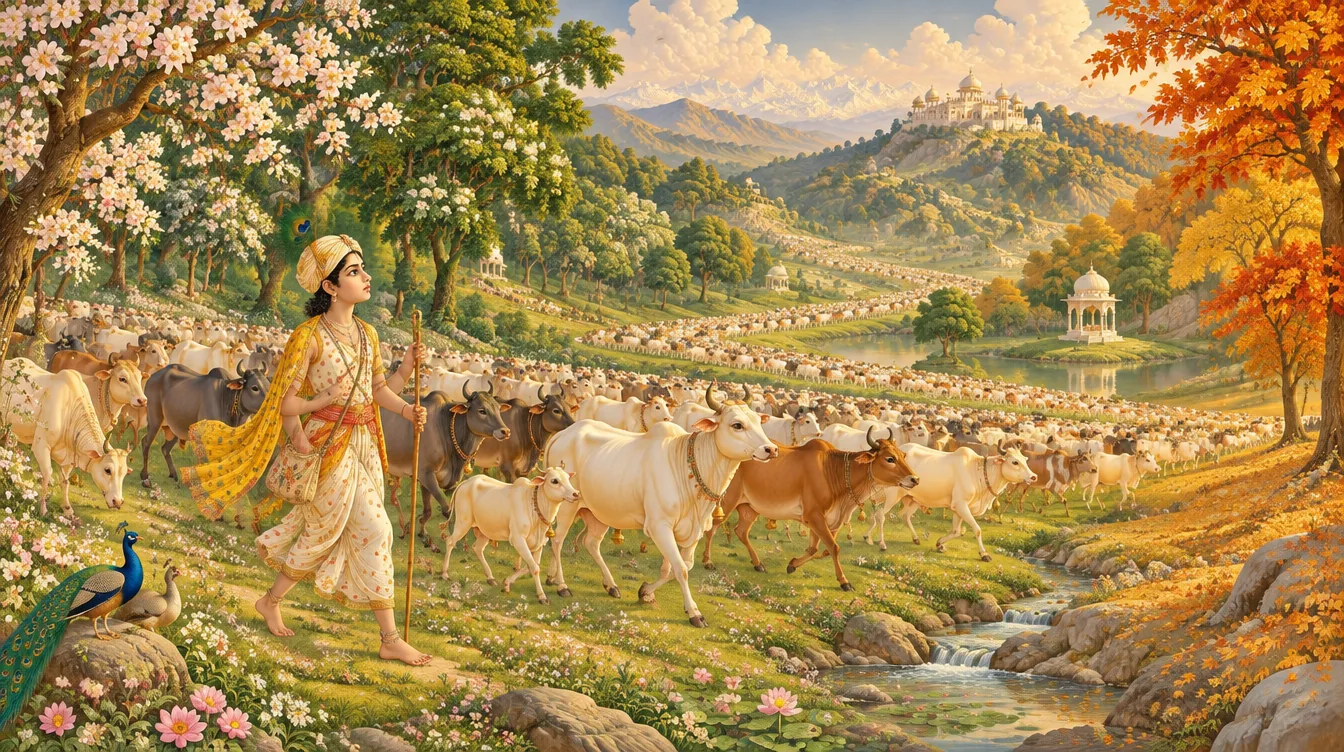
Fetching firewood, tending cows and begging for food were part of the education, teaching humility, discipline and care.

04

No fees, one gift

Teaching was not sold. At the end the student offered guru-dakshina, a gift of gratitude, often whatever the teacher asked.

A day in the gurukul

From the quiet hour
to the evening fire.

A typical day as the household manuals and stories describe it. Routines varied with teacher, place and period.

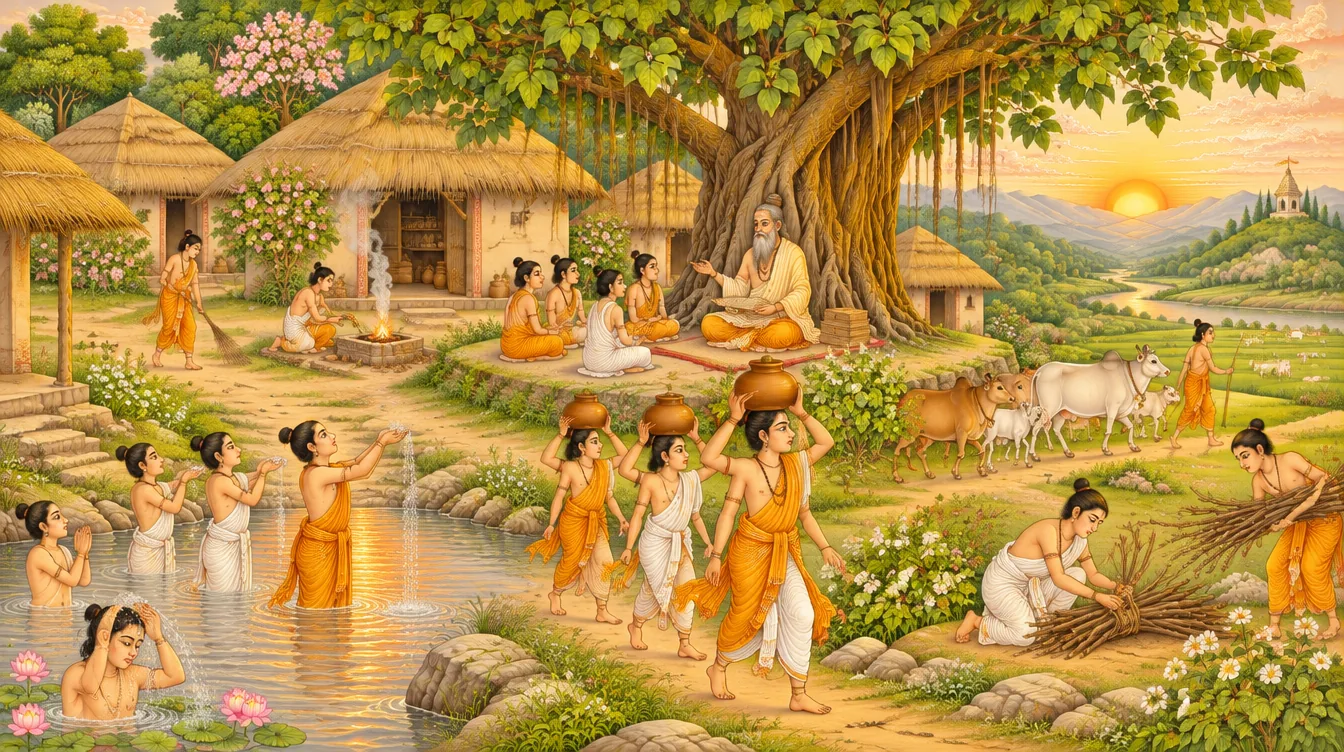
Students at dawn fetching water, gathering firewood and tending cows. An artist's impression.
Artist's impression.
  1. Before dawnWake in the brahma muhurta, the quiet hour before sunrise. Bathe in the river.
  2. SunriseSandhya worship and offerings to the sacred fire. Water offered to the rising sun.
  3. MorningRecitation with the teacher: new lines heard, repeated and corrected, old lines revised.
  4. MiddayBegging rounds in the village for food, which is brought back and first offered to the teacher.
  5. AfternoonChores: firewood, water, cattle. Discussion, debate and practical arts such as archery or medicine.
  6. SunsetEvening sandhya and fire offering. Review of the day's lessons.
  7. NightEarly sleep on a simple mat. Strict self-restraint (brahmacharya) throughout the years of study.
The student's journey

From the sacred thread
to the parting bath.

Four stages took a child into the teacher's household and, years later, out into the world.

Stage 1

Upanayana · the sacred thread

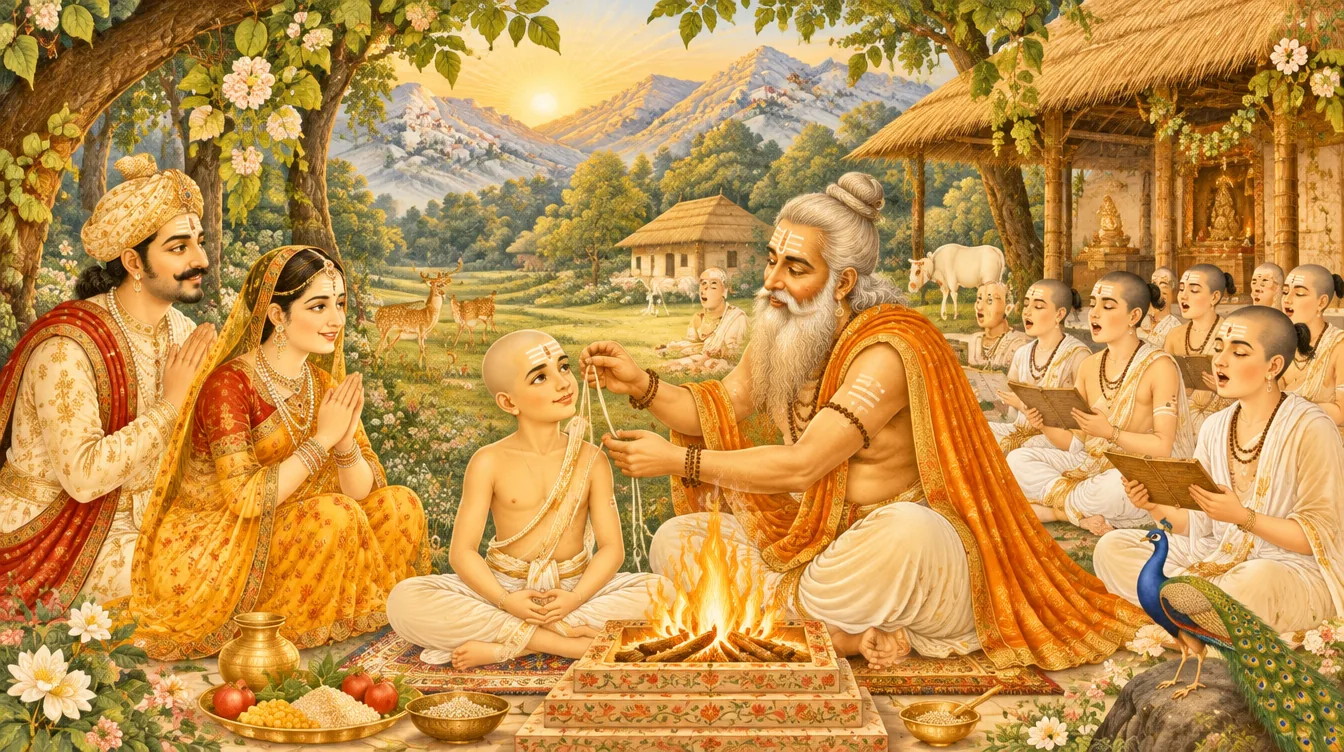
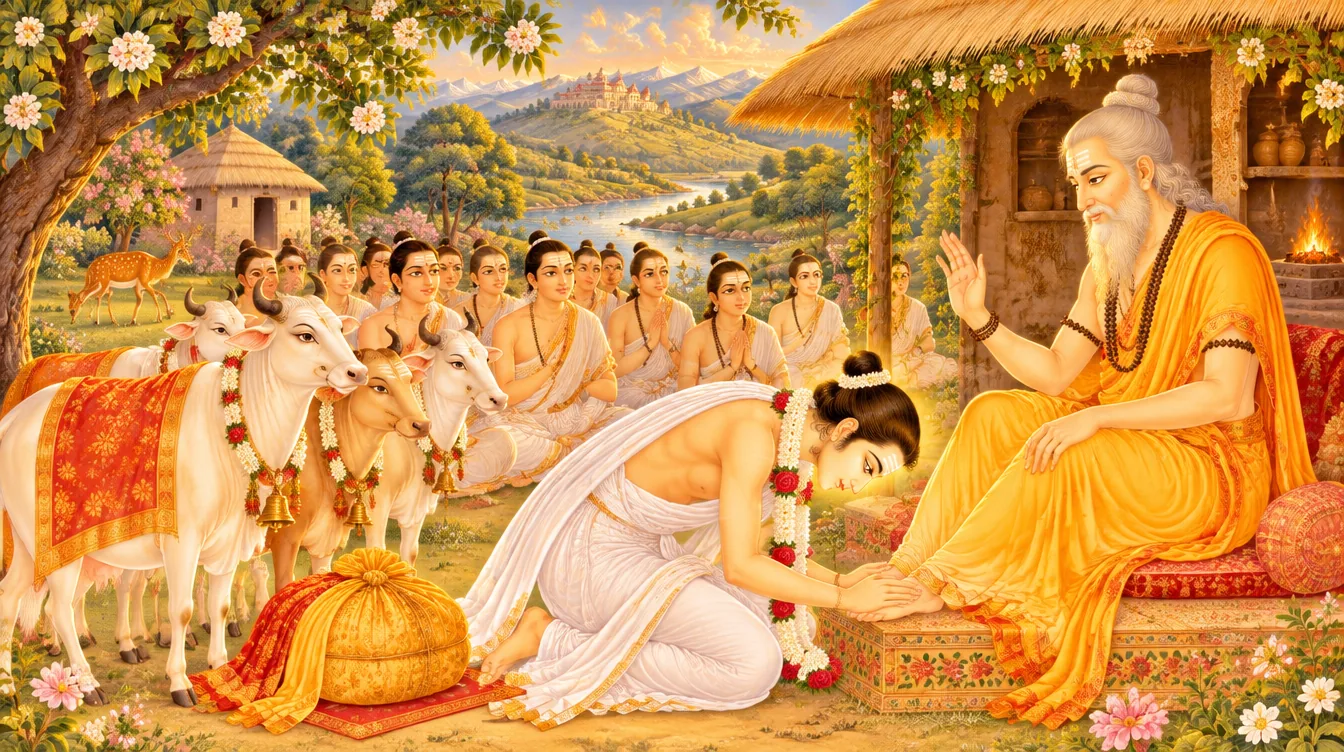
Study began with upanayana, "leading near" the teacher. The child received the sacred thread and was taught the Gayatri mantra. Tradition calls this a second birth, into learning. The ideal age varied in the texts by social group, often between eight and twelve.
Stage 2

Brahmacharya · the student years

The first of the four stages of life. The student lived simply, served the household and studied for many years. Traditional texts speak of twelve years for one Veda, and longer for more.

Stage 3

Learning the texts

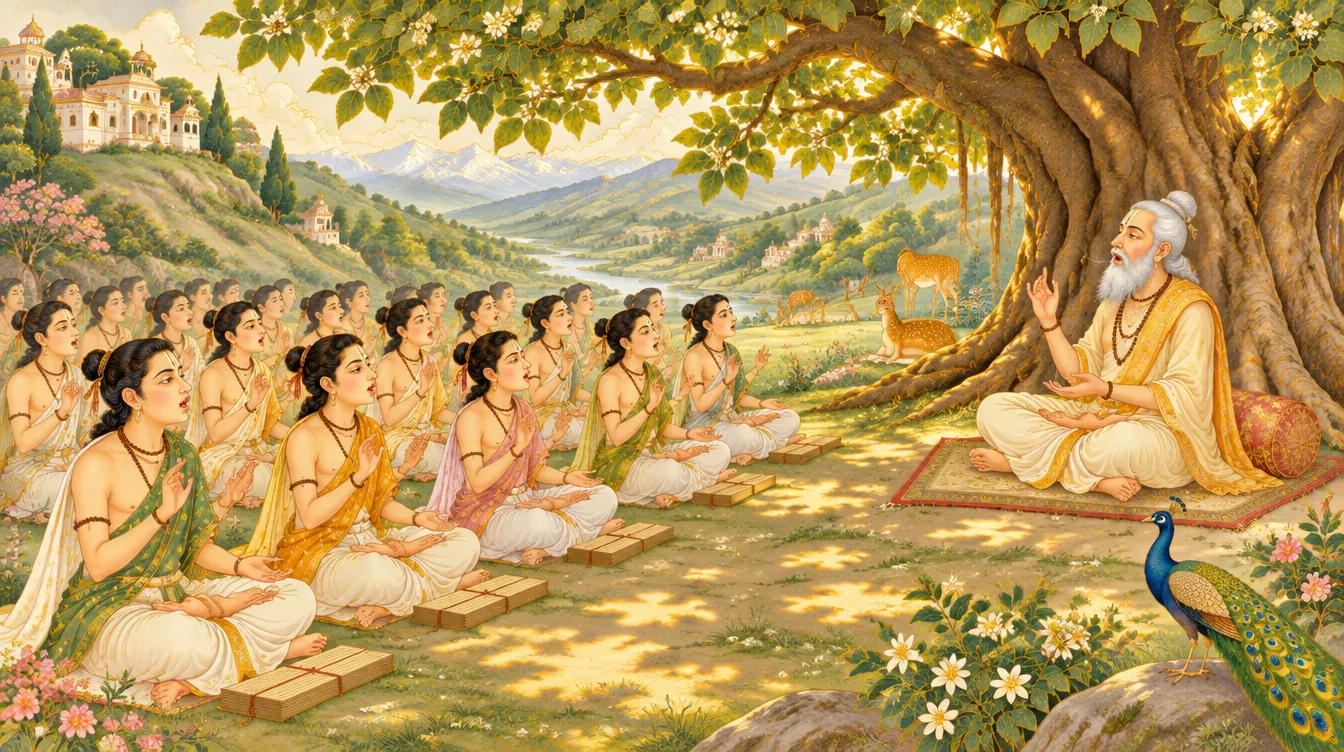
Lessons were heard, repeated and memorised. Elaborate recitation patterns, such as reciting word pairs forwards and backwards, locked the sounds in place so no syllable could drift.

Stage 4

Samavartana · the return

Graduation was a ceremonial bath (snana), after which the student, now a snataka, put on new clothes and prepared to return home and enter family life.

Taittiriya Upanishad 1.11 · the teacher's parting words to the graduating student
सत्यं वद । धर्मं चर । स्वाध्यायान्मा प्रमदः । मातृदेवो भव । पितृदेवो भव । आचार्यदेवो भव । अतिथिदेवो भव ।
satyaṃ vada | dharmaṃ cara | svādhyāyān mā pramadaḥ | mātṛdevo bhava | pitṛdevo bhava | ācāryadevo bhava | atithidevo bhava |

Speak the truth. Live by dharma. Never neglect your own study. Treat your mother as divine, your father as divine, your teacher as divine, your guest as divine.

What was taught

Fourteen branches
and many arts.

Tradition counts fourteen classic branches of learning: the four Vedas, six Vedangas, Purana, Nyaya, Mimamsa and Dharmashastra. That is the number Kautsa's teacher uses in the Raghuvansh.

The four Vedas

Rig, Sama, Yajur and Atharva: hymns, chants, ritual formulas and practical prayers. The core of Vedic study.

Read →

Shiksha

Phonetics: how every sound is produced. The first of the six Vedangas, the limbs of the Veda.

Vyakarana

Grammar. Panini's Ashtadhyayi, about four thousand compact rules, is still admired by linguists.

Chandas

Metre: the rhythmic patterns of verse.

Nirukta

Etymology: why words mean what they mean.

Kalpa

Ritual procedure, domestic rites and dharma.

Jyotisha

Astronomy and the calendar for timing rituals.

Dharmashastra

Law and conduct, in texts such as Manu, Yajnavalkya and Narada.

Read →

Nyaya and Mimamsa

Logic, debate and the interpretation of texts.

Itihasa and Purana

The epics and ancient histories, told and retold.

Read →

Dhanurveda

Archery and the arts of war, for princes and warriors.

Ayurveda

Medicine, taught through apprenticeship and the great compendia of Charaka and Sushruta.

Gurus and students

Stories the
gurukul told about itself.

Teachers and pupils remembered in the Upanishads, the epics and the Puranas. These are traditional stories, valued for what they teach.

Ayoda Dhaumya and Aruni

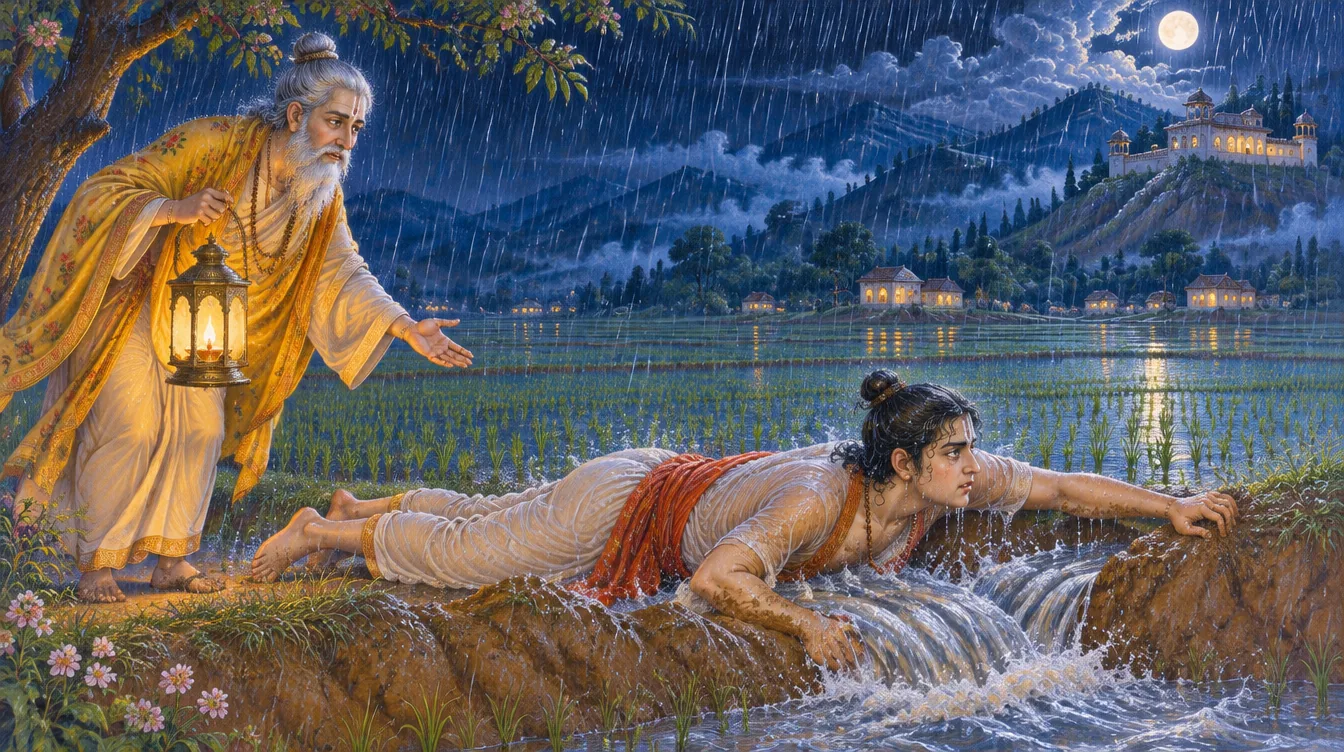
Aruni and the broken dyke

Sent to stop water breaching a field embankment, the student Aruni could not plug the gap, so he lay down in it himself. Searching at night, his teacher called him, and Aruni rose from the mud. Pleased, Dhaumya blessed him with all the Vedas.

Source: Mahabharata, Adi Parva

Gautama Haridrumata and Satyakama Jabala

Satyakama's honest answer

Asked his lineage, the boy Satyakama repeated exactly what his mother told him: she did not know who his father was. The teacher accepted him at once, saying only a true brahmin would speak such truth. Sent to tend four hundred thin cows, he returned years later with a thousand, and with wisdom learned on the way.

Source: Chandogya Upanishad 4.4 to 4.9

Uddalaka Aruni and Shvetaketu

You are that

Shvetaketu came home from twelve years of study proud and empty. His father taught him with salt dissolved in water and the seed of a banyan fruit, ending each lesson with tat tvam asi, "you are that".

Source: Chandogya Upanishad 6

Sandipani and his pupils

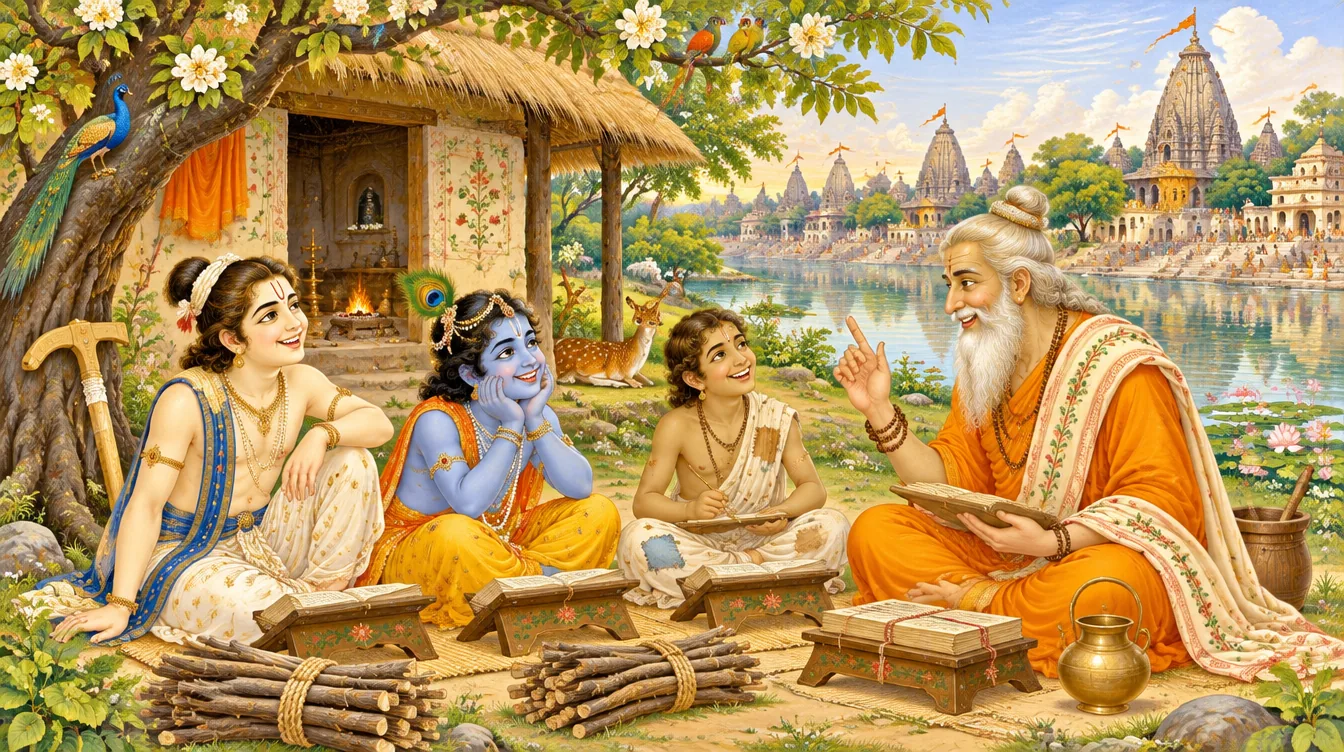
Krishna, Balarama and Sudama

In the hermitage of Sandipani at Avanti (Ujjain), Krishna and Balarama studied alongside a poor boy, Sudama. As guru-dakshina the teacher asked for his lost son, and Krishna brought him back from the realm of death.

Source: Bhagavata Purana, Book 10

Varatantu and Kautsa

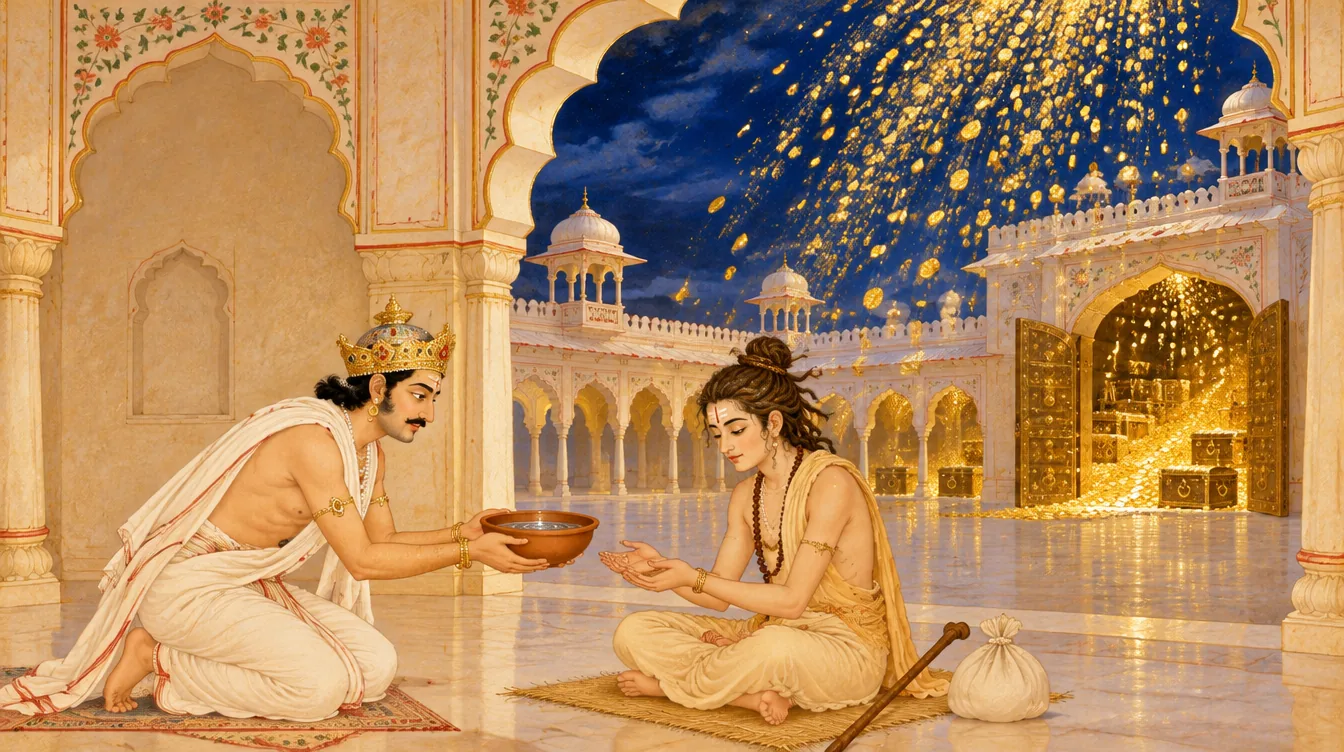
Kautsa's fourteen crore

Kautsa insisted on paying a fee his teacher did not want, and was asked for one crore of gold for each of the fourteen branches of learning. King Raghu found it for him.

Source: Raghuvansh, Canto 5

Read in the saga →
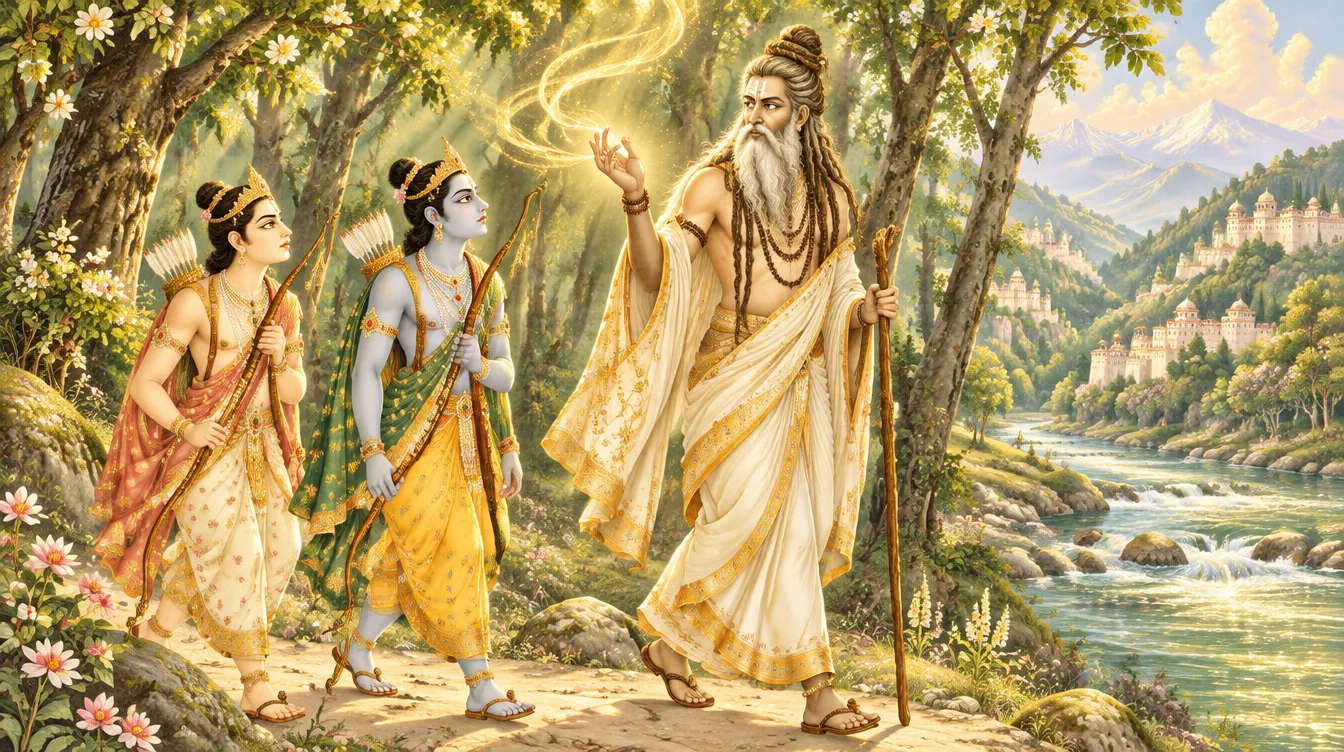
Vishvamitra, Rama and Lakshmana

Two princes on the road

Rama's education in the field: mantras against hunger, divine weapons and stories of the land, given on the journey to protect a sacrifice.

Source: Ramayana, Bala Kanda

Read in the saga →
गुरु
Drona and Ekalavya

Ekalavya

Refused as a pupil, the forest prince Ekalavya made a clay image of Drona and taught himself until he outshone Arjuna. Drona demanded his right thumb as guru-dakshina, and Ekalavya gave it. The story is still told as both devotion and injustice.

Source: Mahabharata, Adi Parva

गुरु
Yama and Nachiketa

Nachiketa and Death

A boy waits three days at the door of Yama, god of death, and is granted three wishes. He refuses every worldly prize for the third and insists on learning what happens after death.

Source: Katha Upanishad

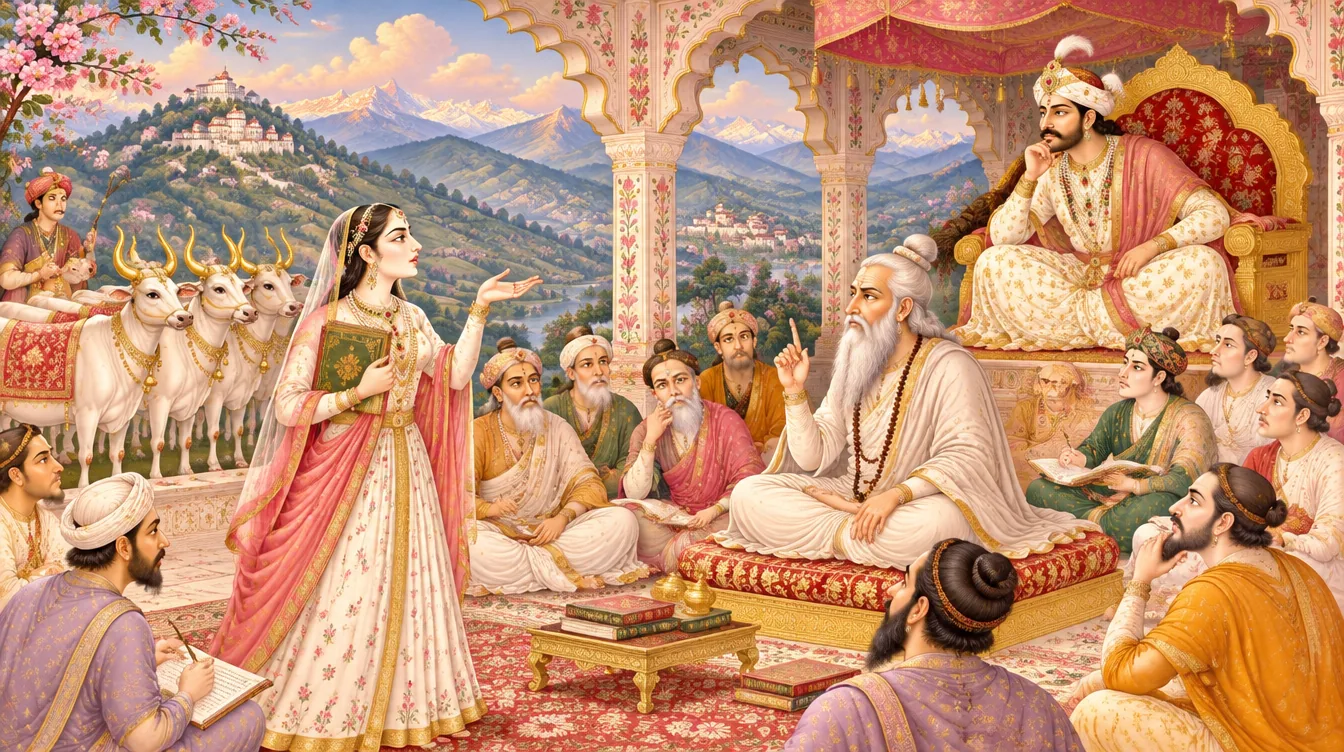
A woman scholar questioning a sage in a king's court. An artist's impression.
Gargi questions Yajnavalkya. Artist's impression.
Women of learning

Voices in
the assembly.

The oldest texts preserve the names of women who composed hymns and debated philosophers.

Gargi Vachaknavi

In the debate at King Janaka's court she pressed the sage Yajnavalkya with question after question about what everything is woven on, until he warned her not to ask too far.

Source: Brihadaranyaka Upanishad 3

Maitreyi

Offered a share of wealth by her husband Yajnavalkya as he left for the forest, she asked whether wealth could make her immortal, and asked for his knowledge instead.

Source: Brihadaranyaka Upanishad 2.4 and 4.5

Lopamudra and Ghosha

Tradition names women among the composers of Rigveda hymns, including Lopamudra and Ghosha.

Source: Rigveda 1.179; 10.39 to 10.40

Seats of learning

Takshashila to Nalanda.

Alongside the forest hermitage grew great centres where thousands studied. Here the story moves from tradition into archaeology and travellers' records.

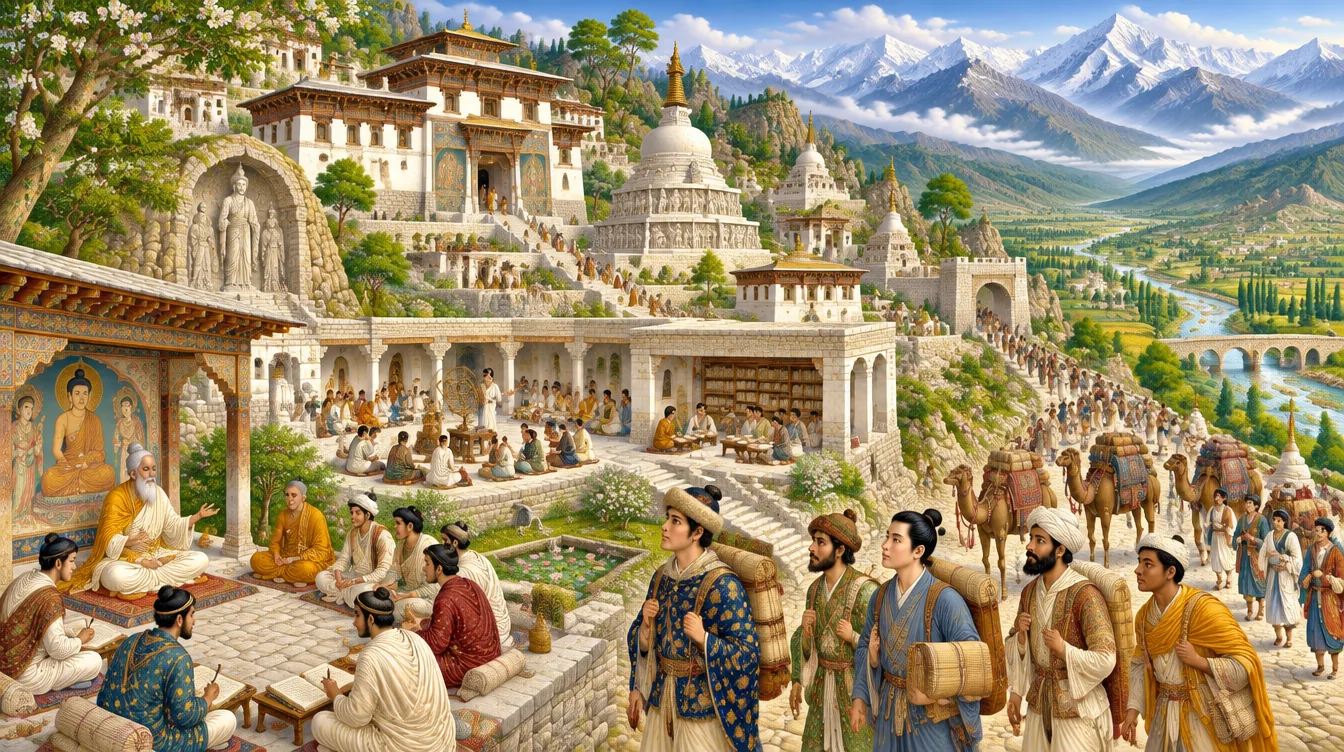
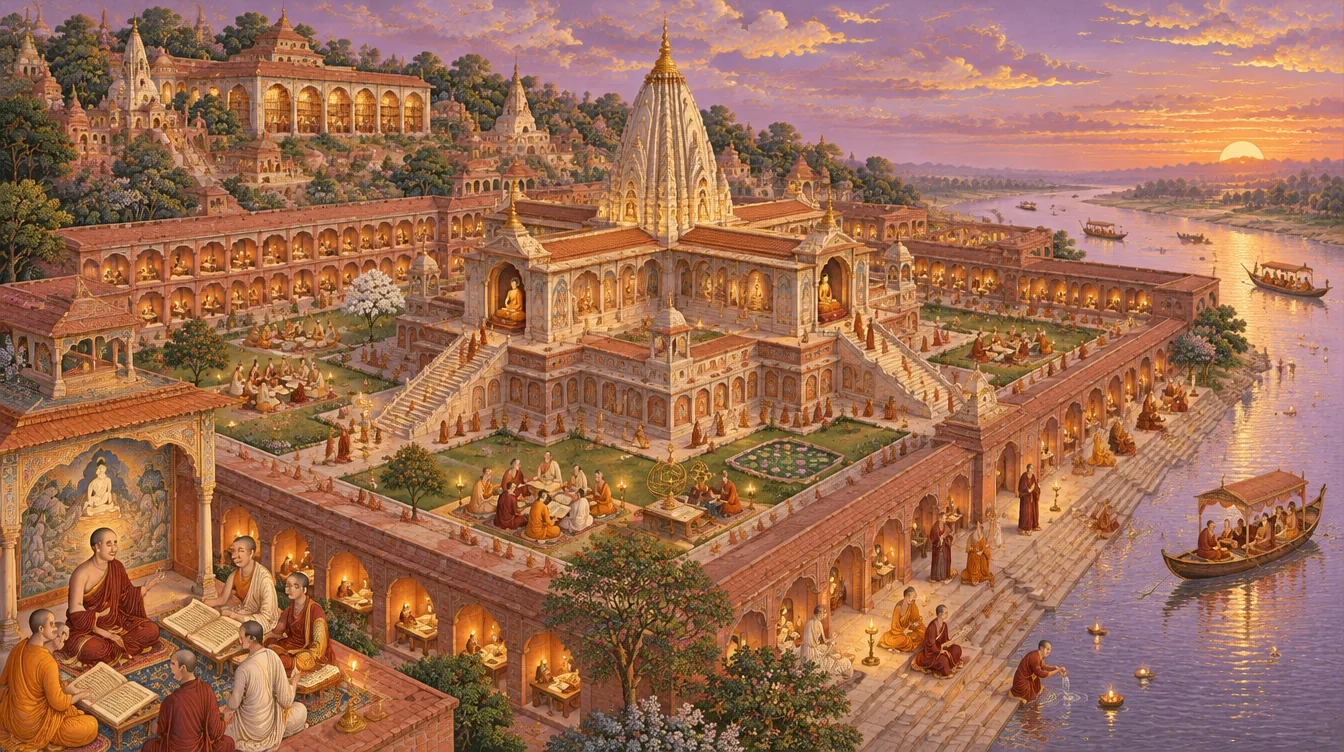
Takshashila: an artist's reconstruction.
Artist's reconstruction, not an archaeological drawing.
Near Taxila, in present-day Pakistan

Takshashila

Flourished from around the 5th century BCE · Tradition and archaeology

Not a single campus but a city of independent teachers to whom students travelled from across the subcontinent. Jataka tales describe princes sent there at sixteen. Tradition links it with the grammarian Panini, the physician Jivaka and the statesman Chanakya. The ruins of Taxila are a UNESCO World Heritage Site.

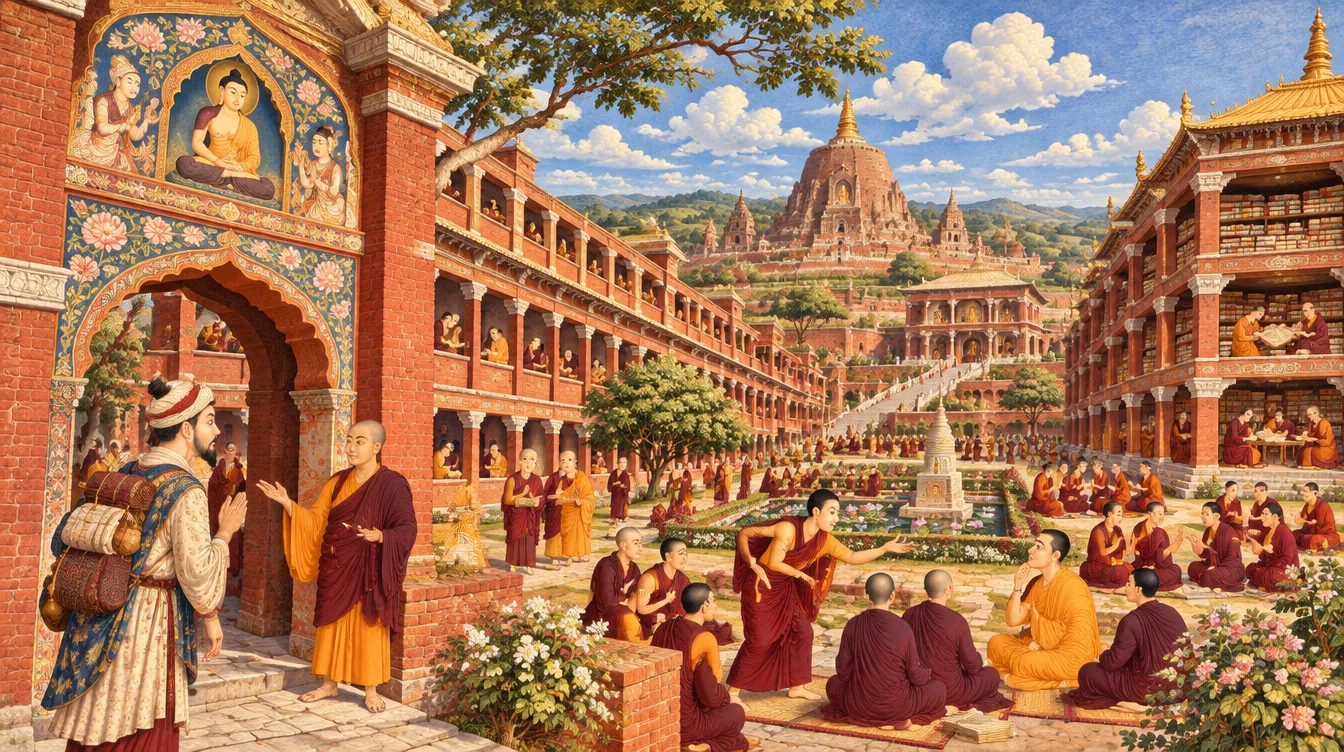
Nalanda: an artist's reconstruction.
Artist's reconstruction, not an archaeological drawing.
Bihar, India

Nalanda

5th century CE to around 1200 CE · Archaeology and travellers' accounts

A Buddhist monastic university founded under the Gupta kings, with monasteries, temples and a famous library. The Chinese pilgrim Xuanzang studied here in the 7th century and described thousands of monks and teachers. It was devastated around the end of the 12th century. The excavated Nalanda Mahavihara is a UNESCO World Heritage Site, and a new Nalanda University now stands nearby.

Vikramashila: an artist's reconstruction.
Artist's reconstruction, not an archaeological drawing.
Bihar, India

Vikramashila

Late 8th century CE to around 1200 CE · Archaeology

Founded by the Pala king Dharmapala on the Ganga, with a great cross-shaped temple at its centre. The scholar Atisha Dipankara taught here before travelling to Tibet. It fell in the same period as Nalanda.

Gujarat, India

Valabhi

Around the 6th to 8th centuries CE · Travellers' accounts

A major centre of Buddhist and secular learning under the Maitraka kings, praised by the Chinese pilgrim Yijing.

Bihar, India and Bangladesh

Odantapuri and Somapura

Pala period, 8th to 12th centuries CE · Archaeology

Further Pala-era monastic universities. The ruins of the Somapura Mahavihara at Paharpur are a UNESCO World Heritage Site.

Timeline

Three thousand years
of teaching.

Approximate dates. Early dates in particular are estimates.

Decline and revival

The forest gurukul faded as kingdoms changed, monasteries fell and, in the 19th century, colonial education turned to English-medium schools. It did not vanish. Traditional pathashalas kept Vedic recitation alive in families and temples, and reformers founded new gurukuls, such as Gurukul Kangri near Haridwar in 1902. Tagore's open-air school at Santiniketan drew on the same ideal of learning in nature and in close company with a teacher.

  1. Vedic ageOral transmission of the Vedas within teacher lineages; hermitage learning.
  2. Around 5th century BCETakshashila emerges as a centre of learning.
  3. Around 4th century BCEPanini's grammar, the Ashtadhyayi, traditionally dated around this time.
  4. 5th century CENalanda founded under the Gupta kings.
  5. 7th century CEXuanzang and Yijing study in India and record what they see.
  6. Late 8th century CEVikramashila founded by Dharmapala.
  7. Around 1200 CENalanda and Vikramashila devastated in raids from the west.
  8. 19th centuryColonial education policy turns toward English-medium schooling.
  9. 1902Gurukul Kangri founded near Haridwar by Swami Shraddhanand.
  10. 1901 to 1921Rabindranath Tagore's school at Santiniketan grows into Visva-Bharati.
  11. 2008UNESCO inscribes the tradition of Vedic chanting as Intangible Cultural Heritage.