A bow is lowered
Arjuna’s hesitation is the beginning of inquiry. The dialogue takes the difficulty seriously rather than treating uncertainty as something to dismiss.
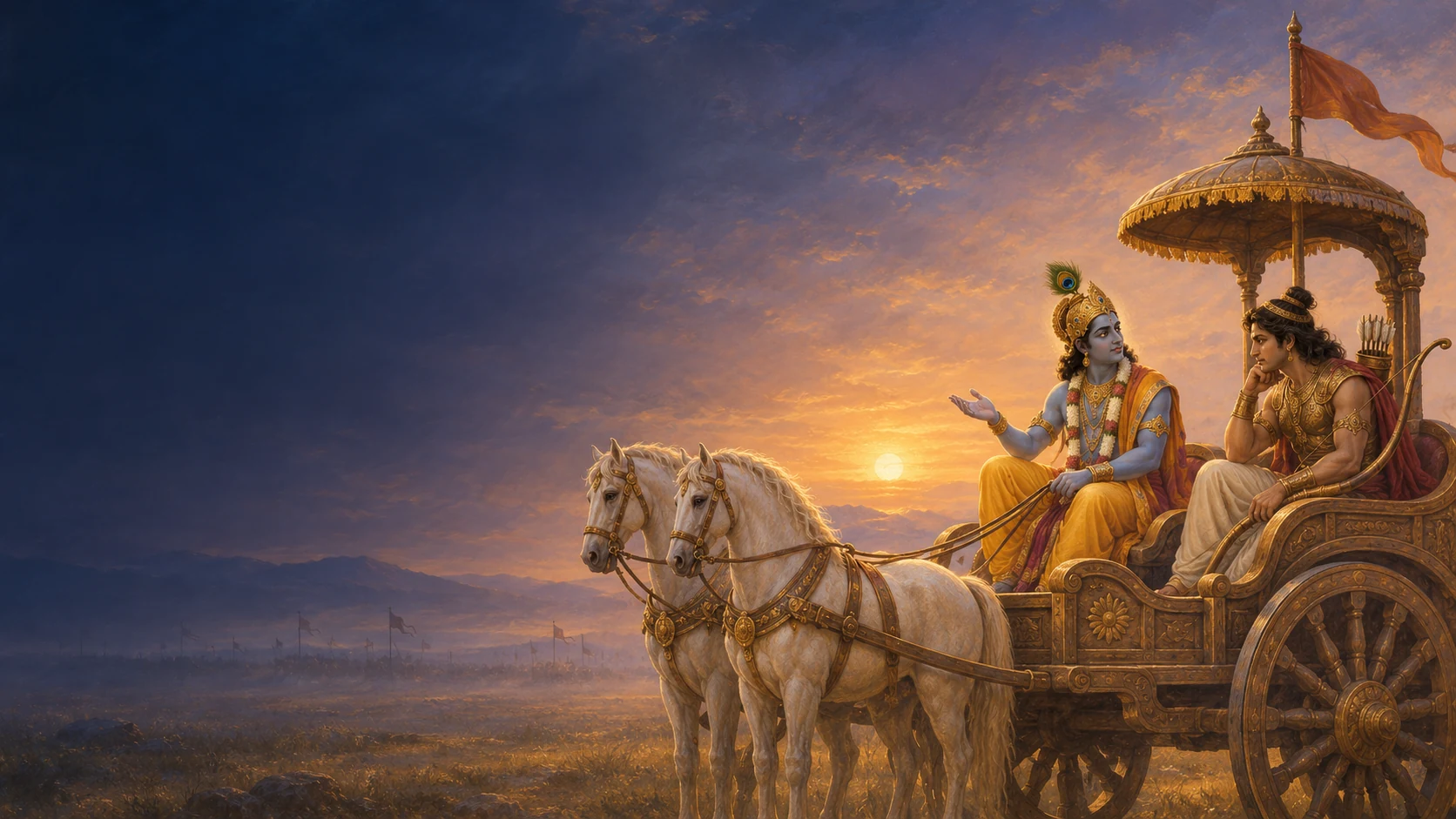
A warrior pauses. A dialogue begins. Journey through Arjuna’s crisis and Krishna’s teaching on action, knowledge, devotion, and liberation.
A traditional account of authority, a historical inquiry, and a living interpretation answer different questions. Keep all three visible.
Follow four connected moments. These are interpretive steps through the subject, not a claim that its history occurred in four simple stages.
Arjuna’s hesitation is the beginning of inquiry. The dialogue takes the difficulty seriously rather than treating uncertainty as something to dismiss.
The teaching asks how one acts without being governed by attachment to results. Renunciation, discipline, duty, and understanding remain intertwined questions.
Krishna teaches about divine presence and reveals the cosmic form in chapter 11. The conversation moves beyond a purely human calculation of advantage.
The final chapter returns to discernment, teaching, surrender, and decision. Reading the ending after the whole dialogue differs from extracting a single command.
Search the divisions and topics, then choose one to learn its place in the whole. Summaries are guide notes, not translations of every chapter.
A thematic route brings passages into conversation. It does not replace the text’s own arrangement or reduce its diversity to one message.
Choose a lens to uncover a different layer of the same subject.
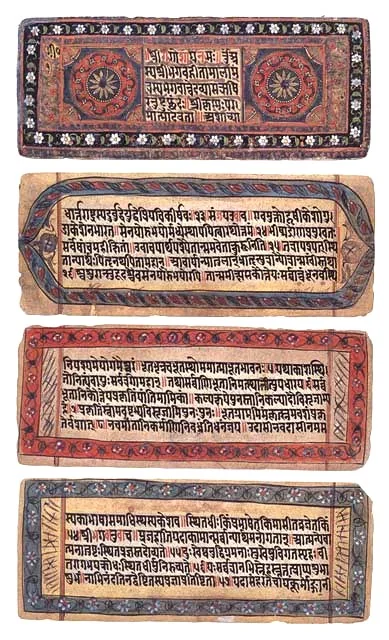
Read one identified passage with Sanskrit, transliteration, word notes, and translations. The edition and the boundaries of an excerpt remain visible.
Switch between Devanagari and IAST, explore selected terms, and compare an educational rendering in seven modern languages.
English is an original AI-assisted educational rendering, not a quoted published translation. Other languages render that English; none has specialist review.
Read and explore the passage ↗Your sphere is action alone, never its fruits. Do not make the fruits of action your motive, and do not become attached to inaction.
Complete selected verse. Sanskrit sandhi is retained; the word notes use separated teaching forms. Compare named commentaries for the force of adhikāra and hetu.
Continue in order, or follow a connection. The four Vedas, the Gita, and the three Dharmaśāstra works belong to related but different textual worlds.
This initial Smriti selection contains Manu, Yajnavalkya, and Narada. It does not claim to exhaust the broad and varying category of Smriti.