A verse is inherited
The words of the opening Kauthuma verse also occur at Rigveda 6.16.10. Shared wording lets us trace relationships while respecting the collections’ different uses.

Enter a tradition where inherited words are reordered, extended, and taught as chant. Discover the Samaveda through text, performance, and living lineages.
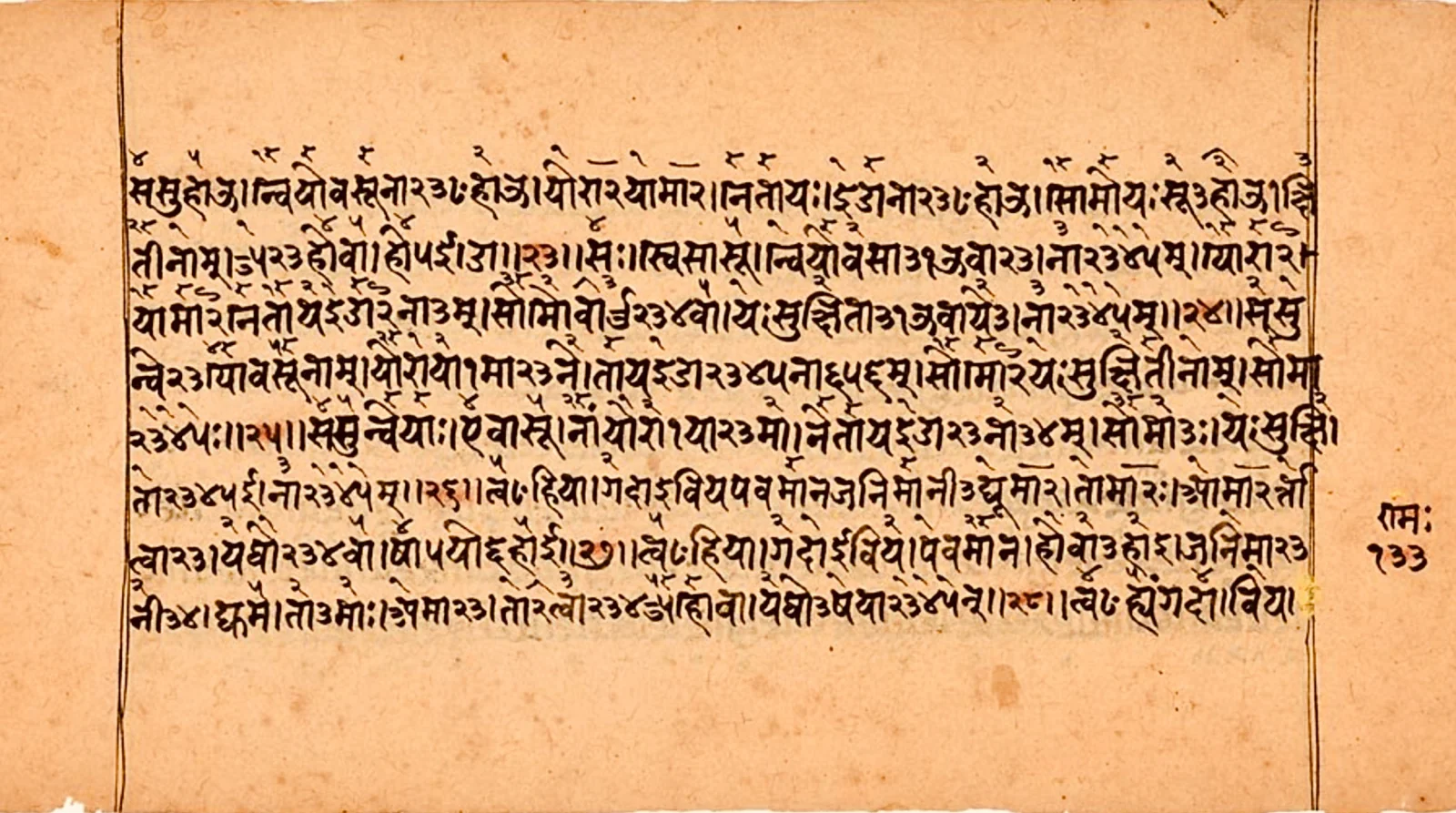
A traditional account of authority, a historical inquiry, and a living interpretation answer different questions. Keep all three visible.
Follow four connected moments. These are interpretive steps through the subject, not a claim that its history occurred in four simple stages.
The words of the opening Kauthuma verse also occur at Rigveda 6.16.10. Shared wording lets us trace relationships while respecting the collections’ different uses.
The verse collections and chant books organize material for performance. Text order is part of a ritual discipline rather than only a literary reading sequence.
Performance can involve elongation, repetition, and additional syllables. These are learned within traditions; a Roman transliteration does not encode the whole musical practice.
Begin with the verbal meaning, then move to an identified tradition’s own recording. The relationship between reading and hearing is the center of the story.
Search the divisions and topics, then choose one to learn its place in the whole. Summaries are guide notes, not translations of every chapter.
A thematic route brings passages into conversation. It does not replace the text’s own arrangement or reduce its diversity to one message.
Choose a lens to uncover a different layer of the same subject.
Read one identified passage with Sanskrit, transliteration, word notes, and translations. The edition and the boundaries of an excerpt remain visible.
Switch between Devanagari and IAST, explore selected terms, and compare an educational rendering in seven modern languages.
English is an original AI-assisted educational rendering, not a quoted published translation. Other languages render that English; none has specialist review.
Read and explore the passage ↗Agni, come for the feast, praised for the offering; sit as invoking priest upon the sacred grass.
Selected verbal verse without chant notation or Vedic accents. This display is not a performance score.
Continue in order, or follow a connection. The four Vedas, the Gita, and the three Dharmaśāstra works belong to related but different textual worlds.
This initial Smriti selection contains Manu, Yajnavalkya, and Narada. It does not claim to exhaust the broad and varying category of Smriti.