Ⅰ
Grain
Barley and emmer appear in early accounts. Their recording reveals allocation and storage as well as food production.
Follow the rivers. Walk the streets. Step into a home. Meet a civilization through the lives its people built—and the words they left behind.
Before palaces and poems, there was a river plain. The story starts in the landscape that made its cities possible.
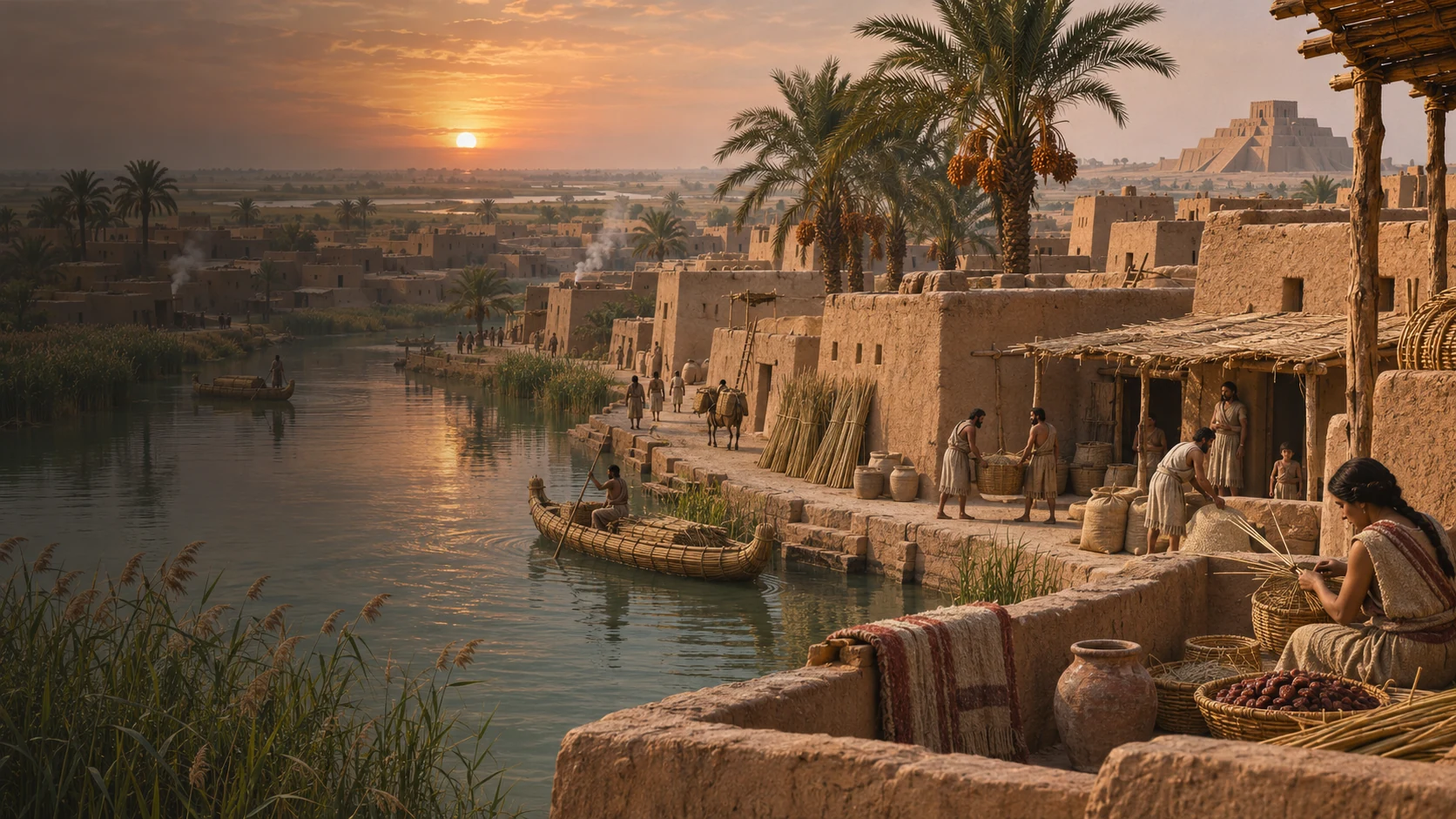
In southern Mesopotamia, rivers connected fields, settlements, and routes of exchange. Cultivation demanded work: water had to be directed, canals maintained, and people organized. These were not cities standing apart from nature. They were cities woven into a managed landscape.
“Sumer” names the southern region, not a single kingdom that remained unchanged. Communities shared traditions while building local identities, competing for resources, and passing under different rulers.
Agricultural production supported urban populations. A harvest also required storage, allocation, transport, and accounting.
An irrigation account from Umma records the laborers needed for work on waterways. Water management was a recurring task, not a one-time invention.
Small communities and villages preceded the great urban centers. Urbanization developed through long processes rather than a single founding event.
River courses and shorelines changed. The landscape today cannot be treated as an exact map of ancient waterways.
Move through the eras to see how city-states, empires, and later scribes fit into the story.
Approximate conventional dates. Political periods, spoken-language history, and the dates of surviving manuscripts do not line up neatly.
Choose a place. Uruk, Ur, Nippur, and Girsu belonged to a shared cultural world, but they were never interchangeable.
Homes, temple complexes, and monumental platforms shared a material world—but served very different purposes.
A city is also a collection of doorways. Here the scale changes from dynasties to people, rooms, storage, light, and work.
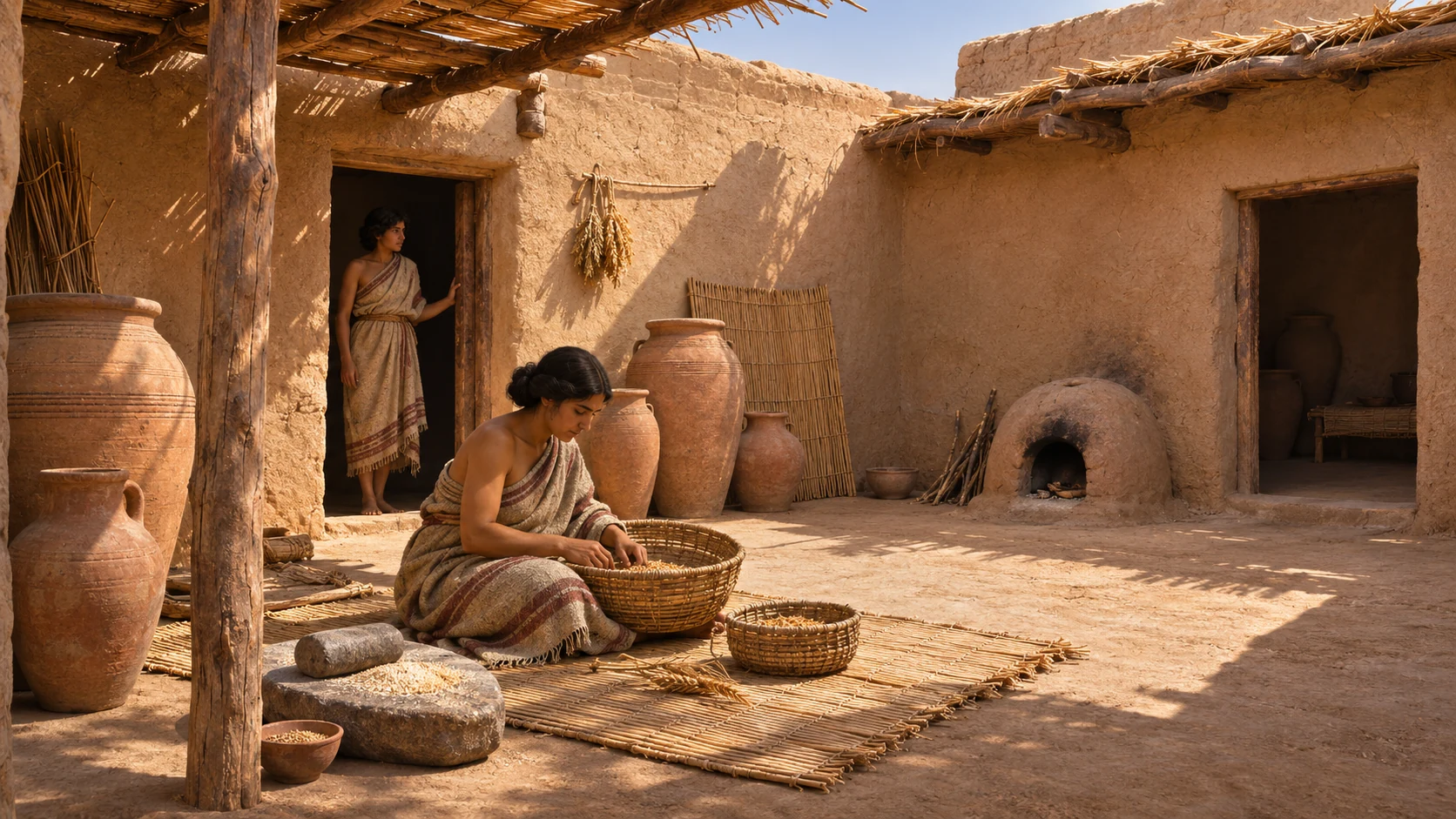
Conceptual teaching plan, not a measured excavation drawing. Room uses could overlap and change.
Some of the best-documented houses at Ur are early second millennium BCE, after the Ur III kingdom. A recent example belonged to Sîn-nada and Nuttuptum around 1850 BCE. It helps us understand the city’s continuing domestic life; it is not a snapshot of every Sumerian household.
Follow a thematic day through fields, household labor, food, and evening. This is a guided synthesis—not a diary recovered from one ancient person.
Barley and emmer appear in early accounts. Their recording reveals allocation and storage as well as food production.
Sumerian records count quantities of beer. Brewing belongs to economic history, not just modern stories of ancient recipes.
Grinding, cooking, storing, and serving are forms of work. Pottery and household spaces add evidence beyond written lists.
An elite banquet is not an ordinary family meal. A distribution record is not a menu for everyone in the city.
Neither “the Sumerian family” nor “the Sumerian woman” describes one universal experience. Elite priestesses, rulers, workers, and people represented in household documents had different opportunities and constraints. Named women and objects of display illuminate particular lives; they do not make every household visible.
School tablets preserve practice in making wedges, copying signs, studying words, and calculation. Much of this evidence comes from the early second millennium BCE. It shows a specialized educational tradition, rather than proving that all children attended school or learned to read.
A tablet from Nippur, catalogued as CBS 14221 at the Penn Museum, preserves medical writing. Such evidence belongs to a long, changing history of Mesopotamian healing. It should not be collapsed into a single timeless “Sumerian medicine,” or used as modern treatment advice.
The laws attributed to Ur-Namma are an important early legal collection, transmitted through later manuscripts. A collection can express royal ideals and exemplary decisions; it is not a complete record of how every dispute was resolved. The date of a surviving copy must be kept distinct from the ruler’s lifetime.
Cylinder seals carried miniature carved images and could be rolled into clay. They served purposes of identification and ownership, while their imagery communicated religious or social meaning. A seal and its impression give us different views of the same carefully made object.
The Royal Cemetery at Ur preserves exceptional burials, including Puabi’s. Rich adornments, instruments, and other objects reveal deliberate forms of commemoration and elite display. These tombs cannot serve as a universal description of burial practice across Sumer’s many places and centuries.
A statue, a seal, a woven cloth, a clay pot: objects preserve the meeting of skills, resources, institutions, and people.
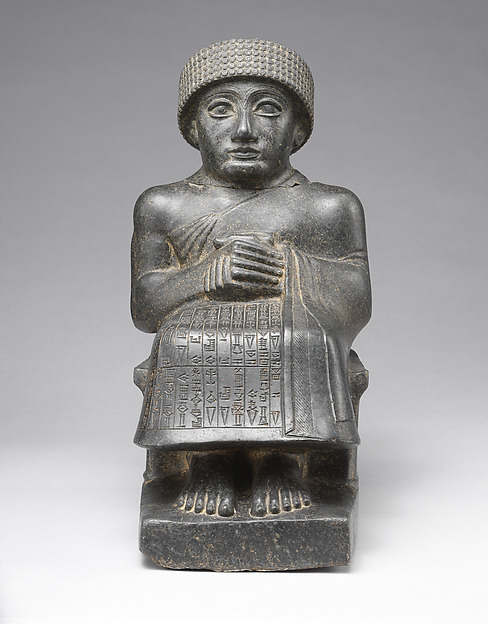
The ruler’s clasped hands and inscribed body present devotion as a lasting public image. This is a crafted argument about a ruler, not a candid portrait of ordinary life.
Objects also ask practical questions: who obtained the material, shaped it, transported it, and placed it in a meaningful setting?
Urban life depended on practiced skills. Surviving artifacts reveal work in clay, stone, metal, shell, and other materials, even when the makers are unnamed.
City elites sought materials obtained through wider networks. Connections could involve exchange, political relationships, and conquest; “trade” is not a complete explanation for every object.
Dress, jewelry, and seals could communicate status and identity. Evidence for elite display should not be generalized into one costume worn by everyone.
Some people controlled resources; others supplied labor under unequal conditions. Institutional records preserve the perspective of administrators more readily than workers’ own accounts.
Image: The Met, 59.2 · public domain.
Belief did not live in a separate chapter of ancient experience. Temple service, offerings, rulers, households, and literature could all meet here.
A major heavenly deity. His relationships and authority varied across traditions; no single fixed divine family tree captures every text.
A deity of contrasting powers, associated with sexuality, warfare, and Venus. Her literary journeys connect divine and urban worlds.
The moon god’s cult helps place the priestess Enheduanna within a religious institution and a political world.
Offerings, ceremonies, and service to divine houses organized activities and resources. Rulers advertised building for the gods; texts and objects preserve that claim.
Household experience was more varied than official monumental imagery. A royal inscription cannot stand for every person’s beliefs.
Enheduanna was a historical priestess, daughter of Sargon. Later Sumerian tradition attributes hymns to her. Her office, the voice of the poems, and the history of their later copies deserve to be considered together.
Meet Enheduanna ↗People did more than work. Games, performance, and displays of physical ability open another window—though the evidence is uneven.
A praise poem of Shulgi celebrates a remarkable return run between Nippur and Ur. It links strength and speed to ideal kingship. Read it as royal praise, not a timed athletics result.
Early Dynastic objects from Khafajah include wrestlers. These attest to representations of physical contests; they do not give us a complete rulebook or prove the existence of a modern sports league.
The lyres from Ur’s Royal Cemetery show the craft and prestige of musical instruments. Instruments, images, and texts complement one another, but a surviving lyre does not preserve the exact sound of a performance.
Royal burial objects also come from exceptional contexts. Their richness should not be mistaken for an average evening in an average home.
The decorated boards found at Ur are ancient. The surviving written rules used in modern reconstructions are much later. Our short game is a clearly labelled adaptation, not a claim to reproduce Early Dynastic rules exactly.
Three pieces per player, instead of a full traditional set. Roll four binary dice for 0–4. Enter and race along your track, through the shared middle row, and off the far end. An exact roll is needed to leave. Landing on an opponent in the shared row sends it home. Rosettes grant another turn; the middle rosette is safe. First to bring all three pieces home wins.
Physical boards and later rule texts are different kinds of evidence from different times. There are multiple modern reconstructions and adaptations. This game teaches the race-game idea without presenting one rule set as a recovered Sumerian certainty.
A record can outlive its purpose. A copied poem can outlive the language of everyday conversation. Now the story becomes something you can read.
Cuneiform is the writing system; Sumerian is a language written with it. Transliteration represents interpreted readings in Roman letters. Translation carries those readings into another language.
Our reader keeps those layers visible, with clickable word notes and seven modern translation-language options. The on-site passages are short excerpts, with links to complete editions.
Open the full text reader ↗Typeset opening phrase only: an gal-ta ki gal-še₃
From the great heaven she set her mind on the great below.
Oxford ETCSL · English translation. The signs above cover only the opening phrase.
A dynasty can end. A language can change its role. Neither means that an entire population simply vanishes.
Sumerian continued as a language of learned, literary, and ritual use long after its everyday spoken life changed. Later copyists helped preserve works that modern readers encounter through editions assembled from multiple witnesses.
The picture remains incomplete. Administrative archives amplify institutions; monuments amplify power; surviving houses come from particular neighborhoods and centuries. A responsible story makes room for people whose own words were not preserved.
Artifacts have excavation and collection histories, not just ancient dates. The Royal Cemetery at Ur was excavated by a joint expedition, with finds divided between Iraq and partner institutions. Modern photographs, restorations, and reconstructions belong to that later history too.
This guide separates objects, texts, interpretations, and artistic impressions. It offers a broad route through the subject, rather than claiming that everything about Sumer is known.