01
The first verse
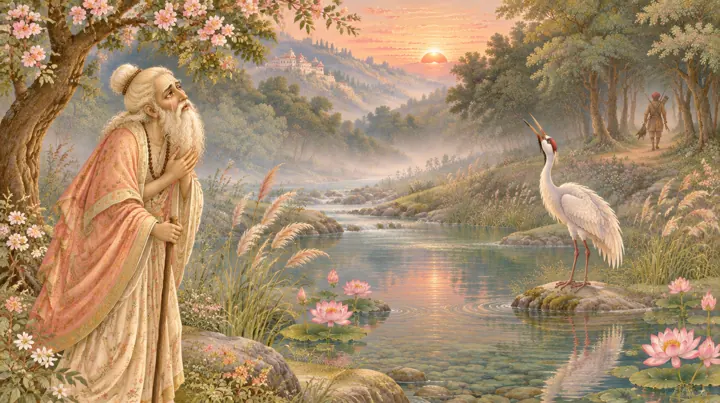
The sage Valmiki sees a hunter kill one of a pair of cranes. His grief comes out as a perfect verse, and the creator god asks him to tell the story of Rama in that same metre.
The first poem, by tradition. A prince gives up a throne to keep his father's word, loses his wife to a demon king, finds friends among the creatures of the forest, crosses the sea and comes home. Then the harder questions begin.
Five minutes for the shape of the story. Then read the full storyline below, episode by episode.
The sage Valmiki sees a hunter kill one of a pair of cranes. His grief comes out as a perfect verse, and the creator god asks him to tell the story of Rama in that same metre.
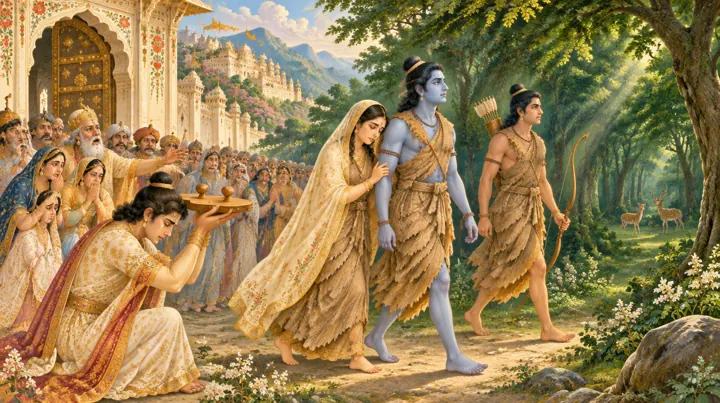
On the eve of his coronation Rama is exiled for fourteen years to honour his father's old promise to Queen Kaikeyi. Sita and Lakshmana go with him.
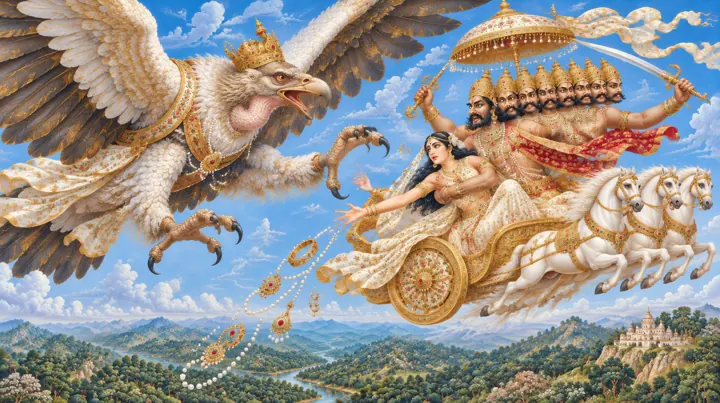
In the Dandaka forest a golden deer lures Rama away. The demon king Ravana carries Sita off to Lanka, and the old vulture Jatayu dies trying to stop him.
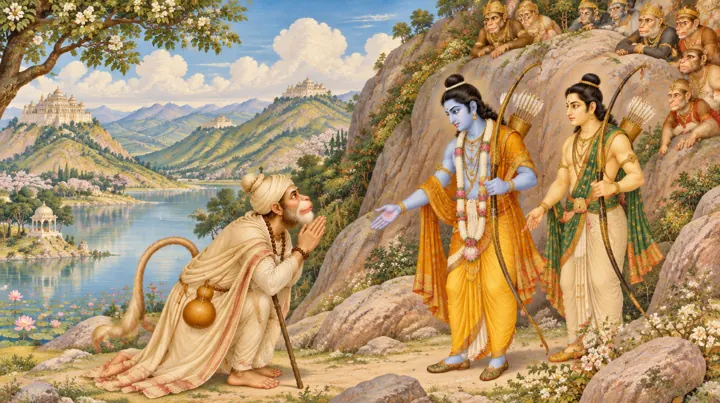
Rama meets Hanuman and the exiled monkey king Sugriva. A pact is made, and search parties go out in every direction.
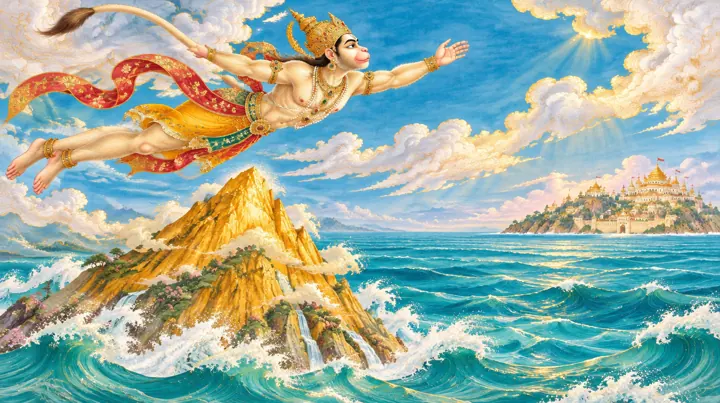
Hanuman crosses the ocean in a single leap, finds Sita in a grove in Lanka, gives her Rama's ring, and leaves the city in flames.
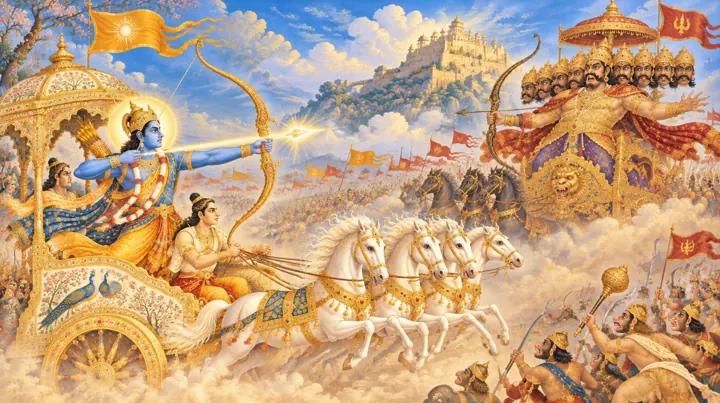
A bridge crosses the sea. After a long war Rama kills Ravana, Sita passes through fire, and the exiles fly home to Ayodhya to be crowned.
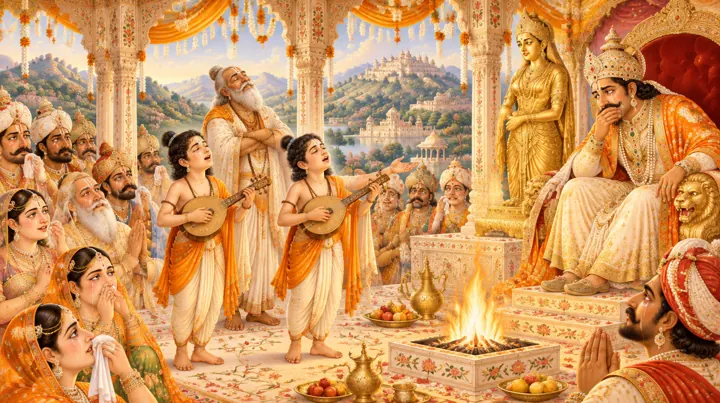
Rama's reign is shadowed by gossip. Sita is sent away, raises twin sons in Valmiki's hermitage, and at last returns to the Earth her mother.
The families at the heart of the story. Choose a name to jump to their episode.
King of Ayodhya in the line of Ikshvaku and Raghu. See the Raghuvansh saga for his ancestors.
Episode 2 →2Son of Kausalya. Sita is the daughter of King Janaka of Mithila, found in a furrow of the earth.
Episode 5 →3Son of Sumitra. Shares the whole exile.
Episode 5 →4Son of Kaikeyi. Rules as regent with Rama's sandals on the throne.
Episode 10 →5Son of Sumitra. Later defeats the demon Lavana.
Episode 32 →6Twin sons of Rama and Sita, raised by Valmiki.
Episode 32 →7King of Lanka, son of the sage Vishrava. His siblings are Kumbhakarna, Vibhishana and Shurpanakha. His son Indrajit is his greatest warrior.
Episode 30 →Ten stops from Ayodhya to Lanka. Choose a place to see what happened there, then jump to the episode.
Choose a stop on the road.
A schematic route as the epic tells it, not a scale map. Many of these places are identified with real sites by tradition; scholars debate several of them, including the location of Lanka.
Hunter, may you never find rest for endless years, for you killed one of a pair of cranes lost in love.
To anyone who comes to me even once and asks, saying "I am yours", I give protection from all beings. This is my vow.
English renderings are our own plain-language versions for readers, not quoted published translations.
How the poem came to be written, how Rama came to be born, and how a boy with a bow became a bridegroom.
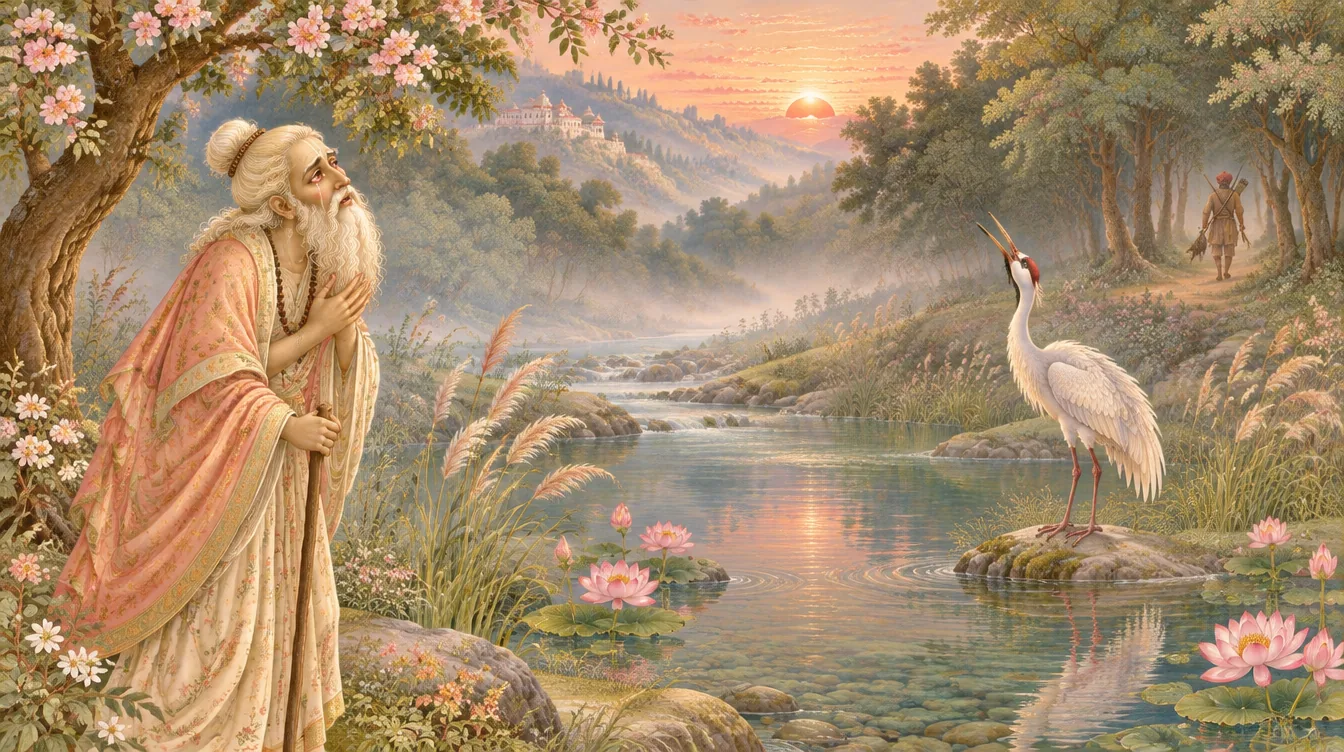
The poem begins with a question. Valmiki asks the wandering sage Narada whether any man alive is truly virtuous, brave, truthful and steady. Narada names Rama of Ayodhya and tells his story in brief.
Later, bathing at the river Tamasa, Valmiki watches a pair of krauncha birds. A hunter shoots the male, and the female cries out over him. Valmiki's grief (shoka) breaks out of him as a curse on the hunter, and he realises it has come out as a measured verse (shloka).
Brahma, the creator, appears and tells him to use this new metre to tell the whole of Rama's life. Valmiki teaches the finished poem to two young singers. Tradition remembers him as the adi kavi, the first poet.
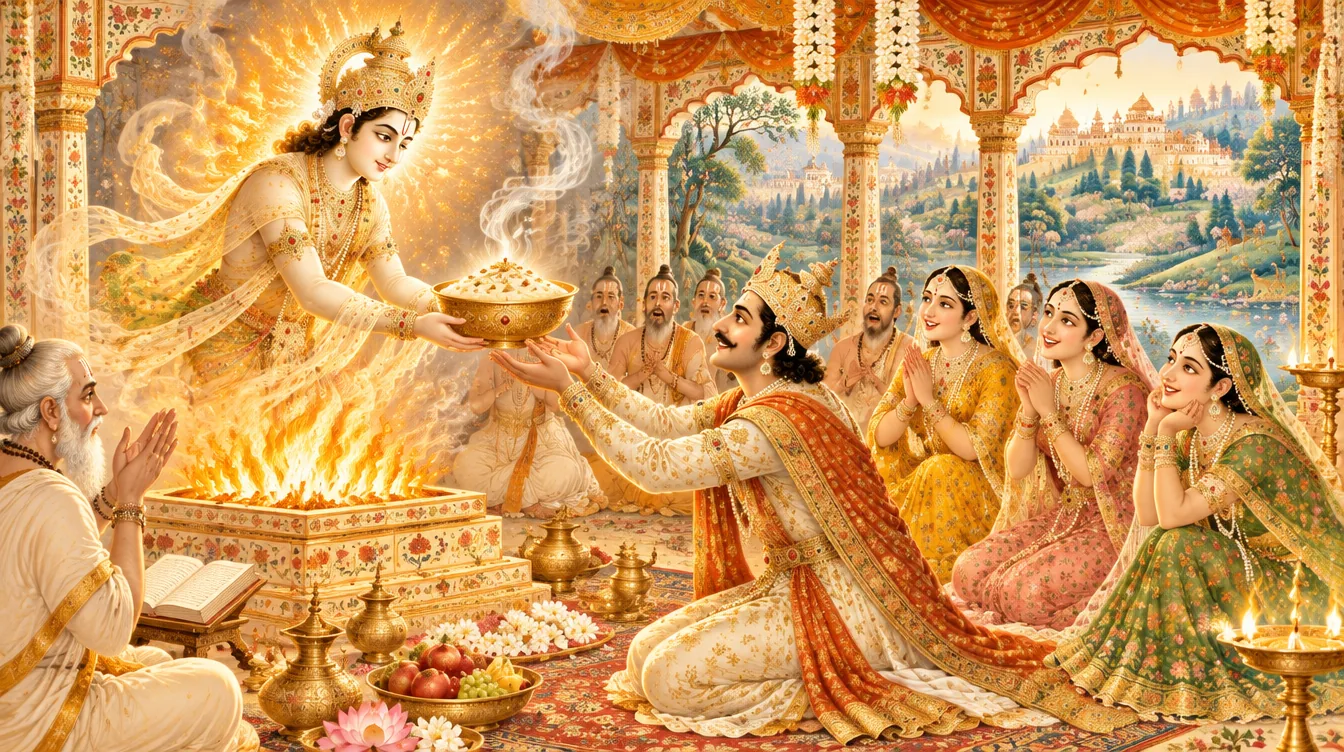
Ayodhya is rich, orderly and happy, and its king Dasharatha has no son. On the advice of his ministers he invites the sage Rishyashringa to perform a sacrifice for sons.
In heaven, the gods are being tormented by Ravana, king of the rakshasas, who cannot be killed by gods or demons. Vishnu agrees to be born as a man. From the sacrificial fire a radiant being rises carrying a bowl of sweet rice. Dasharatha shares it among his queens.
Kausalya bears Rama, Kaikeyi bears Bharata, and Sumitra bears the twins Lakshmana and Shatrughna. Lakshmana attaches himself to Rama from childhood, and Shatrughna to Bharata.
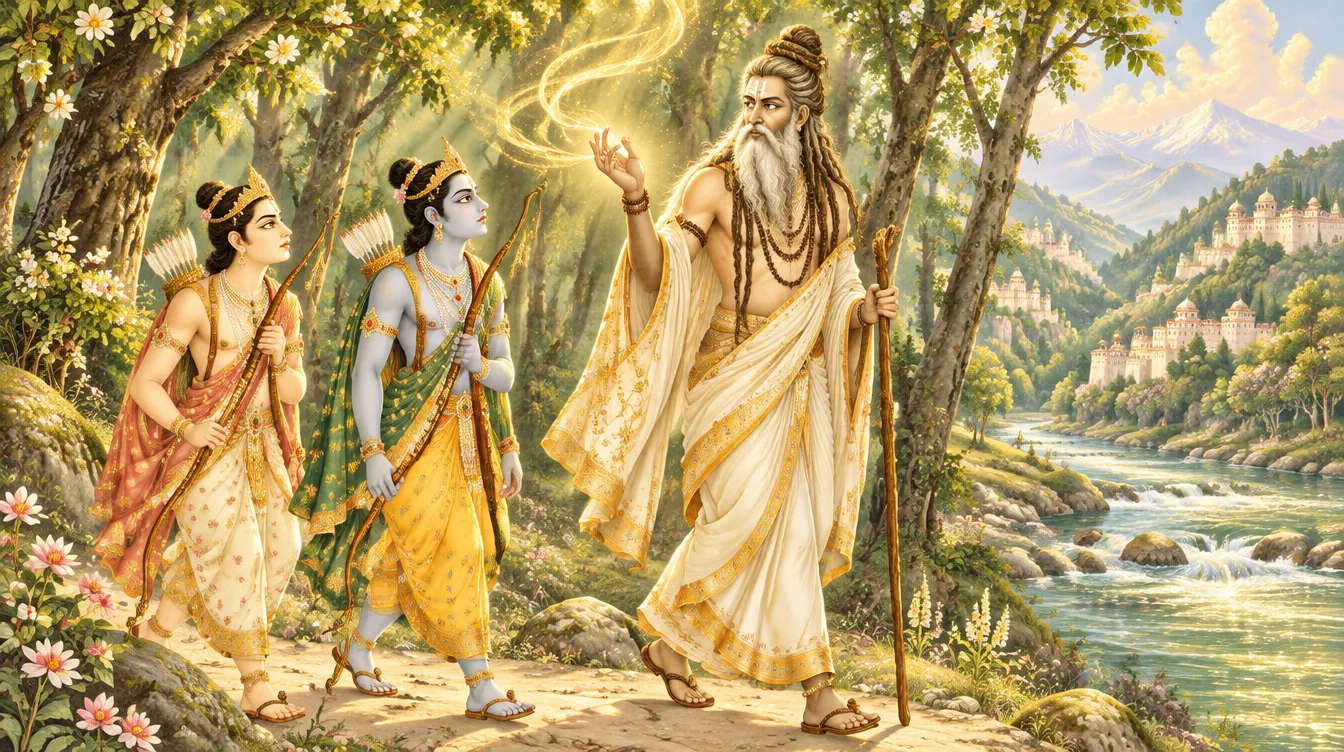
When Rama is not yet sixteen, the formidable sage Vishvamitra arrives and asks the king for him. Demons are defiling his sacrifice and only Rama can stop them. Dasharatha is horrified, but Vasishtha persuades him to agree.
On the road Vishvamitra teaches the brothers two mantras that keep away hunger and fatigue. Rama kills the demoness Tataka, who has turned a region into wasteland, and the sage rewards him with a store of divine weapons.
At the hermitage Rama protects the sacrifice for six days and nights, driving away Maricha and killing Subahu.
Vishvamitra fills the journey with stories. He tells how King Bhagiratha's austerities brought the Ganga down from heaven, caught in Shiva's hair, to purify the ashes of his ancestors.
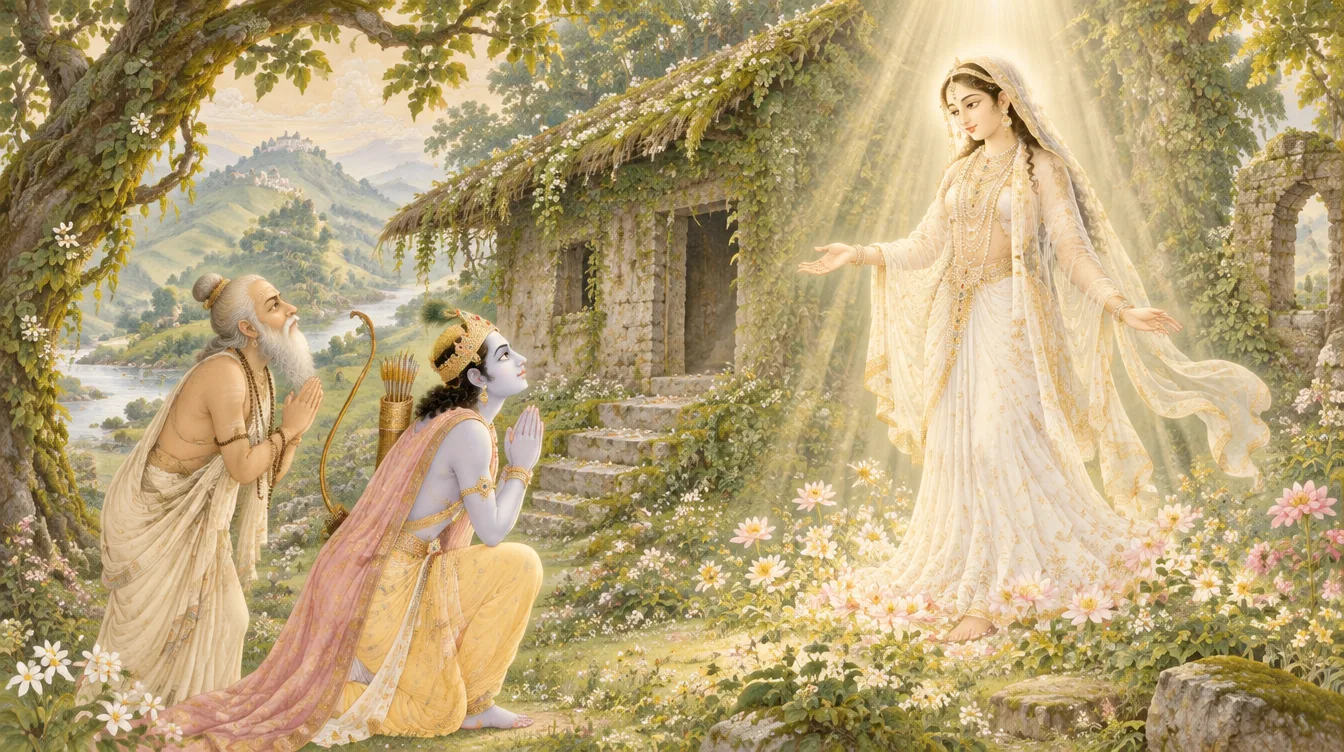
Near Mithila they reach an empty hermitage. Here, says the sage, Ahalya, wife of the sage Gautama, was cursed to live unseen and fasting for an affair with Indra, until Rama should come. Rama enters and she is released, shining, and receives him as an honoured guest.
In Valmiki's telling she is not turned to stone. The stone appears in later versions of the story.
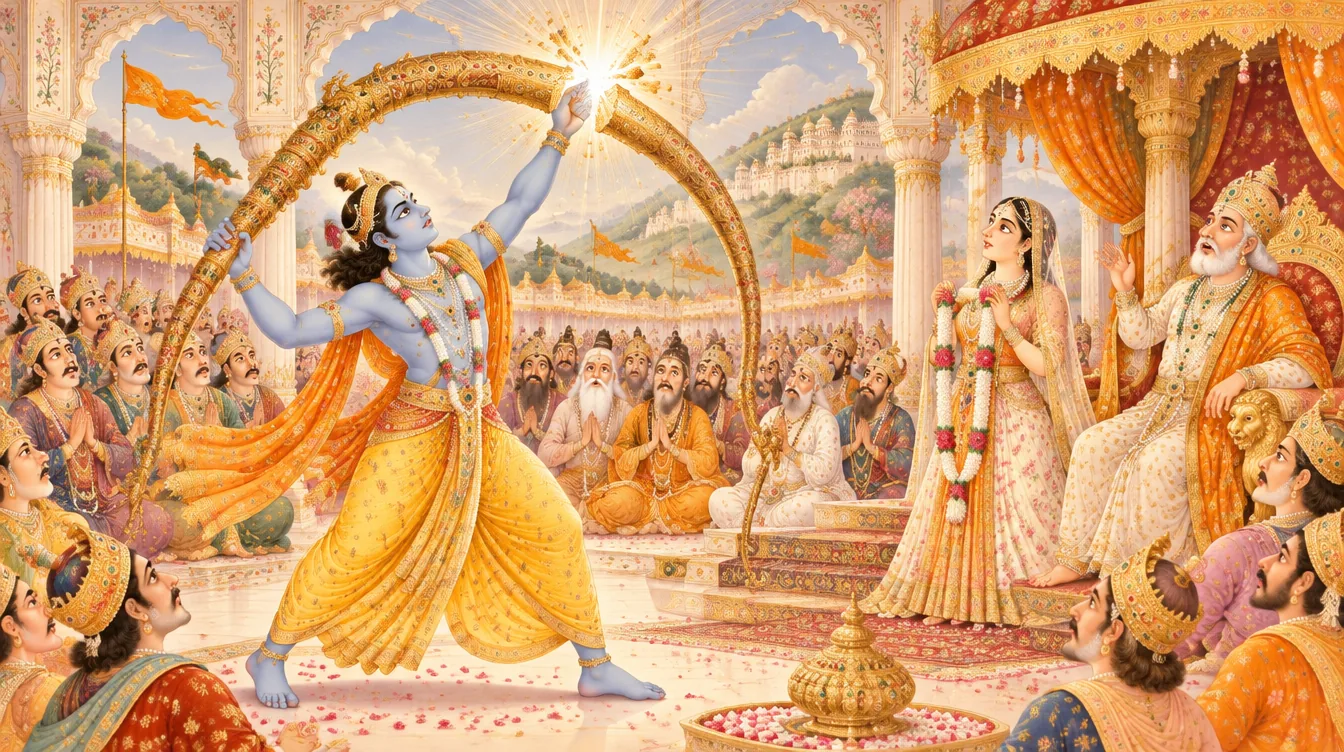
King Janaka of Mithila owns a colossal bow that once belonged to Shiva. He has promised his daughter Sita, whom he found in a furrow while ploughing a sacrificial field, to the man who can string it.
The bow is wheeled in on a cart pulled by hundreds of men. Rama lifts it easily, strings it, and draws it so far that it breaks with a sound like thunder.
Dasharatha comes from Ayodhya and the four brothers marry four princesses: Rama with Sita, Lakshmana with Urmila, Bharata with Mandavi and Shatrughna with Shrutakirti. On the way home the warrior sage Parashurama blocks the road, furious about Shiva's bow. Rama strings Parashurama's own bow of Vishnu, and the older hero yields.
A coronation becomes an exile. The longest and most human book of the epic, about families, promises and grief.
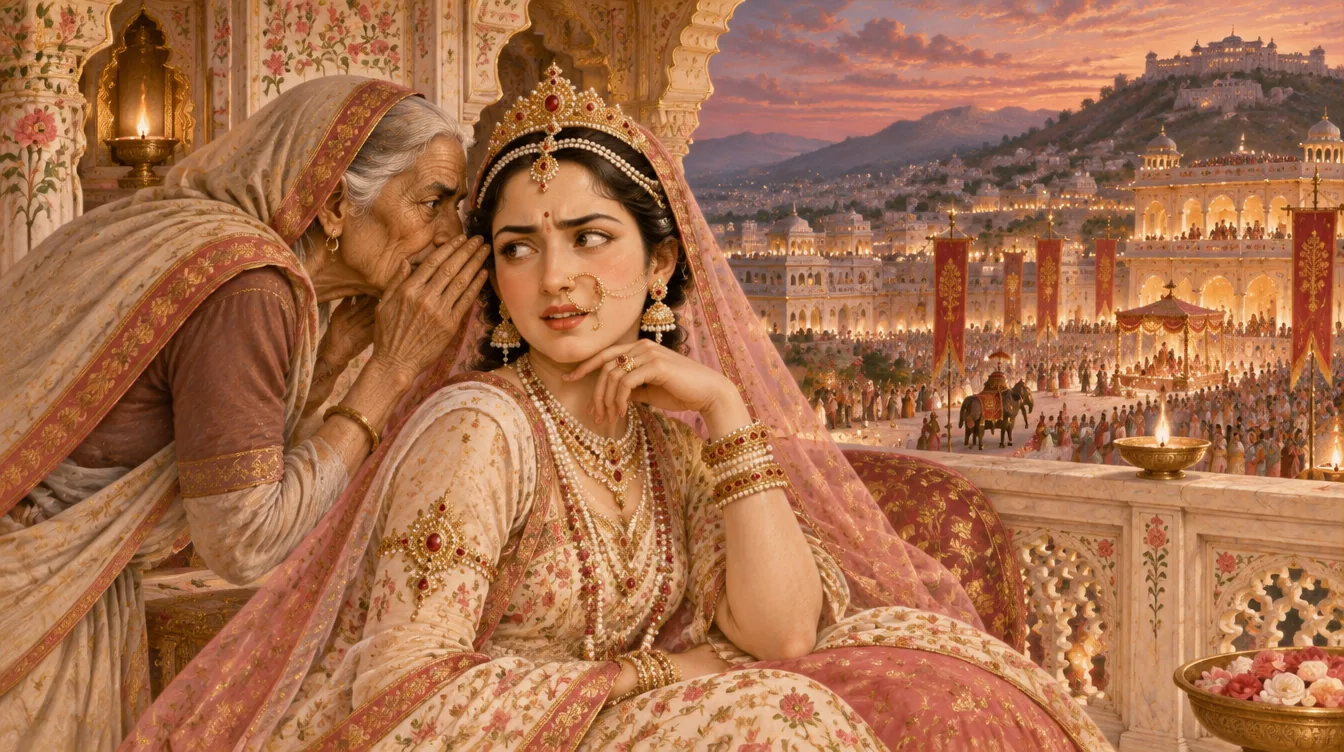
Dasharatha, growing old, decides to crown Rama as crown prince. The city is overjoyed and decorates its streets.
Manthara, Kaikeyi's old maid, sees the preparations from the palace roof. She goes to Kaikeyi, who at first is delighted for Rama and gives Manthara a jewel. Manthara works on her patiently: Kausalya will rule the palace, Bharata will be a servant, Kaikeyi will be pushed aside.
By the end of the conversation Kaikeyi has changed her mind.
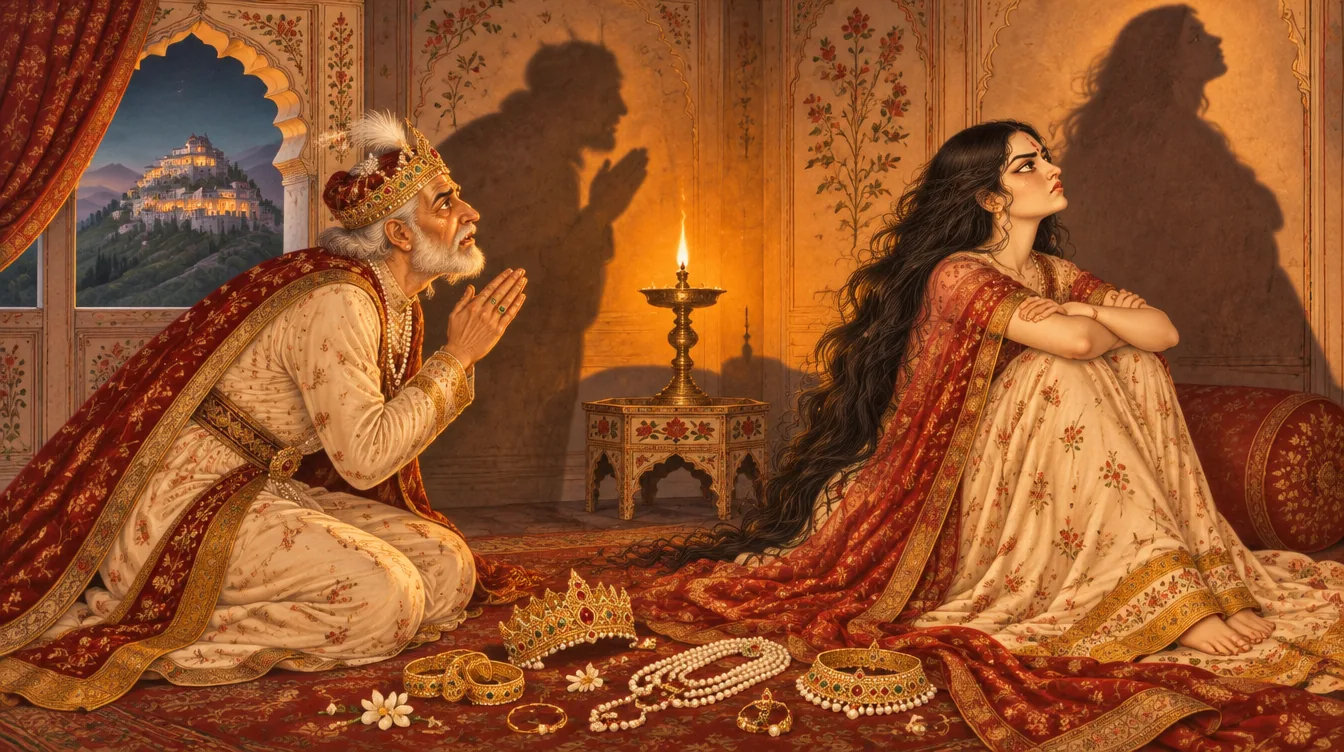
Long ago Kaikeyi saved Dasharatha's life in a battle between the gods and demons, and he granted her two boons to claim whenever she wished. She claims them now, lying on the floor of the anger chamber with her ornaments thrown aside.
Bharata must be crowned. Rama must go to the forest for fourteen years.
Dasharatha begs, rages and faints. Bound by his word, he cannot refuse.
Rama hears the news calmly and agrees at once, so that his father will not be a liar. Kausalya is shattered. Lakshmana is furious and ready to fight. Sita refuses to stay behind: a wife's place, she argues, is beside her husband.
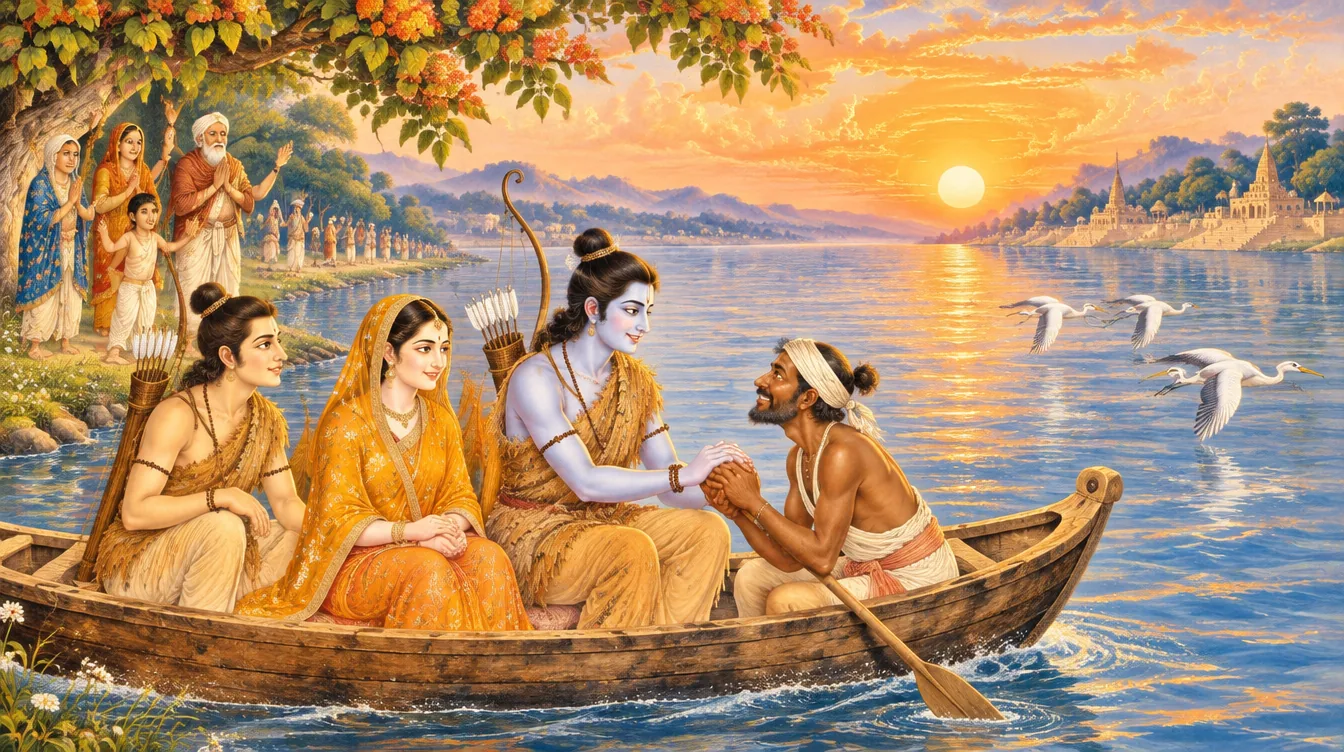
The three leave in bark garments as the city weeps. At Shringaverapura Guha, king of the Nishadas, ferries them across the Ganga. At Prayaga the sage Bharadvaja directs them to Chitrakuta, where they build a hut.
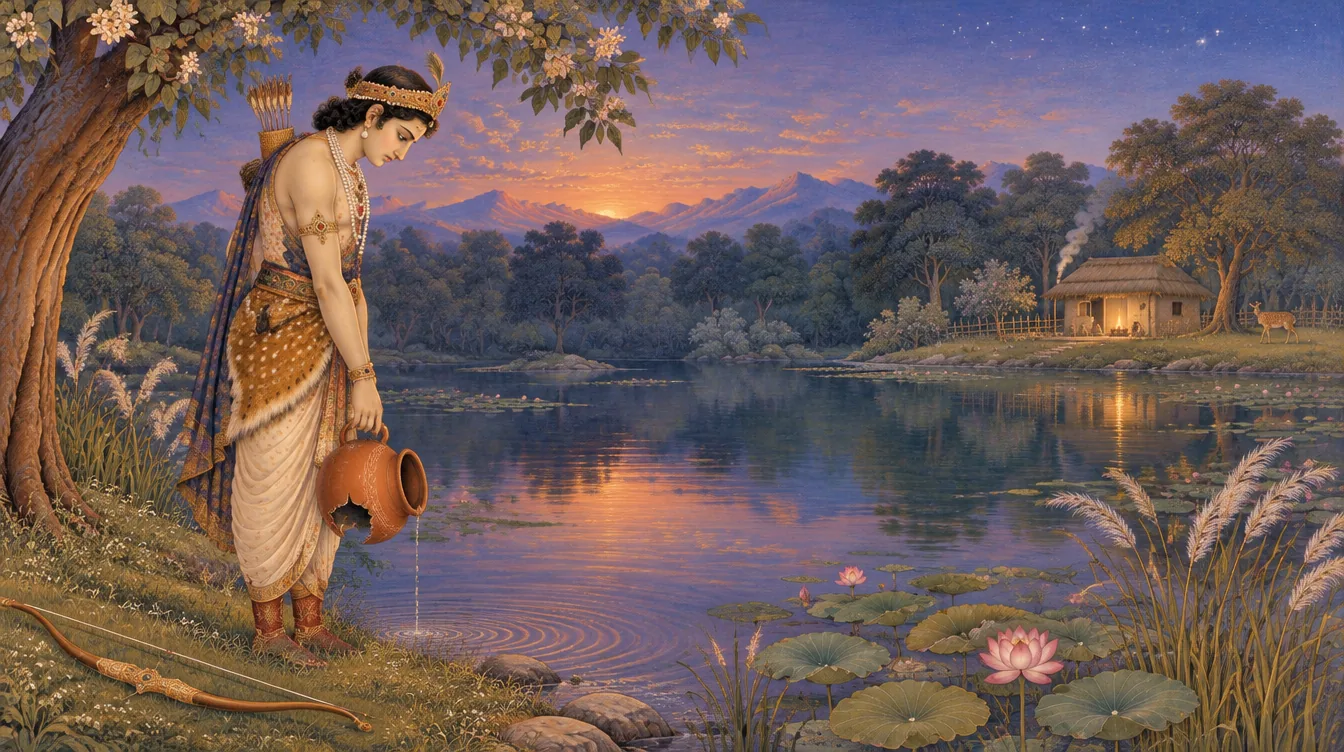
Back in Ayodhya, Dasharatha cannot sleep. In the night he tells Kausalya a secret from his youth: hunting by a river at dusk, he shot at a sound he took for an elephant drinking. It was a young ascetic filling a pot for his blind parents. Later tradition calls the youth Shravana.
The father cursed the king to die grieving for a son. Now the curse has come due. Dasharatha dies calling Rama's name.
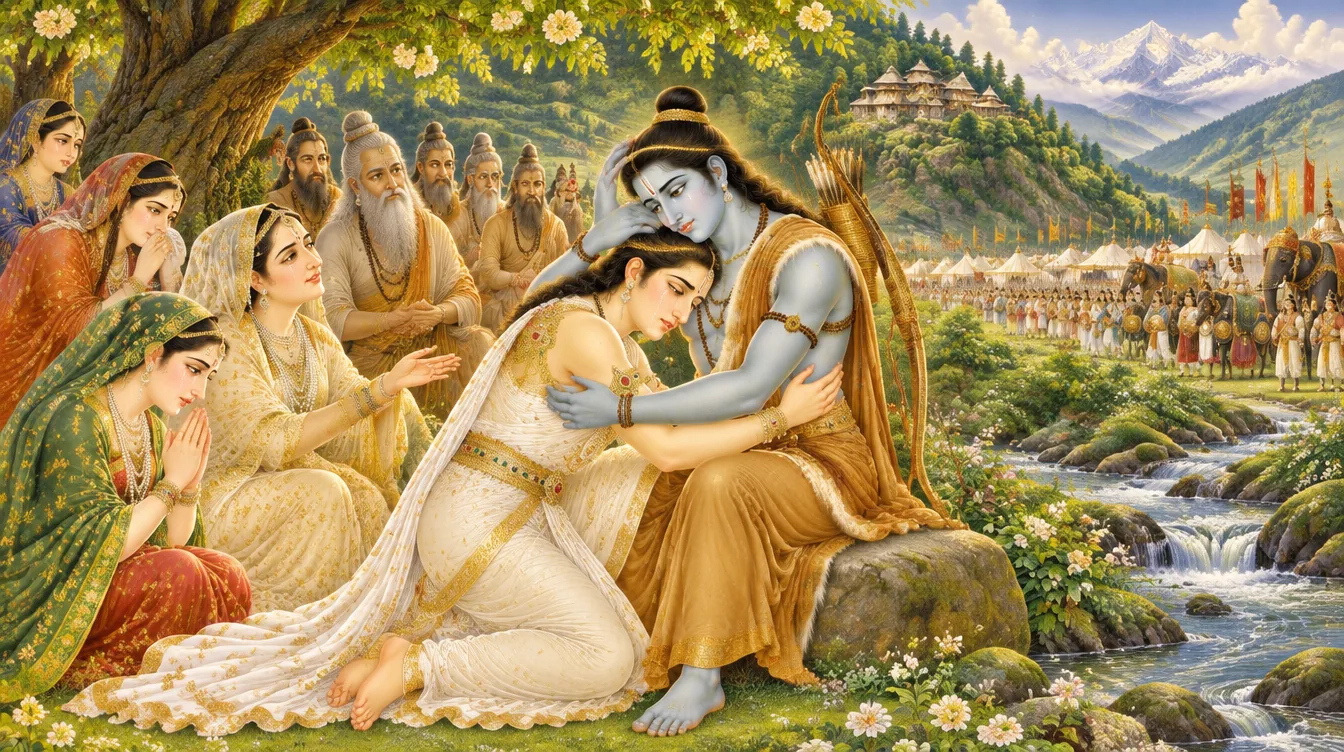
Bharata is summoned home from his uncle's kingdom and learns everything at once. He rejects his mother, refuses the throne, performs his father's funeral and sets out with the army and the queens to bring Rama back.
At Chitrakuta the brothers meet. Rama will not return before the fourteen years are over. Bharata takes Rama's sandals, places them on the throne, and rules as regent from the village of Nandigrama, living as an ascetic himself.
Rama, Sita and Lakshmana move deeper south, visiting the sage Atri and his wife Anasuya, who gives Sita ornaments that never fade.
Years pass among hermits and demons. Then a single afternoon changes everything.
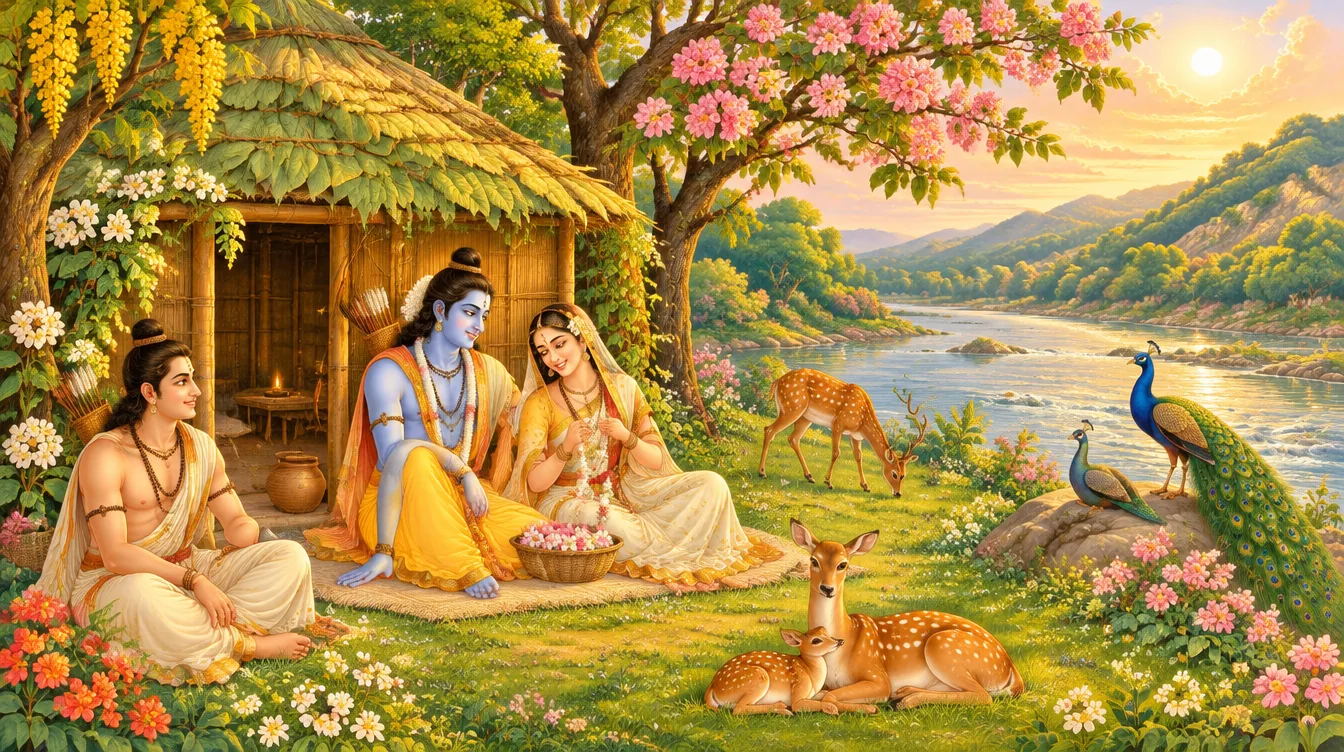
The exiles spend about ten years moving among the hermitages of the Dandaka forest. The sages ask for protection against the rakshasas, and Rama promises it. Sita gently questions whether a man vowed to the forest should carry weapons at all.
The great sage Agastya gives Rama divine weapons and advises him to settle at Panchavati on the Godavari. There they meet the old vulture Jatayu, a friend of Dasharatha, who offers to guard Sita.
Ravana's sister Shurpanakha sees Rama and desires him. Rama teases her and sends her to Lakshmana, who sends her back. When she turns on Sita, Lakshmana mutilates her, cutting off her nose and ears.
She runs to her brothers Khara and Dushana, whose army of fourteen thousand Rama destroys alone. Then she goes to Lanka and describes Sita to Ravana.
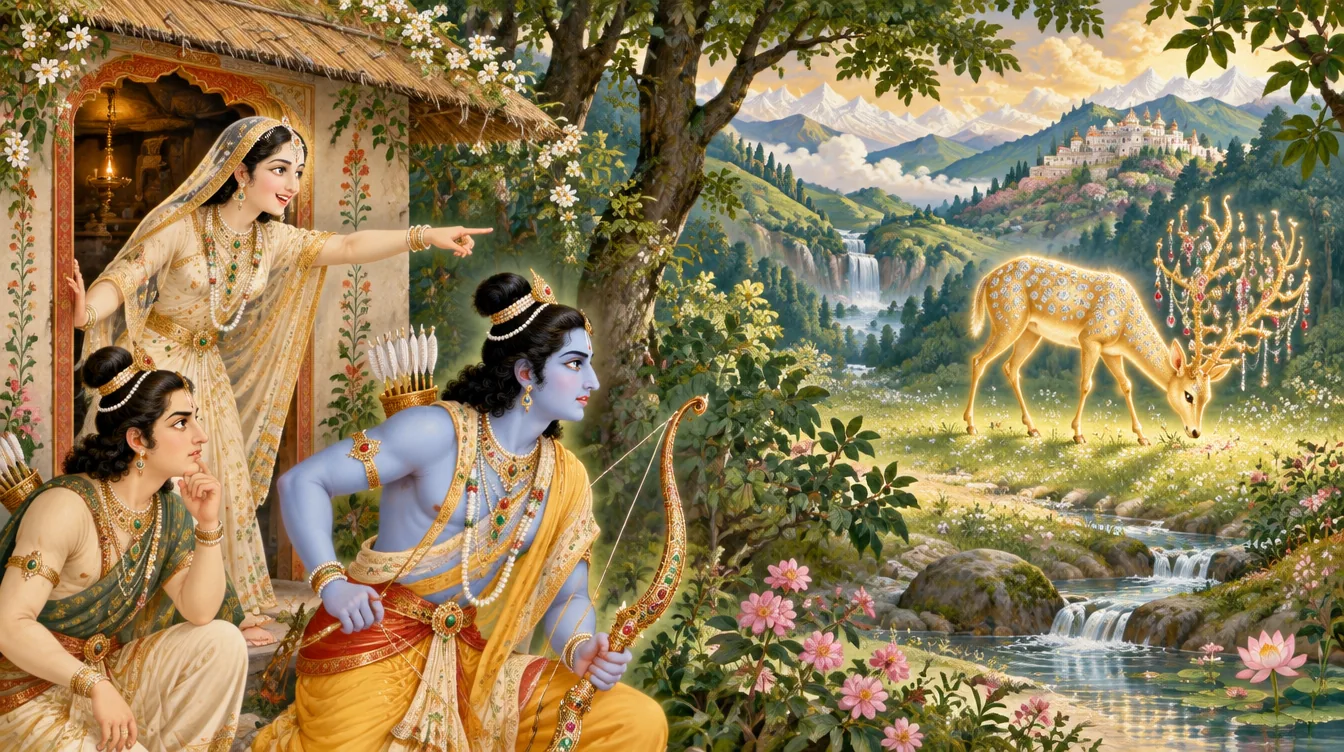
Ravana orders his uncle Maricha, the demon Rama once spared, to take the shape of a golden deer. Sita sees it and asks Rama to catch it. Lakshmana warns that it is a trick.
Rama chases it deep into the forest and kills it. As it dies Maricha cries out in Rama's voice for Lakshmana. Sita begs Lakshmana to go, and when he refuses she accuses him of wanting her for himself. Stung, he leaves.
The famous protective line drawn around the hut, the Lakshmana rekha, does not appear in Valmiki. It comes from later retellings.
Ravana comes to the hut disguised as a wandering ascetic. Sita offers him hospitality. He reveals himself, praises her beauty and asks her to be his queen. She refuses him with contempt.
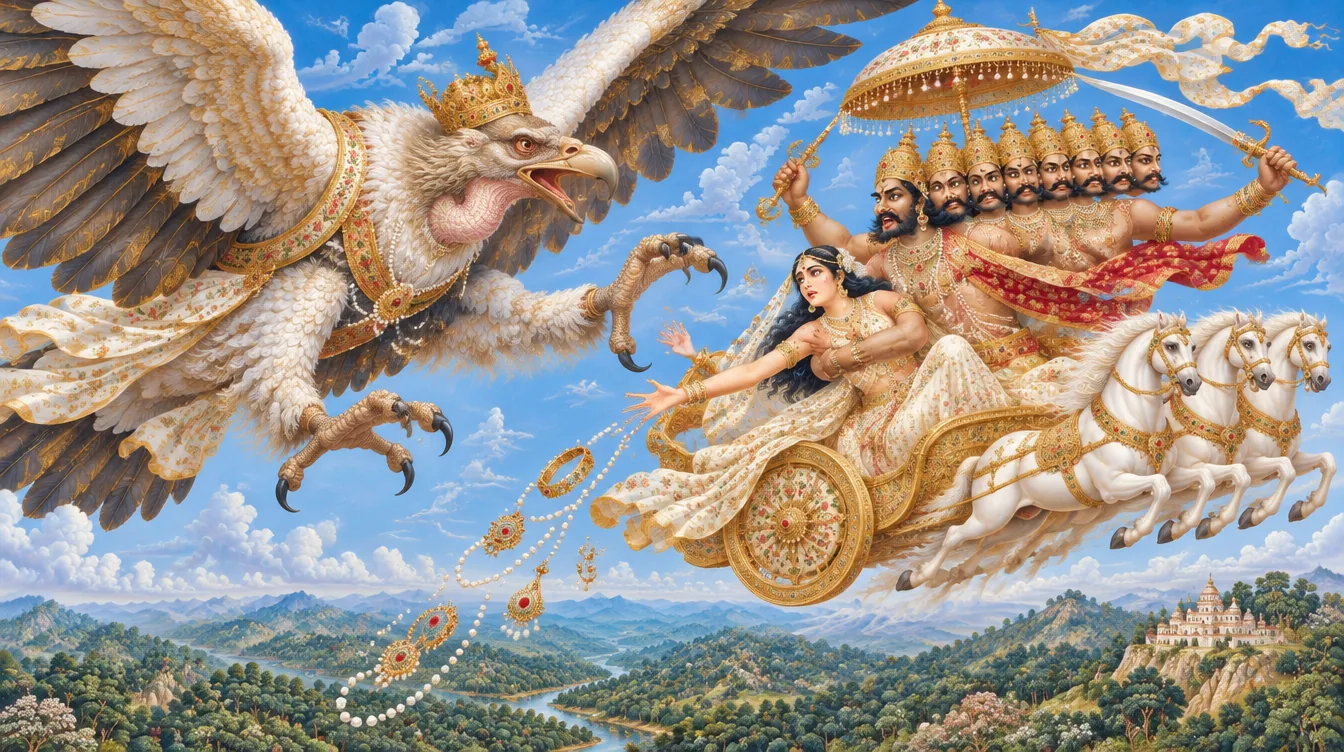
He seizes her and carries her into the sky in his chariot. Jatayu attacks and wrecks the chariot, but Ravana cuts off the old bird's wings. As they fly south Sita drops her jewellery to a group of monkeys on a hilltop.
In Lanka she is kept in the ashoka grove and given a year to change her mind.
Rama returns to an empty hut and is overwhelmed by grief and rage. The brothers find the dying Jatayu, who tells them what happened. Rama performs his funeral rites as for a father.
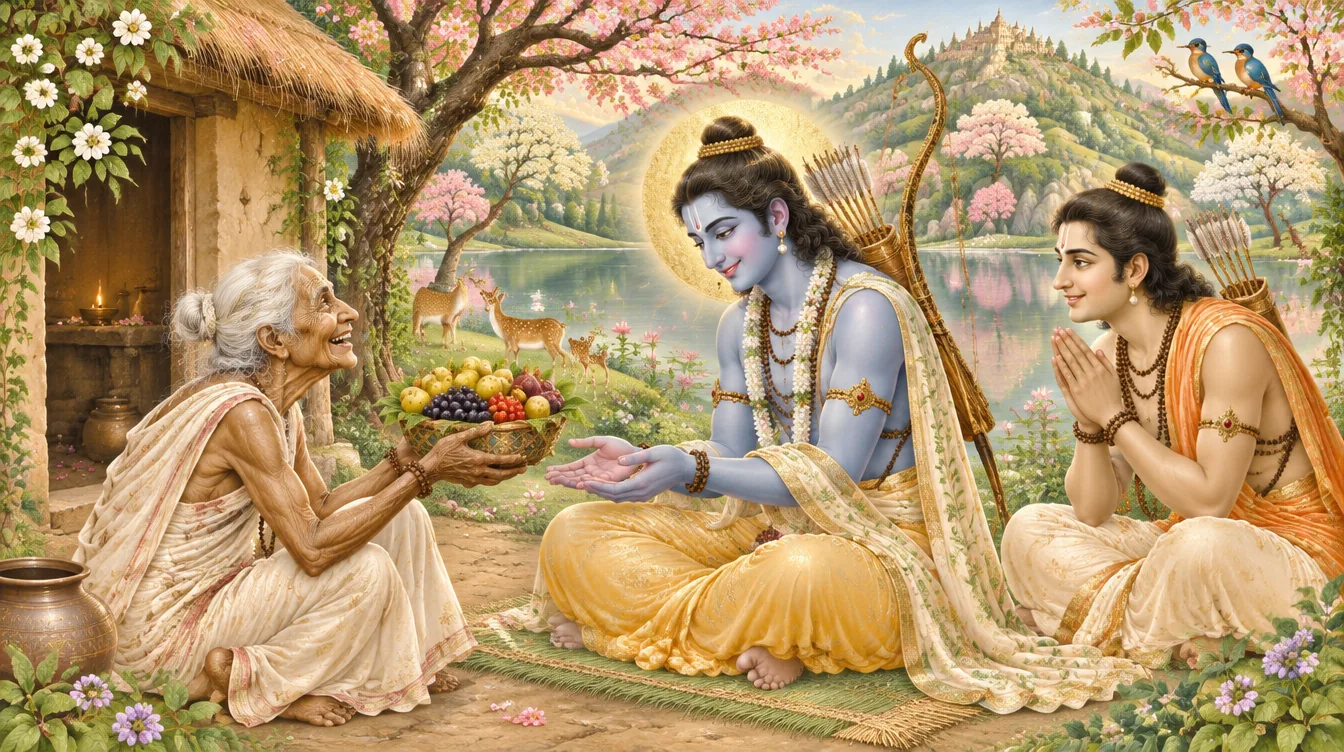
The headless monster Kabandha, freed from a curse by Rama, advises him to find Sugriva. On the way they reach the hermitage of Shabari, a devout old woman who has waited years to see Rama. She offers them fruits, then departs this life.
The tender detail of Shabari tasting each berry first is a later devotional addition, much loved, but not in Valmiki.
In the kingdom of the vanaras Rama finds allies, makes a hard choice, and waits out a monsoon.
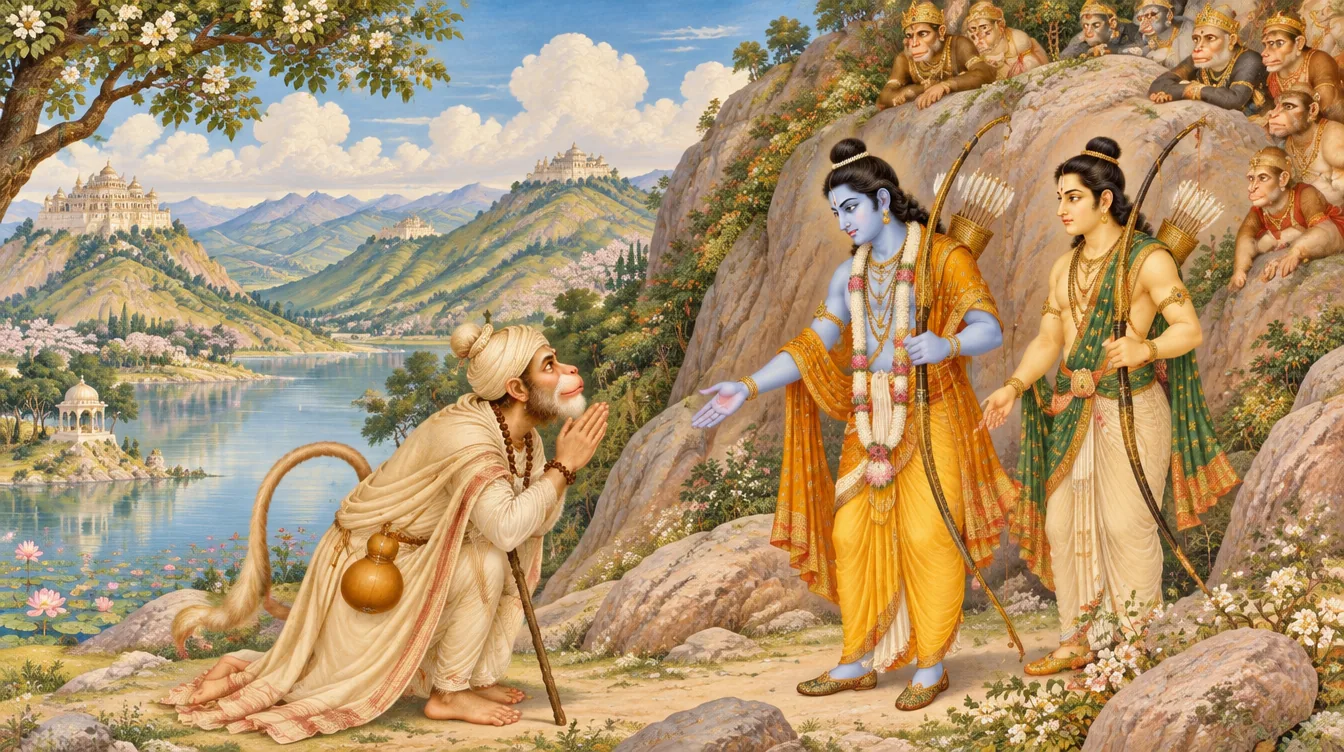
On the hill of Rishyamukha the exiled vanara Sugriva watches two armed strangers with alarm. He sends his minister Hanuman, son of the wind god, to find out who they are.
Hanuman approaches disguised as a mendicant and speaks so beautifully that Rama remarks to Lakshmana that no one could speak like this without mastering the Vedas and grammar. It is the start of the most famous devotion in Indian literature.
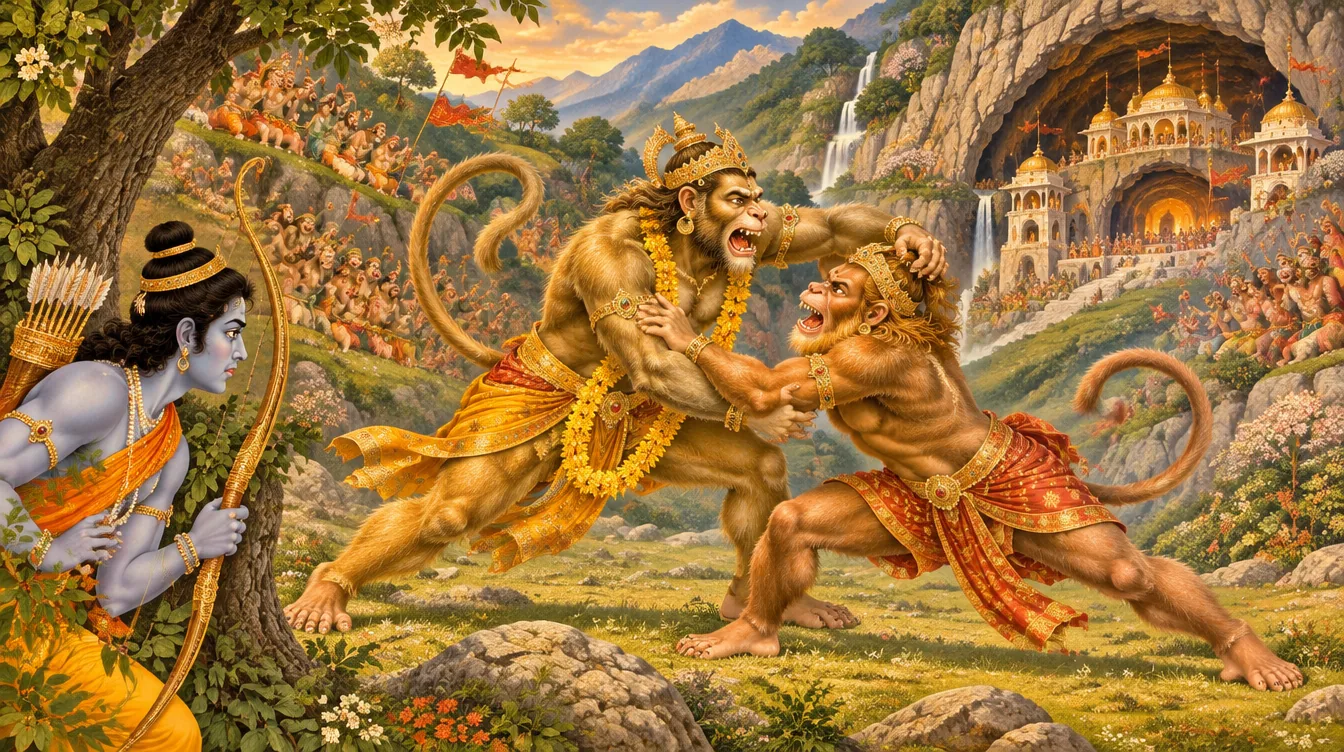
Sugriva's brother Vali drove him out of Kishkindha and took his wife. Sugriva shows Rama the jewellery Sita dropped, and the two swear friendship before a fire: Rama will kill Vali, Sugriva will find Sita.
The brothers fight. In the first duel they look so alike that Rama cannot shoot. In the second, Sugriva wears a garland, and Rama shoots Vali from behind a tree.
The dying Vali protests that he was struck unfairly by a man who was not his enemy. Rama answers that Vali broke the law by taking his brother's wife. Readers have argued about this exchange ever since. Vali's wife Tara mourns him, and Sugriva is crowned.
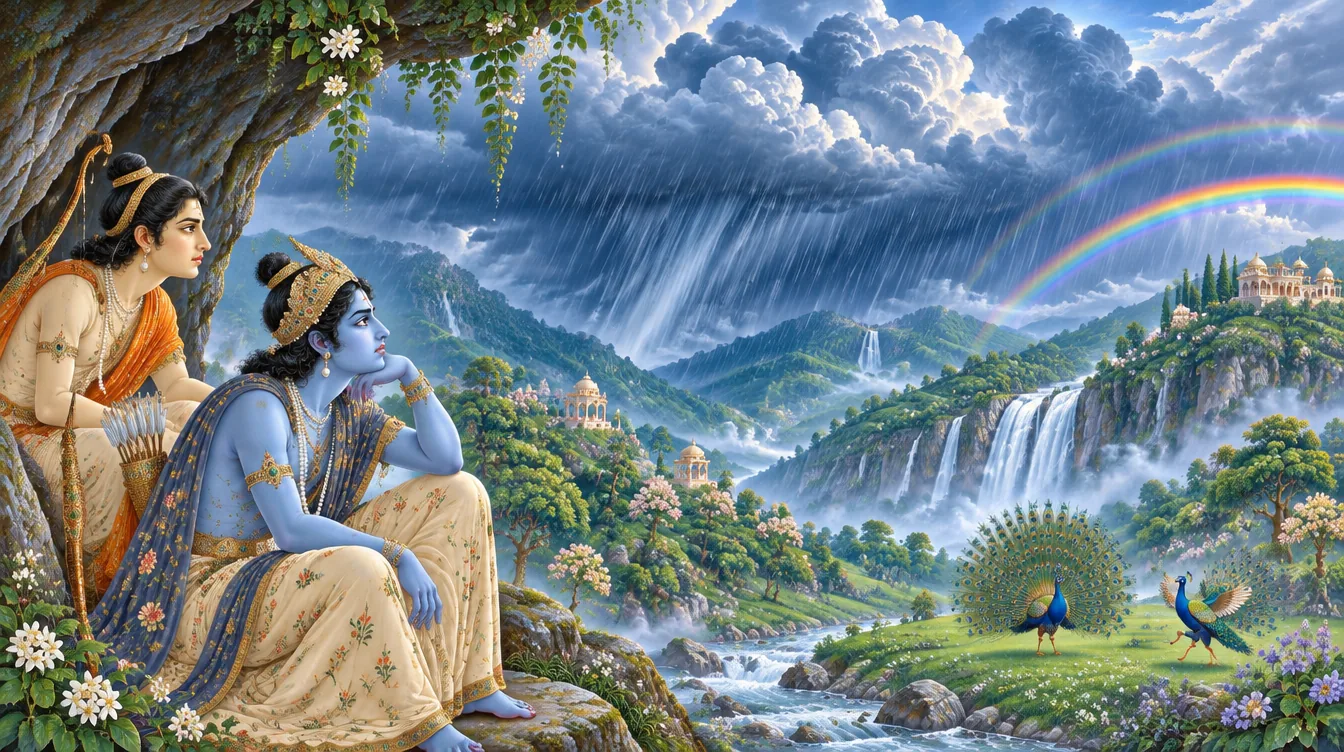
The monsoon arrives and nothing can move. Rama waits in a mountain cave, and the rains become one of the great nature poems of Sanskrit: clouds like elephants, peacocks dancing, rivers swollen, and Rama aching for Sita.
When the sky clears Sugriva is still enjoying his new kingdom. Lakshmana storms into Kishkindha in anger. Tara calms him, and Sugriva sends his armies out in all four directions. Rama gives Hanuman his signet ring, sure that he will be the one to find her.
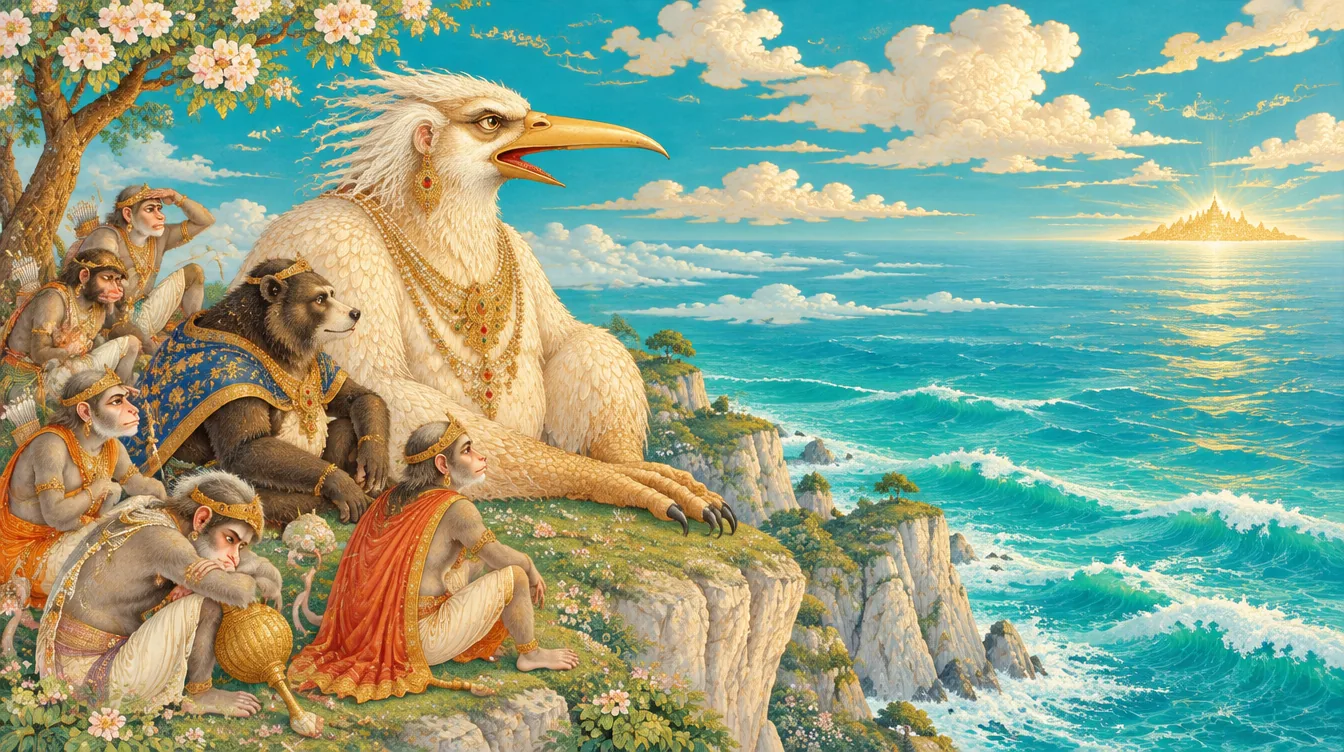
The southern search party, led by Angada with Hanuman and the old bear Jambavan, wanders for a month and reaches the ocean with no news. They resolve to fast to death.
Their talk of Jatayu is overheard by Sampati, Jatayu's elder brother, whose wings were burnt long ago when he shielded his brother from the sun. With his keen sight he sees Sita in Lanka, a hundred yojanas across the sea.
No one can jump that far. Jambavan reminds Hanuman of who he is: as a child he leapt at the sun thinking it was a fruit. Hanuman grows huge and climbs Mahendra hill.
Hanuman's book. Many households recite it on its own, for courage and for hope.
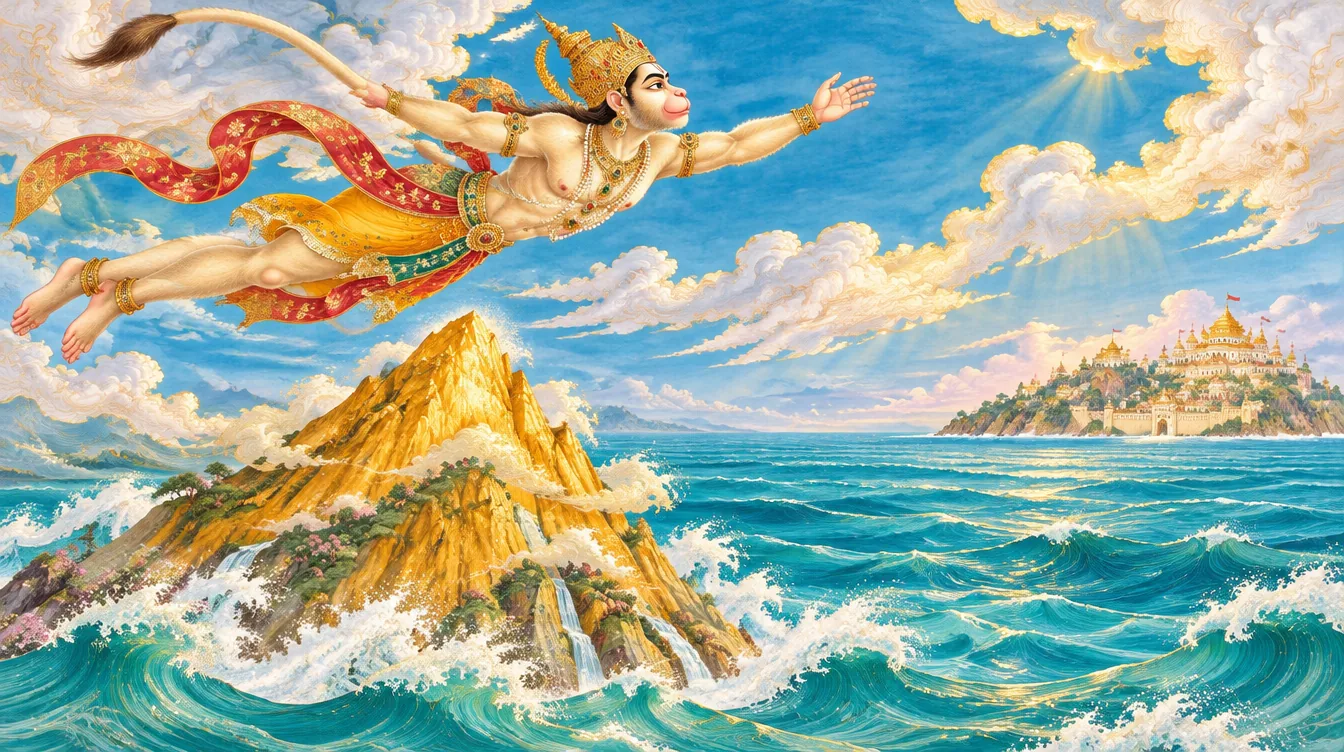
Hanuman pushes off from Mahendra so hard that the mountain shakes. Over the sea the mountain Mainaka rises to offer him rest, and he touches it politely and flies on.
Surasa, mother of serpents, blocks his way with open jaws to test him. He grows, she grows, then he shrinks to the size of a thumb, flies in and out of her mouth, and she blesses him. The shadow-seizing demoness Simhika drags at his shadow, and he destroys her.
He lands on the slopes of Lanka at evening.
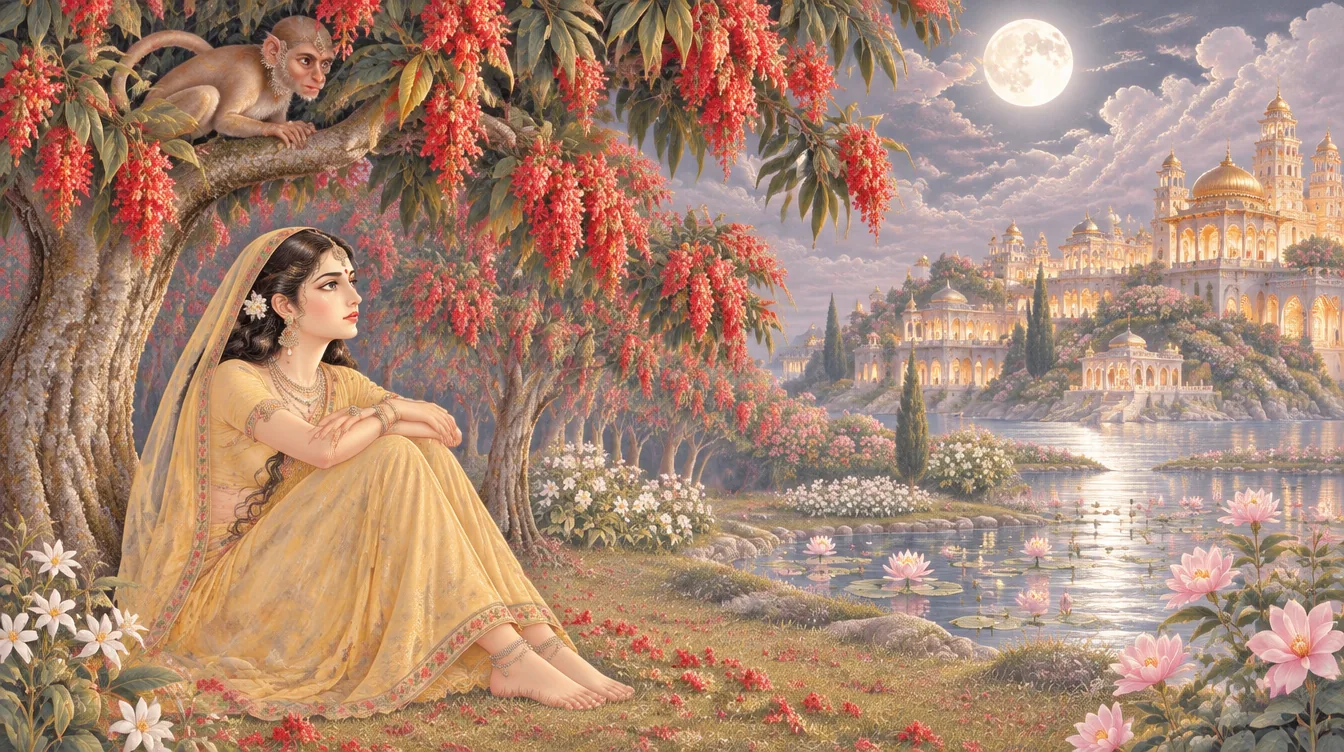
Shrinking to the size of a cat, Hanuman searches the golden city by moonlight: palaces, drinking halls, sleeping women. For one moment he mistakes Ravana's queen Mandodari for Sita and is ashamed of himself.
At last, in the ashoka grove, he sees a thin, pale woman in a single faded garment, surrounded by rakshasi guards. Hidden in a tree he watches Ravana come and threaten her: two months left. Sita answers him with scorn.
After Ravana leaves, the old rakshasi Trijata tells the guards of a dream in which Ravana falls and Rama triumphs.
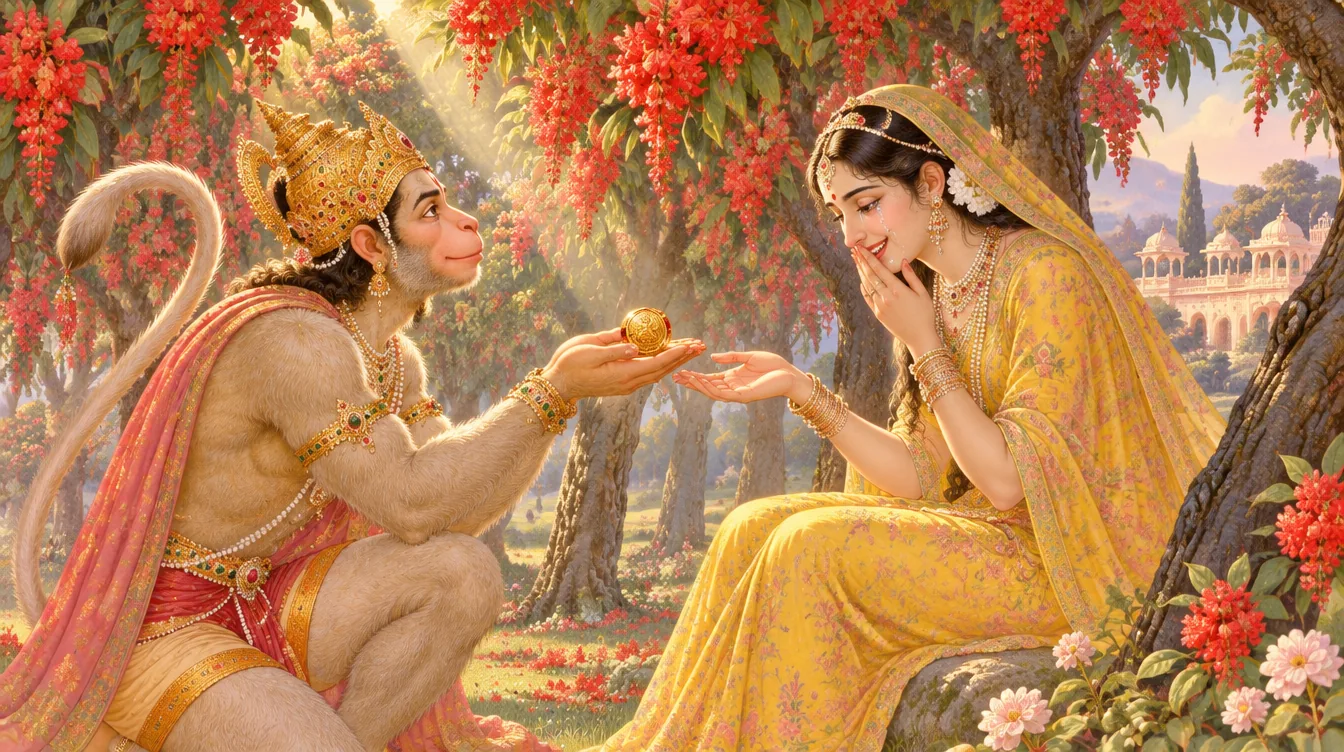
Sita, in despair, is about to end her life. From the branches Hanuman begins softly to sing the story of Rama. Then he climbs down and gives her Rama's ring.
He offers to carry her home on his back. She refuses: it would be dishonourable for Rama, and she will not willingly touch another man. Rama must come himself.
She gives Hanuman her hair jewel, the chudamani, as a token, and a private memory of a crow that only Rama would know.
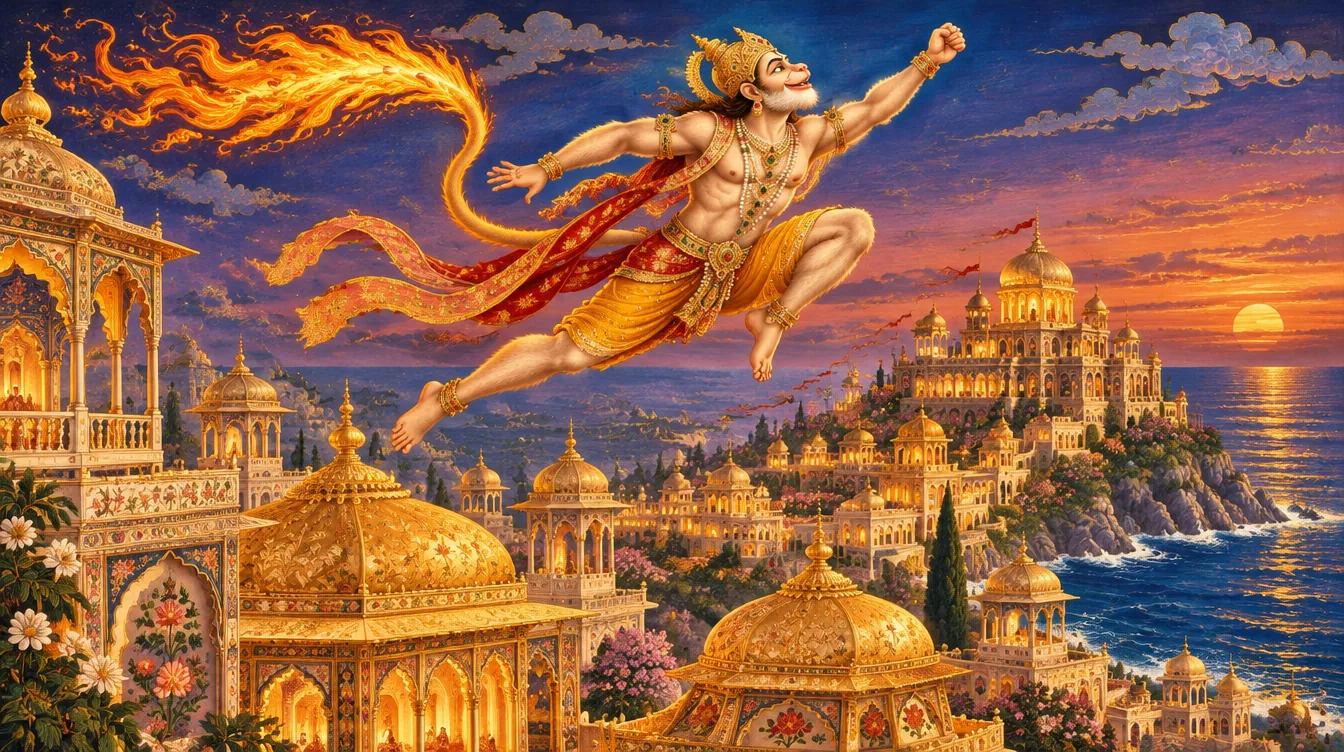
Hanuman decides to test the enemy's strength. He wrecks the ashoka grove and kills the prince Aksha. Indrajit, Ravana's son, binds him with a weapon of Brahma, and Hanuman lets himself be taken to court.
He warns Ravana to return Sita. Vibhishana stops Ravana from killing an envoy, so they set Hanuman's tail on fire instead. He breaks free and leaps from roof to roof until the city is ablaze.
Horrified that he may have burned Sita too, he checks, finds her unharmed, and leaps home to report: "I have seen Sita."
The largest book: a bridge across the sea, a long war, a single combat and a painful homecoming.
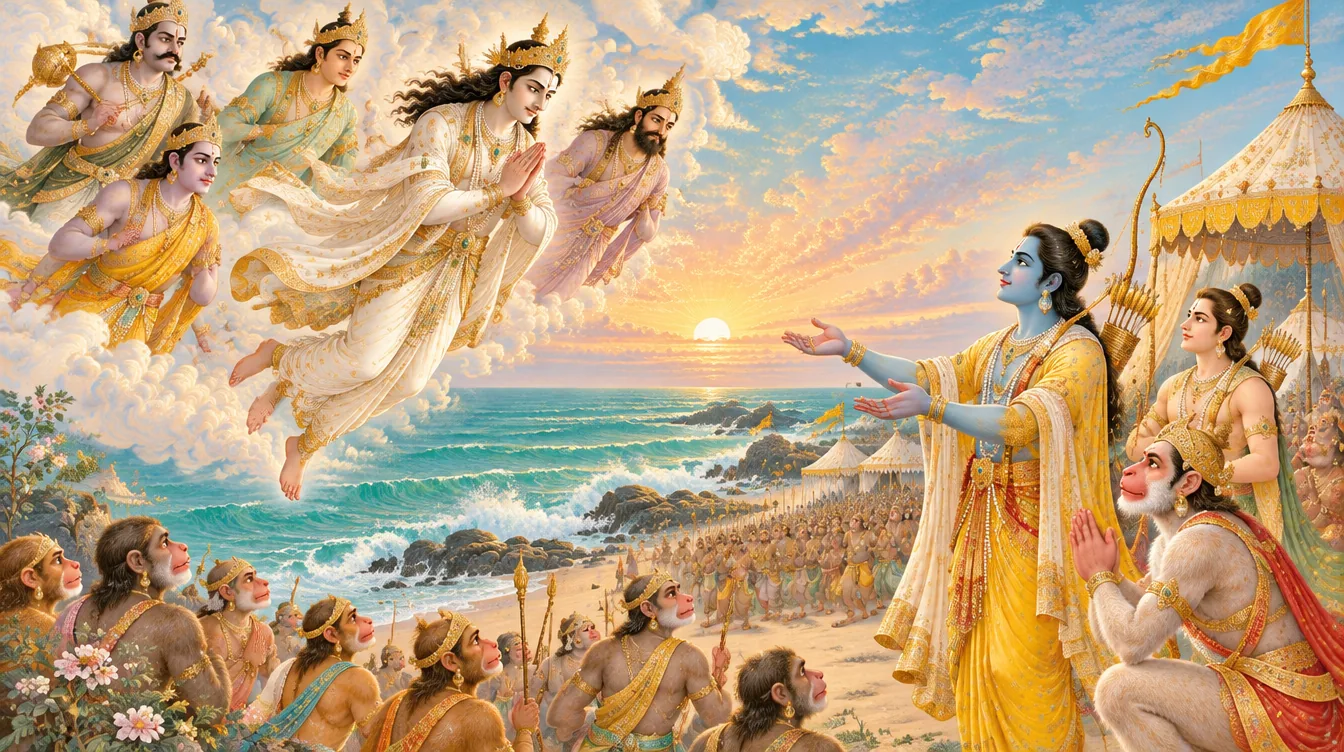
In Lanka's council Ravana's brother Vibhishana urges him to return Sita and avoid ruin. Ravana insults him as a traitor. Vibhishana leaves with four companions and flies to Rama's camp.
The vanaras want to kill him as a spy. Rama overrules them with a vow: anyone who comes to him once and says "I am yours" receives his protection. He even promises Vibhishana the throne of Lanka.
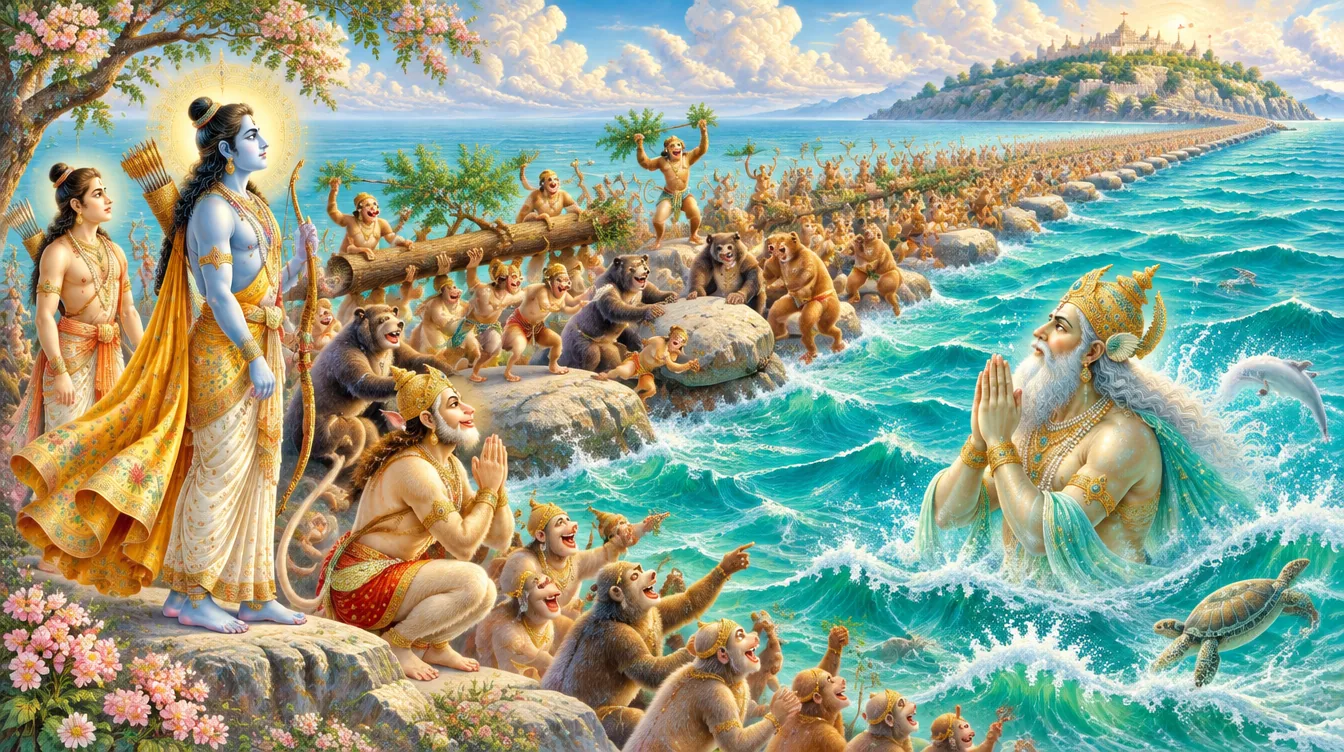
Rama asks the Ocean for passage and waits three days. When there is no answer he raises a weapon to dry the sea. The Ocean rises in person and suggests that Nala, son of the divine architect, build a bridge he will support.
The vanaras haul trees and rocks, and in five days the bridge reaches Lanka. The army crosses and camps beneath the city walls. Angada goes as a last envoy, and Ravana rejects peace.
The war is fought in waves. Indrajit, fighting invisibly, binds Rama and Lakshmana with serpent arrows, and they are freed only when the eagle Garuda arrives.
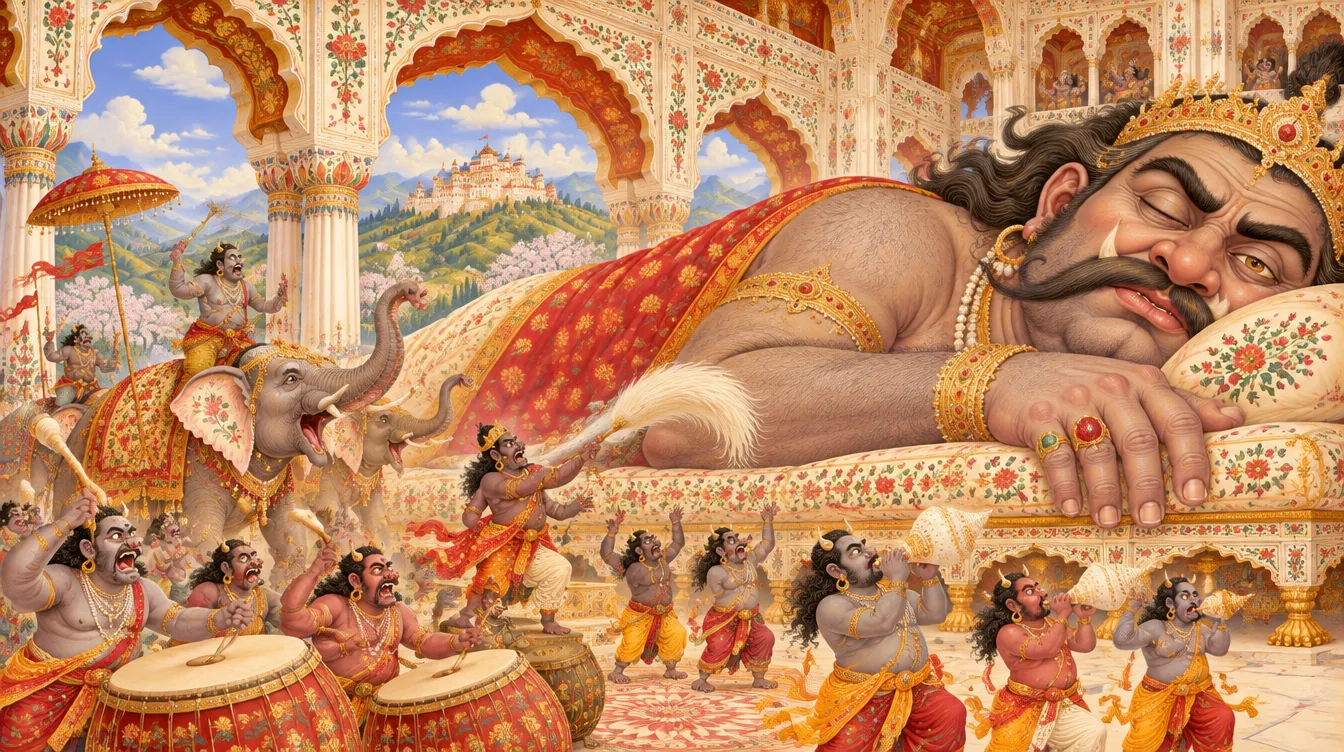
As his generals fall, Ravana has his brother Kumbhakarna woken from his months-long sleep with drums, trumpets and elephants. The giant tells Ravana plainly that he has done wrong, then fights for him anyway. He devastates the vanara army before Rama kills him.
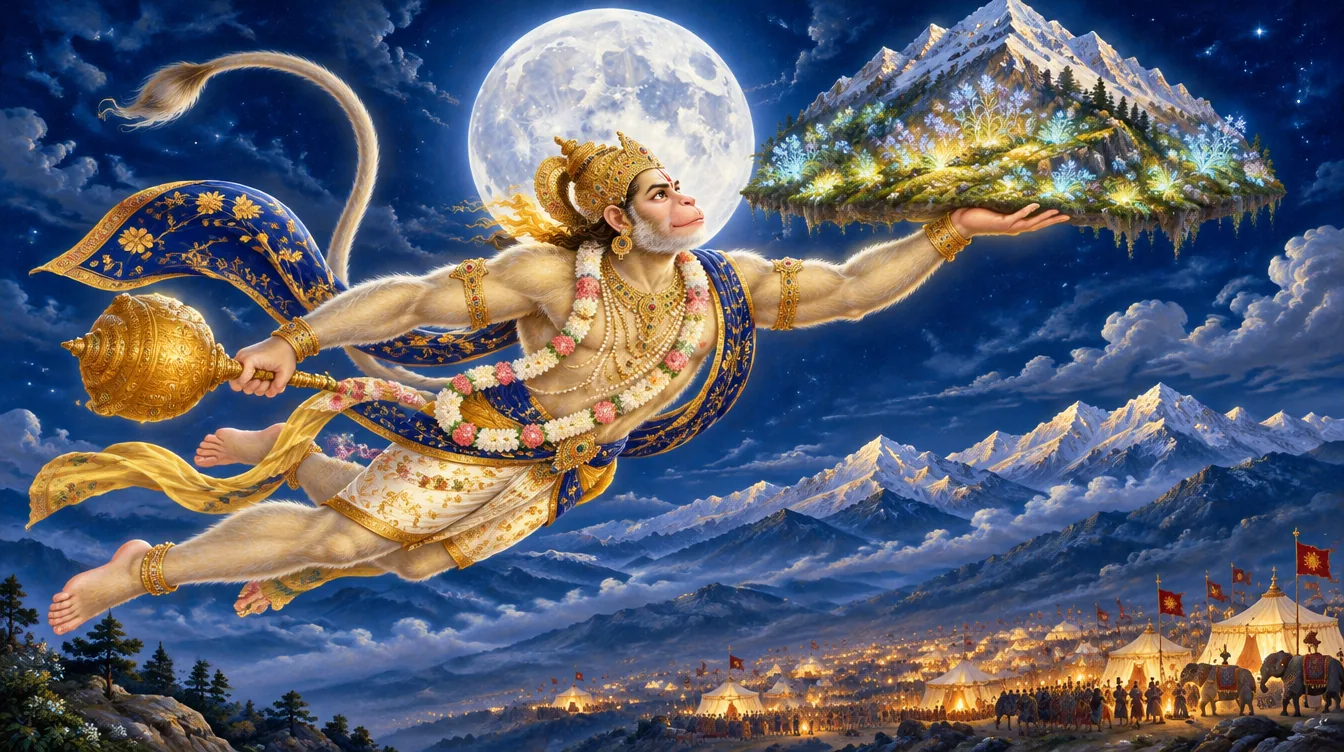
Indrajit strikes down the whole army with a weapon of Brahma. Jambavan sends Hanuman to the Himalaya for four healing herbs. Unable to tell which plants they are, Hanuman lifts the whole mountain peak and flies it back. The scent alone revives the fallen.
Later Lakshmana is struck down by Ravana's spear, and the herbs save him again. Lakshmana finally kills Indrajit, after Vibhishana shows him how to interrupt Indrajit's sacrifice.
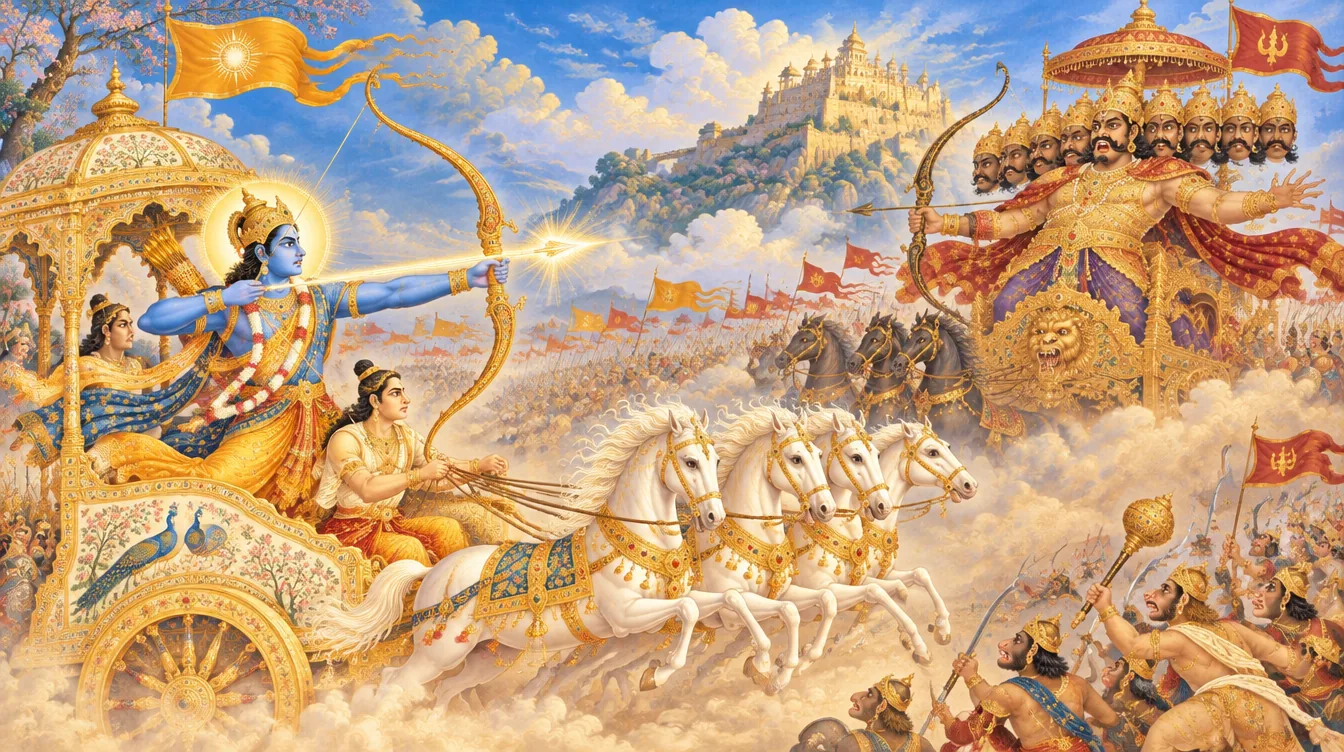
Ravana comes out at last. Before the final battle the sage Agastya teaches Rama the Aditya Hridaya, a hymn to the sun. Indra sends his own chariot and charioteer Matali.
The duel lasts a long time. Rama cuts off Ravana's heads, and they grow back. On Matali's advice he uses the weapon of Brahma, which strikes Ravana in the heart.
Rama orders full funeral rites for his enemy, saying that hostility ends with death. Vibhishana is crowned king of Lanka.
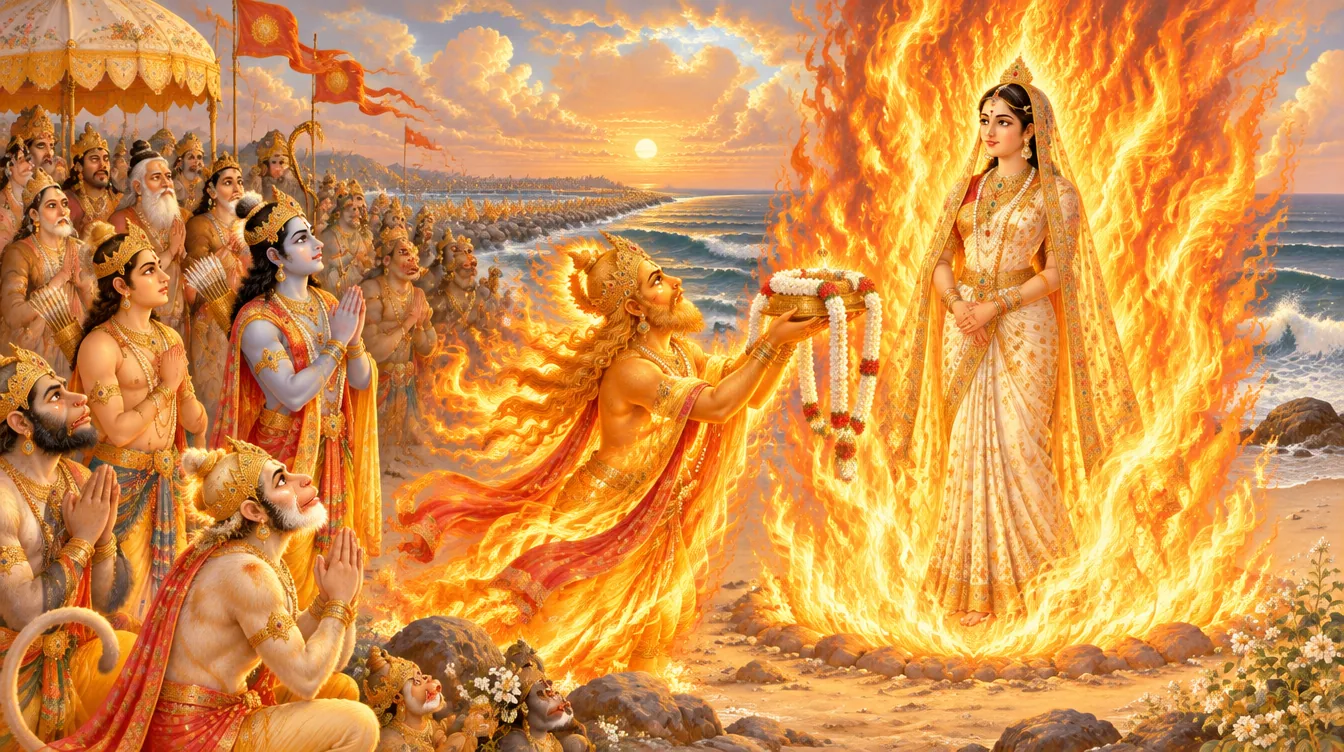
Sita is brought before Rama, and he speaks to her harshly in front of everyone: he fought to restore his honour and doubts her after a year in Ravana's house. Sita answers with dignity and asks Lakshmana to build a fire.
She walks into it. Agni, god of fire, rises carrying her unharmed and declares her pure. Rama says he never doubted her but the world needed to see. This scene is among the most debated in the epic.
The exiles fly home in the aerial chariot Pushpaka. Bharata meets them with the sandals, and Rama is crowned in Ayodhya. Sita gives Hanuman a pearl necklace.
Many scholars regard this book, like parts of the first, as a later layer. It is still read as the epic's sombre ending.
After the coronation the sage Agastya tells the court the backstory. Ravana was the grandson of the sage Pulastya and half-brother of Kubera, lord of wealth. Through fierce austerities he won from Brahma a boon that no god, demon or celestial could kill him. He did not think humans worth mentioning.
He drove Kubera from Lanka, took his chariot Pushpaka, and terrorised the three worlds. Agastya also tells of Hanuman's childhood: the leap at the sun, Indra's thunderbolt, and the curse that made him forget his strength until reminded.
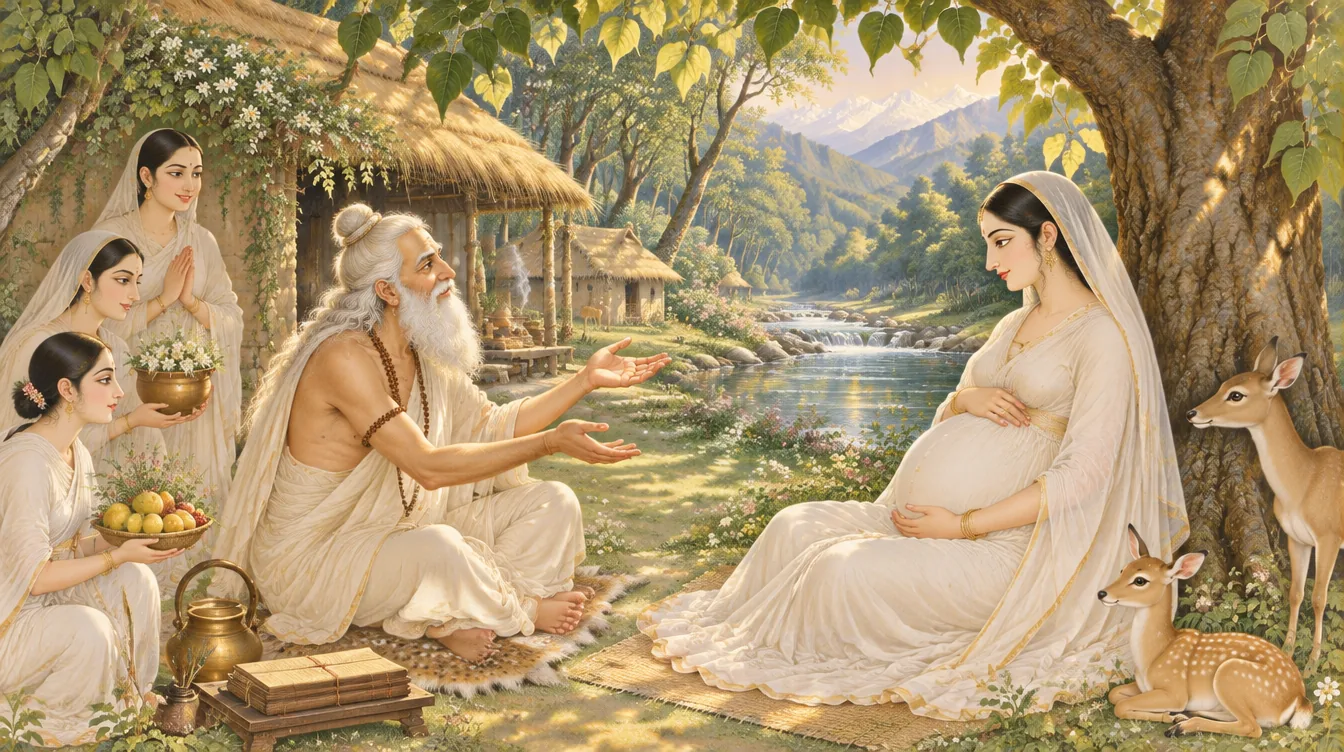
Rama learns that his subjects gossip about a king who took back a wife from another man's house. Torn between his love and his duty as king, he orders Lakshmana to leave the pregnant Sita in the forest.
Lakshmana tells her only at the river bank. Sita sends Rama a dignified message and is taken in by Valmiki, in whose hermitage she gives birth to twins, Lava and Kusha.
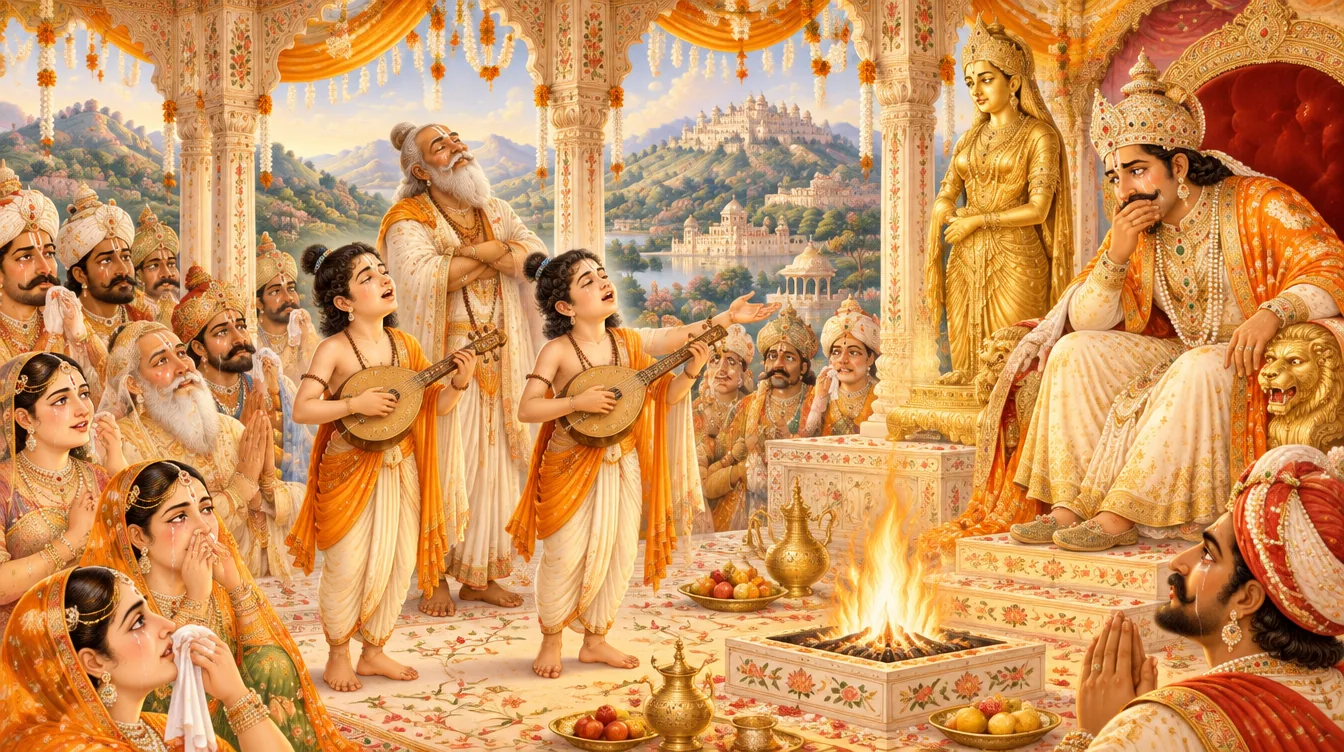
Years later Rama performs a horse sacrifice with a golden image of Sita beside him. Valmiki's pupils, Lava and Kusha, sing the Ramayana in the assembly, and Rama recognises his sons.
Valmiki brings Sita to the court and vouches for her. Rama asks her to swear her purity before everyone. Sita calls on the Earth, her mother, to receive her if she has been true. The ground opens, a throne rises, and the Earth takes her.
Time itself comes to Rama as an ascetic and asks for a private meeting: anyone who interrupts must be banished. Lakshmana guards the door. The short-tempered sage Durvasa arrives and threatens to curse the kingdom unless he is let in. Lakshmana enters to save the kingdom, and Rama must let him go. Lakshmana walks to the Sarayu and leaves his body.
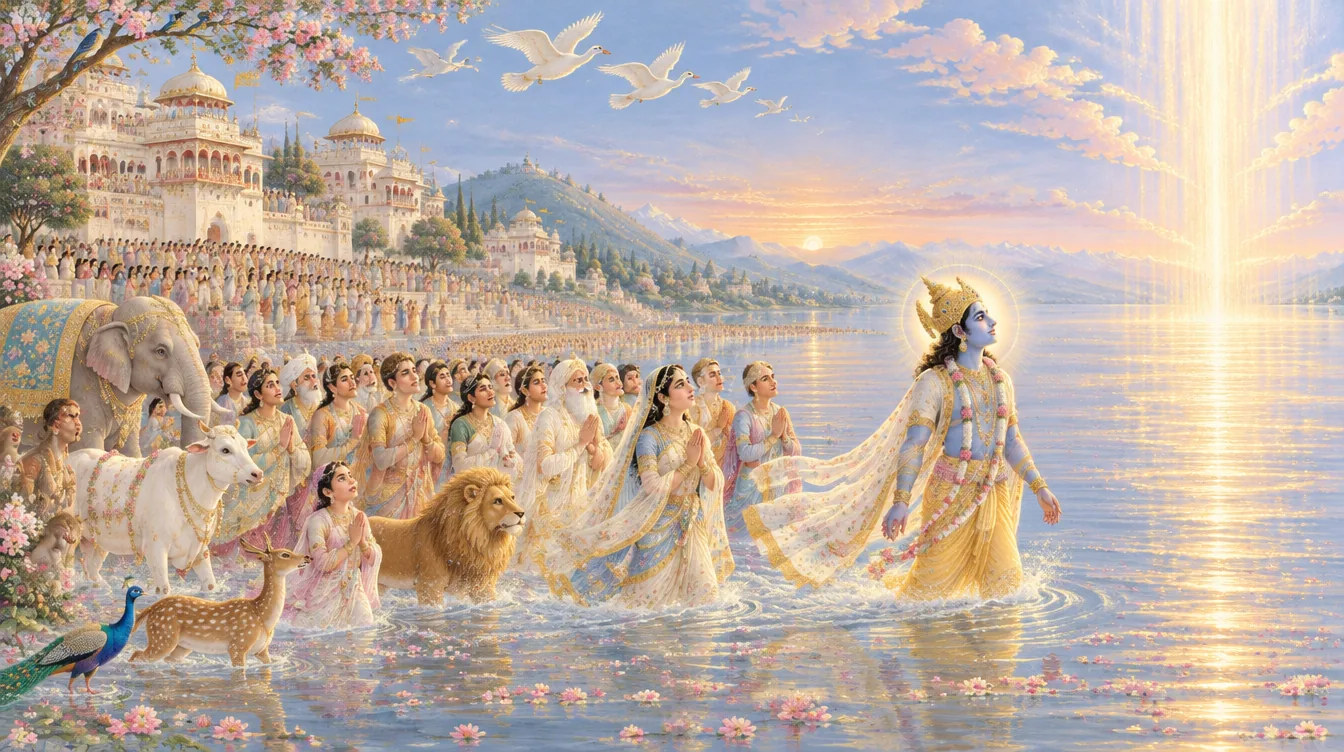
Rama divides the kingdom between his sons and nephews and walks into the Sarayu, followed by his people, and returns to his form as Vishnu.
Search by name or role. Choose “Find in the story” to jump to the first episode where they appear.
Vishnu born as a man; the epic's model of duty and its costs.
Daughter of the Earth, wife of Rama, unbending in captivity.
Shares the exile and guards Rama and Sita.
Refuses the throne and rules as regent with Rama's sandals.
Defeats the demon Lavana.
Stays in Ayodhya through the fourteen years.
Bound by two old boons; dies of grief.
Chief queen.
Claims her boons and sends Rama into exile.
The quiet third queen.
Persuades Kaikeyi to act.
Sita's father and a philosopher king.
Composes the Ramayana and shelters Sita.
Tells Valmiki Rama's story in brief.
Guides the house of Ayodhya.
Trains Rama and leads him to Sita.
Released from a curse by Rama.
Yields to Rama after the breaking of Shiva's bow.
Ferries the exiles across the Ganga.
Directs the exiles to Chitrakuta.
Gives Rama weapons and the Aditya Hridaya.
Dies trying to save Sita.
Waits years to welcome Rama.
Finds Sita; the epic's great devotee.
Rama's ally once Vali is gone.
Killed by Rama from behind a tree.
Wise counsellor in Kishkindha.
Leads the southern search party; envoy to Ravana.
Reminds Hanuman of his strength.
Sees Sita across the sea.
Builds the bridge to Lanka.
Ten-headed, learned and proud; abducts Sita.
Mourns him at the end of the war.
Takes refuge with Rama; crowned king of Lanka.
The giant who sleeps for months and fights out of loyalty.
Invisible fighter who twice fells Rama's army.
Her humiliation sets the war in motion.
Becomes the golden deer.
Dreams of Ravana's fall and comforts Sita.
Twin who sings the Ramayana.
Twin who sings the Ramayana; later restores Ayodhya.
What the story keeps returning to.
The epic keeps putting duty in conflict with love and fairness: Dasharatha's promise, Vali's death, Sita's ordeal and exile. It shows the cost, and readers still argue.
Bharata, Lakshmana, Hanuman, Shabari and Jatayu each show a different kind of love for Rama. In later traditions this becomes the heart of the story.
Rama and his brothers, Vali and Sugriva, Ravana with Kumbhakarna and Vibhishana: three families, three ways of being a brother.
Ayodhya is the story's centre and its absence. The forest years are where the characters are tested and changed.
A prince, a boatman, an old vulture, a forest woman, monkeys and bears, a defector from Lanka: Rama's allies come from everywhere.
Kamban's Tamil Ramavataram, Tulsidas's Ramcharitmanas, the Bengali Krittivasi, the Thai Ramakien and the Javanese Kakawin tell it differently. Valmiki is the oldest surviving version, not the only one.
The work behind this retelling, and where to read it for yourself.
Tradition calls Valmiki the adi kavi, the first poet, and the Ramayana the adi kavya, the first poem. He appears inside his own story, sheltering Sita and teaching her sons.
About 24,000 verses in seven books (kandas), mostly in the shloka metre that the poem itself says was born at the river Tamasa.
Scholars generally see the core in Books 2 to 6 and treat much of Books 1 and 7 as later additions. Estimates for its composition range across several centuries before and after the turn of the era.
Manuscripts differ by region. The critical edition prepared at the Oriental Institute, Vadodara, compares them to reconstruct the oldest common text. Episodes here follow the commonly read version.
This storyline follows the order of Valmiki's seven books and keeps to his events. Wording is our own. Where a famous detail comes from a later retelling rather than Valmiki, the episode says so. Illustrations are artist's impressions in the manner of Pahari miniature painting, not historical records.