Before a bound book
Imagine hearing a hymn before seeing a page. The text addresses deities through patterned speech, praise, invitation, and petition. Its sound and setting belong to its meaning.

Begin beside the fire. Meet the poets, powers, questions, and oral traditions of the Rigveda—one hymn, one theme, one layer at a time.
A traditional account of authority, a historical inquiry, and a living interpretation answer different questions. Keep all three visible.
Follow four connected moments. These are interpretive steps through the subject, not a claim that its history occurred in four simple stages.
Imagine hearing a hymn before seeing a page. The text addresses deities through patterned speech, praise, invitation, and petition. Its sound and setting belong to its meaning.
The collection associates hymns with seers and lineages. Books 2–7 are conventionally called family books. These attributions organize memory; they should not be turned into simple modern biographies.
Ten maṇḍalas preserve different concentrations of material. Book 9 centers on Soma Pavamāna; other books gather varied deities, situations, and poetic voices.
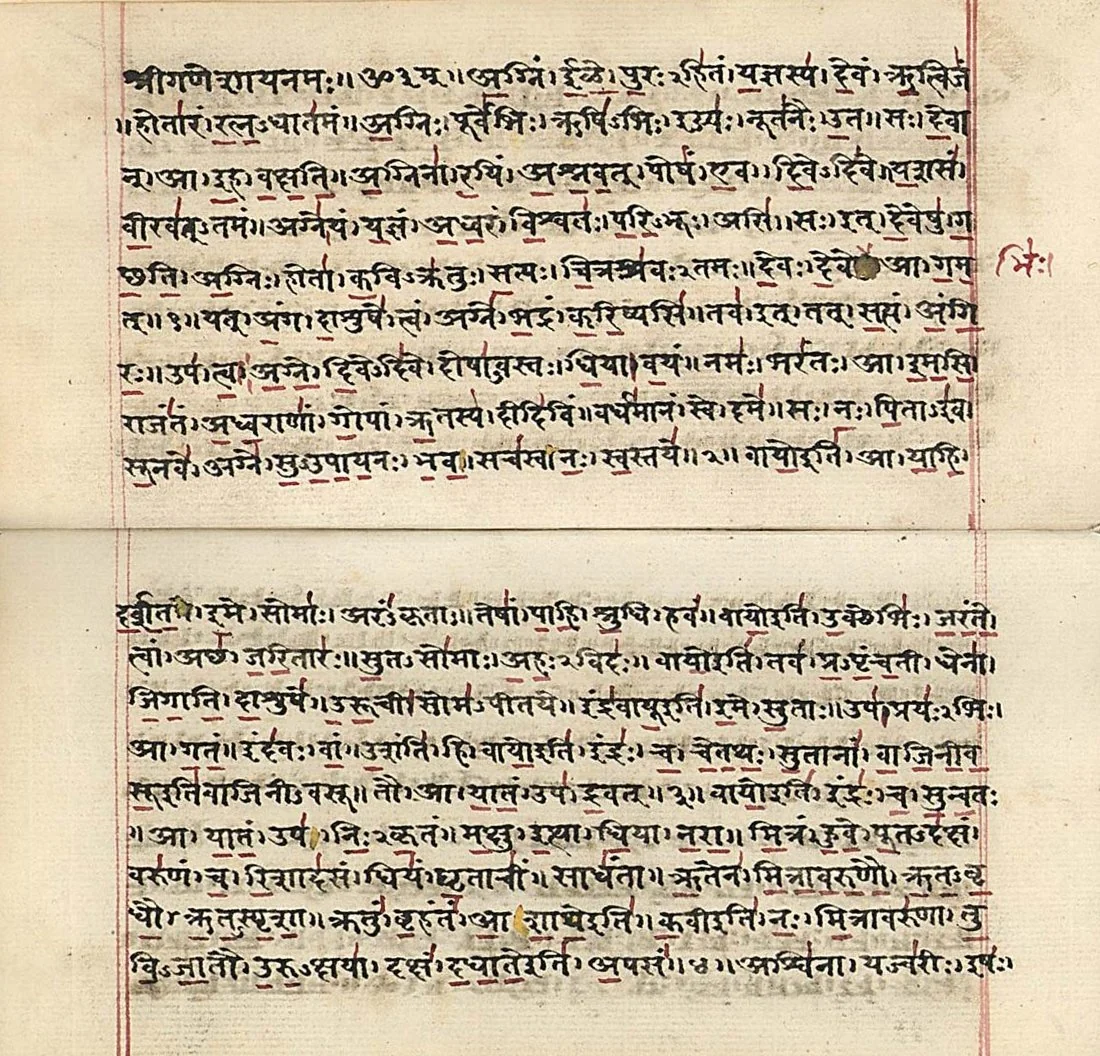
Manuscripts and printed editions are later material forms of a much older oral text. Modern readers meet both the continuity of transmission and the interpretive choices of editors and translators.
Search the divisions and topics, then choose one to learn its place in the whole. Summaries are guide notes, not translations of every chapter.
A thematic route brings passages into conversation. It does not replace the text’s own arrangement or reduce its diversity to one message.
Choose a lens to uncover a different layer of the same subject.
Read one identified passage with Sanskrit, transliteration, word notes, and translations. The edition and the boundaries of an excerpt remain visible.
Switch between Devanagari and IAST, explore selected terms, and compare an educational rendering in seven modern languages.
English is an original AI-assisted educational rendering, not a quoted published translation. Other languages render that English; none has specialist review.
Read and explore the passage ↗I praise Agni, placed in front, the divine priest of sacrifice, the invoking priest, foremost bestower of treasures.
Complete selected verse, shown without Vedic accent marks. The source edition and oral instruction preserve information this simplified display omits.
Continue in order, or follow a connection. The four Vedas, the Gita, and the three Dharmaśāstra works belong to related but different textual worlds.
This initial Smriti selection contains Manu, Yajnavalkya, and Narada. It does not claim to exhaust the broad and varying category of Smriti.