A disagreement becomes visible
Two people do not agree about an obligation, transaction, or boundary. The text’s interest is not merely in saying that harmony is good; it develops categories for disputes.

Follow a different Dharmaśāstra journey: from conflict and pleadings to writing, witnesses, economic relationships, and the question of adjudication.
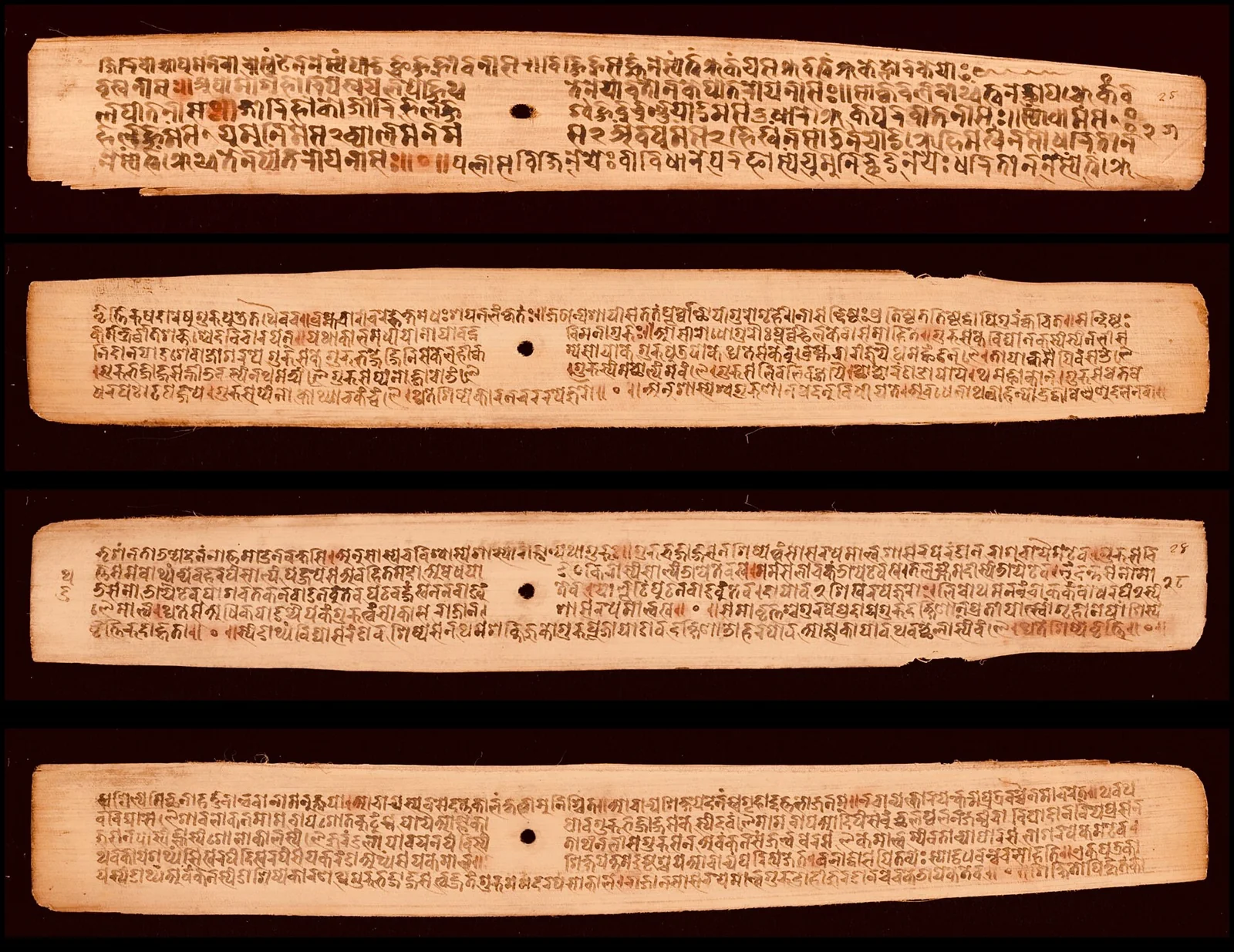
A traditional account of authority, a historical inquiry, and a living interpretation answer different questions. Keep all three visible.
Follow four connected moments. These are interpretive steps through the subject, not a claim that its history occurred in four simple stages.
Two people do not agree about an obligation, transaction, or boundary. The text’s interest is not merely in saying that harmony is good; it develops categories for disputes.
Parties, pleadings, and the court belong to a structured account of adjudication. A teaching pathway can explain this architecture without reconstructing one actual historical trial.
The selected passage names writing and witnesses as means of clarification. Its wording is not a claim that every part of the work recognizes only two forms of proof.
Debt, work, ownership, households, and unequal status surround the procedure. Formal order should not be mistaken for modern equality before the law.
Search the divisions and topics, then choose one to learn its place in the whole. Summaries are guide notes, not translations of every chapter.
A thematic route brings passages into conversation. It does not replace the text’s own arrangement or reduce its diversity to one message.
Choose a lens to uncover a different layer of the same subject.
Read one identified passage with Sanskrit, transliteration, word notes, and translations. The edition and the boundaries of an excerpt remain visible.
Switch between Devanagari and IAST, explore selected terms, and compare an educational rendering in seven modern languages.
English is an original AI-assisted educational rendering, not a quoted published translation. Other languages render that English; none has specialist review.
Read and explore the passage ↗Writing and witnesses are declared here as two methods for clarifying the disputed matter between two litigants.
Complete selected verse, identified as Nar_M1.3 in the linked GRETIL text. Do not infer that every discussion of proof in the work is exhausted by this one statement.
Continue in order, or follow a connection. The four Vedas, the Gita, and the three Dharmaśāstra works belong to related but different textual worlds.
This initial Smriti selection contains Manu, Yajnavalkya, and Narada. It does not claim to exhaust the broad and varying category of Smriti.