01
A terrible vow
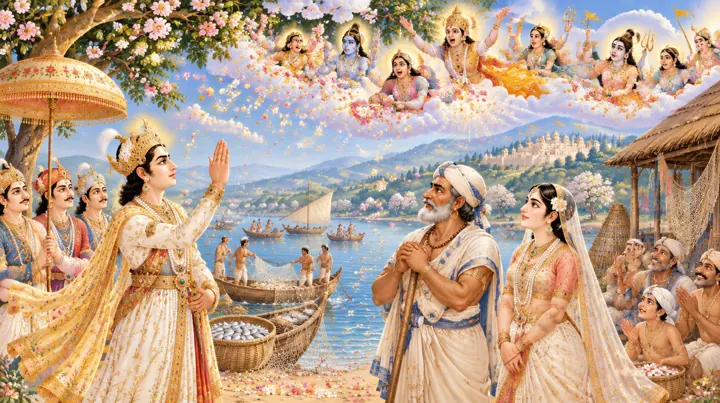
Prince Devavrata gives up the throne and swears lifelong celibacy so his father can marry. The gods name him Bhishma, "the one of the terrible vow", and the succession that follows is never simple again.
Two sets of cousins, one throne. A vow that cannot be broken, a game of dice that cannot be undone, a war that no one truly wins, and a great question running through all of it: what is the right thing to do when every choice costs something?
Five minutes for the shape of the story. Then read the full storyline below, episode by episode.
Prince Devavrata gives up the throne and swears lifelong celibacy so his father can marry. The gods name him Bhishma, "the one of the terrible vow", and the succession that follows is never simple again.
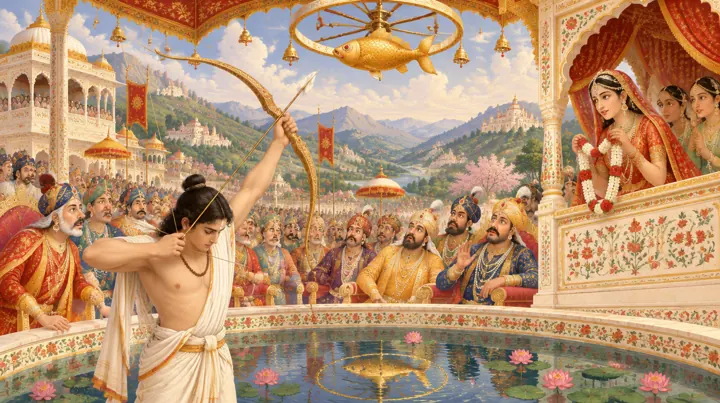
The five Pandava brothers and their hundred Kaurava cousins grow up as rivals. Arjuna wins Princess Draupadi, who becomes the wife of all five brothers.
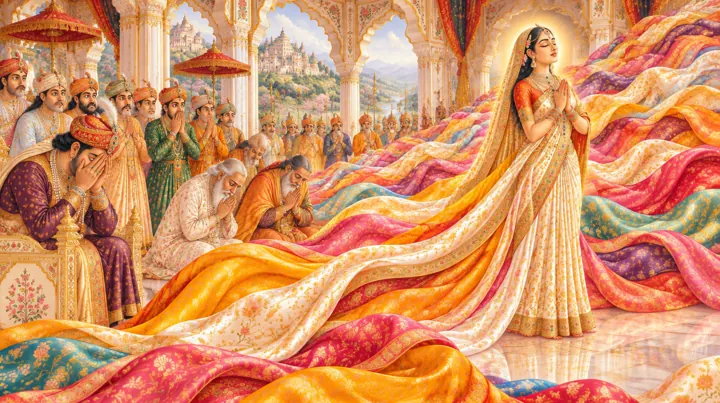
Yudhishthira gambles away his kingdom, his brothers, himself and Draupadi. She is dragged into the assembly and asks a question no one can answer.
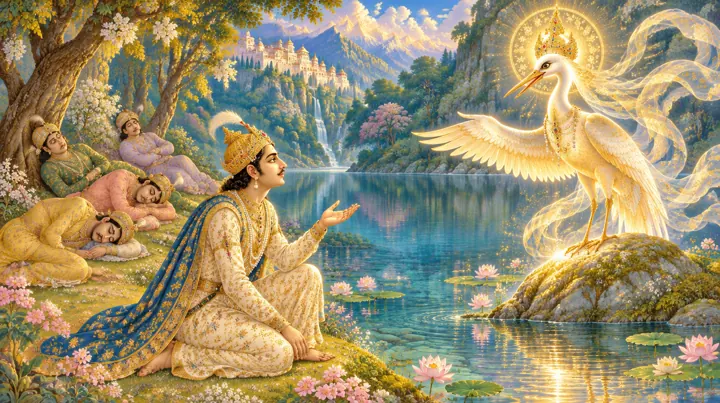
Twelve years in the forest and a thirteenth in disguise. The brothers win divine weapons, hear old stories and are tested at a lake by a voice that asks what matters most.
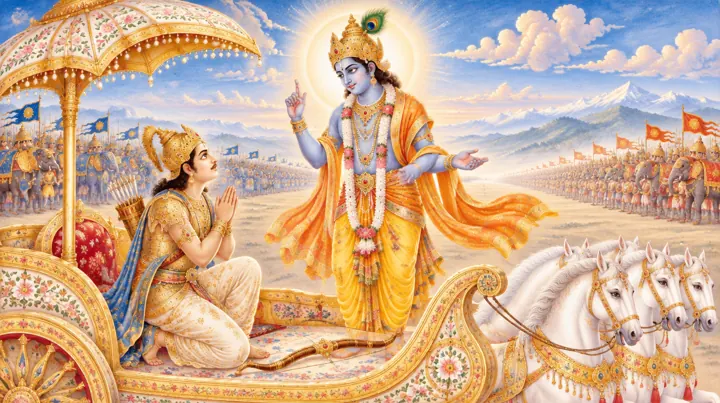
Between two armies Arjuna lowers his bow. His charioteer Krishna answers him with the Bhagavad Gita.
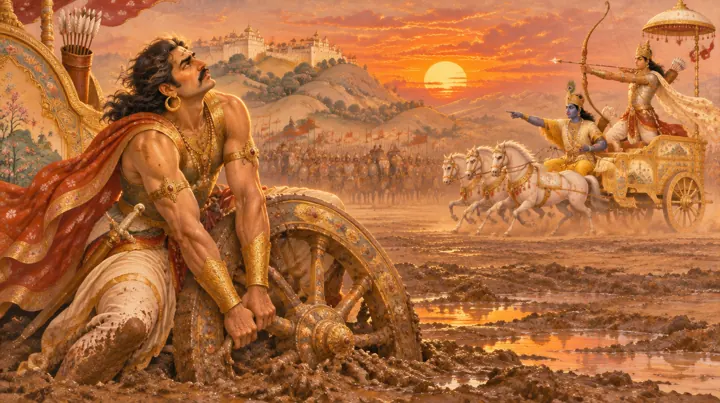
Bhishma, Drona and Karna fall, each by a stratagem. The Pandavas win and almost everyone they love is dead.
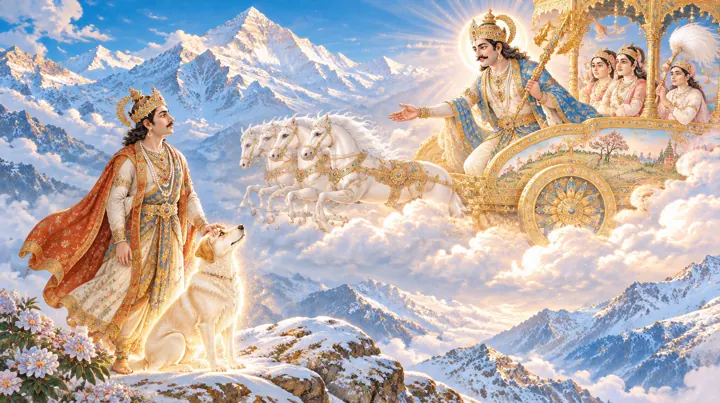
Years later the Pandavas walk toward the Himalaya. One by one they fall, until only Yudhishthira and a faithful dog remain at the gates of heaven.
The family at the centre of the epic, from Shantanu to Parikshit. Choose a name to jump to their episode.
King of Hastinapura in the line of Kuru.
Episode 2 →2Son of Shantanu and Ganga. Sworn never to marry or rule; guardian of three generations.
Episode 2 →3Satyavati's son by the sage Parashara. Father of Dhritarashtra, Pandu and Vidura, and the poet of the epic.
Episode 3 →4Born blind. Father of the hundred Kauravas, led by Duryodhana and Duhshasana.
Episode 3 →5Cursed by a sage. His five sons are born through divine fathers.
Episode 4 →6Kunti's first son, by the sun god, raised by the charioteer Adhiratha and Radha.
Episode 4 →7Yudhishthira, Bhima and Arjuna, sons of Kunti; Nakula and Sahadeva, sons of Madri.
Episode 7 →8Cousin of the Pandavas, son of Kunti's brother Vasudeva, prince of the Yadavas of Dvaraka.
Episode 7 →9Son of Arjuna and Krishna's sister Subhadra.
Episode 22 →10Abhimanyu's son, saved in the womb. His son Janamejaya hears the whole epic.
Episode 29 →The spine of the battle, day by day. Choose a day to see what happened, then jump to the episode.
Choose a stop on the road.
Day numbers follow the commonly read text. The epic describes each day in great detail; these stops are only the spine of the war.
On dharma, wealth, desire and liberation, best of the Bharatas: what is here may be found elsewhere, but what is not here is found nowhere.
Your right is to the action alone, never to its fruits. Do not let the fruit be your motive, and do not cling to doing nothing.
English renderings are our own plain-language versions for readers, not quoted published translations.
How the story came to be told, and how one family divided into two.
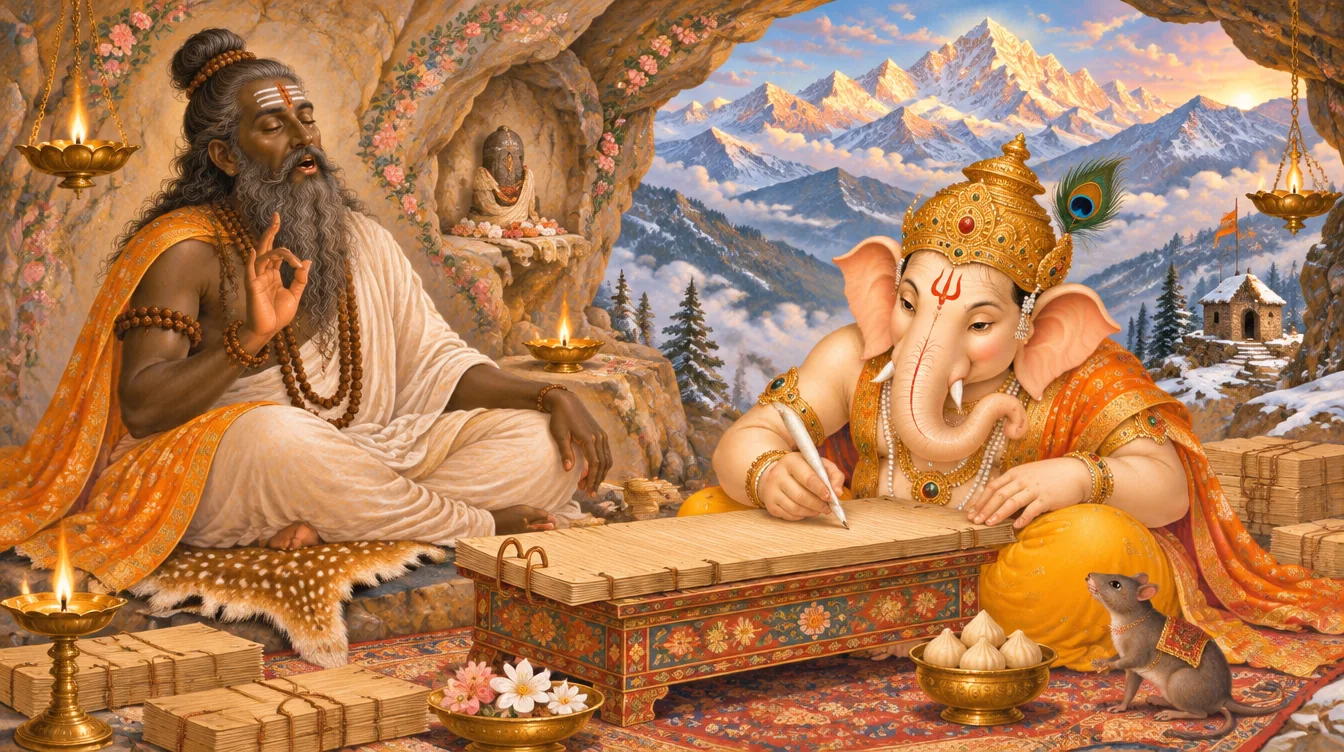
The epic opens in a forest of sages, where the bard Ugrashravas arrives and offers to tell a story he heard at King Janamejaya's great snake sacrifice. There Vaishampayana, a pupil of the sage Vyasa, recited the whole tale of Janamejaya's ancestors. So we hear a teller repeating a teller, who learned it from its author.
A famous tradition adds that Vyasa dictated the poem to Ganesha, who agreed to write only if Vyasa never paused, and Vyasa agreed only if Ganesha understood every verse before writing it. The episode is much loved but is absent from the critical edition.
The poem announces its own ambition: whatever is here about dharma, wealth, desire and liberation may be found elsewhere, but what is not here is found nowhere.
King Shantanu marries the river goddess Ganga on condition that he never questions her. She drowns seven newborn sons, celestial beings cursed to be born as men, releasing them at once. When he stops her at the eighth, she leaves, and the boy, Devavrata, is raised to be a peerless prince.
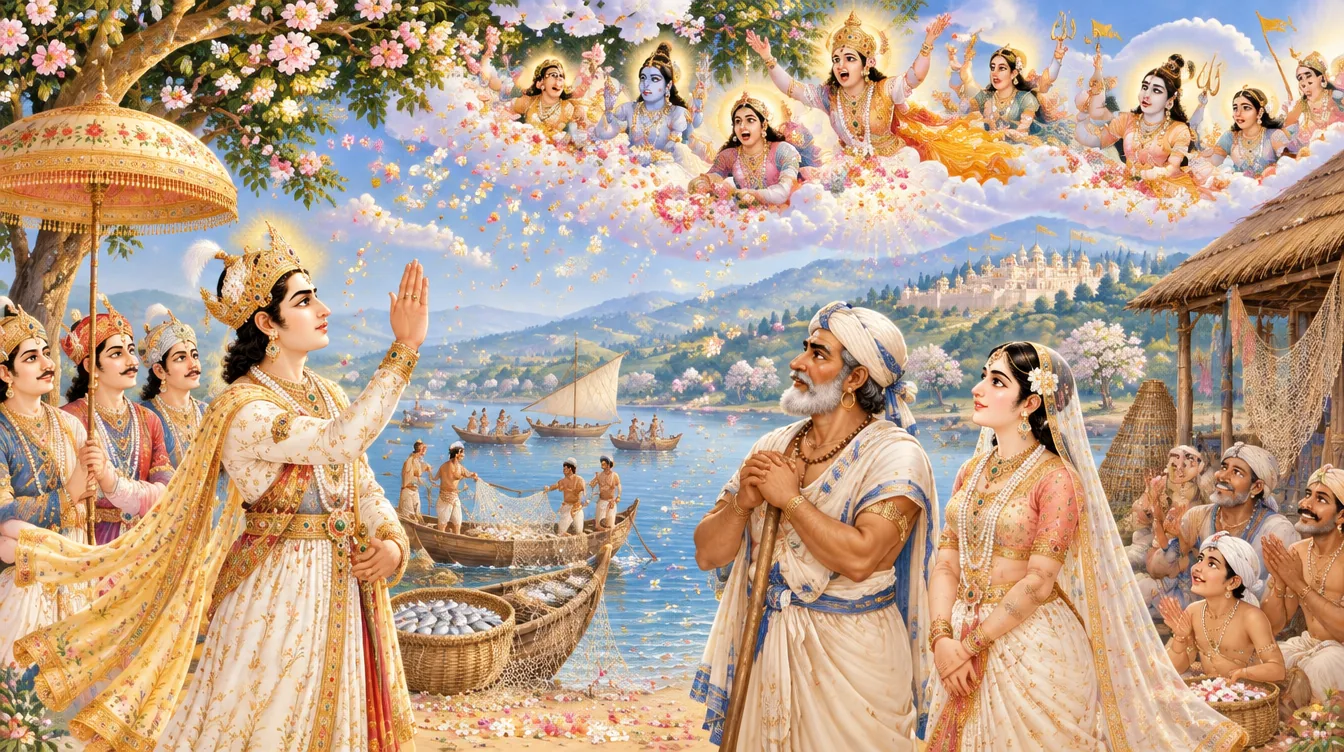
Years later Shantanu falls in love with Satyavati, a fisherman's daughter. Her father demands that her sons inherit. Devavrata renounces the throne, and when the father worries about Devavrata's future children, he vows never to marry. The gods shower flowers and call him Bhishma. His father grants him the power to choose the hour of his death.
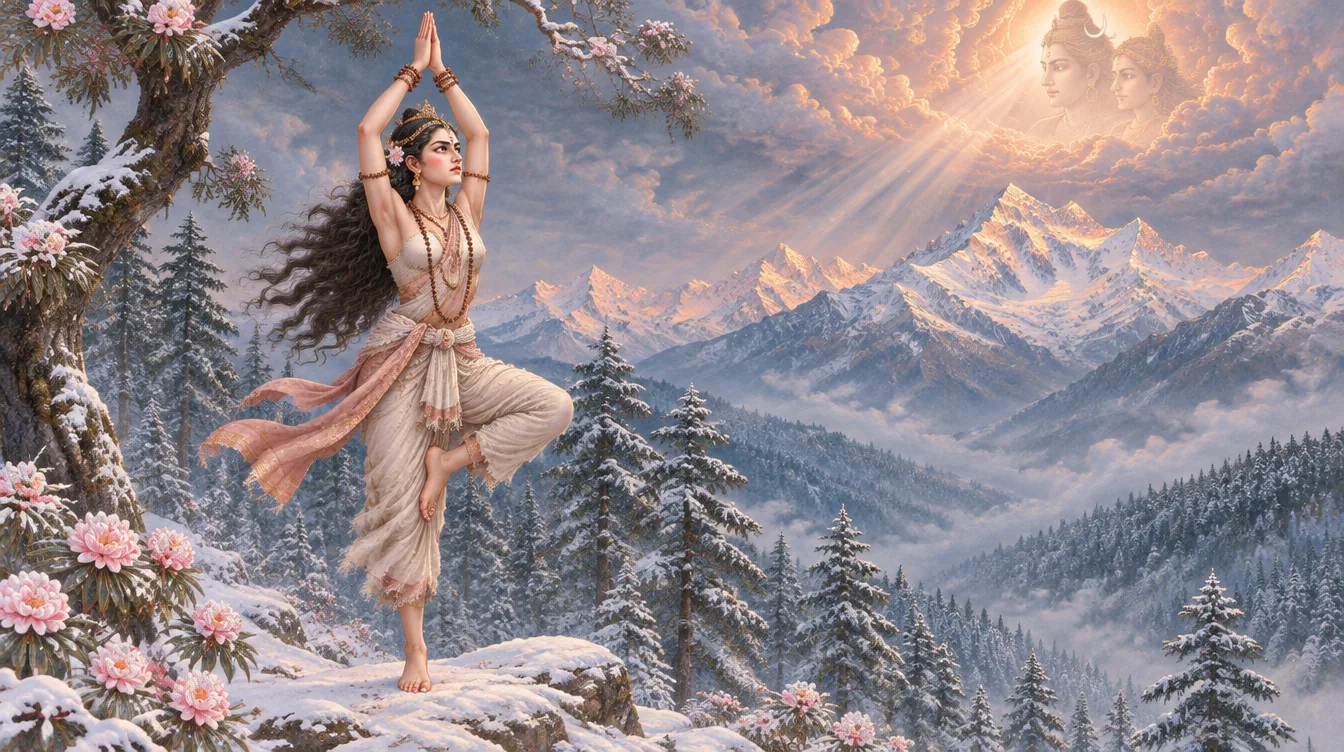
Satyavati's son Vichitravirya needs wives, so Bhishma carries off three princesses of Kashi. The eldest, Amba, loves King Shalva, who now rejects her. Bhishma, bound by his vow, will not marry her either. Amba turns to austerity and wins a boon from Shiva: she will be the cause of Bhishma's death. She is reborn as Shikhandi.
Vichitravirya dies childless. Satyavati calls on her elder son, the sage Vyasa, to father heirs. Ambika shuts her eyes and bears the blind Dhritarashtra. Ambalika turns pale and bears Pandu. A maidservant bears the wise Vidura.
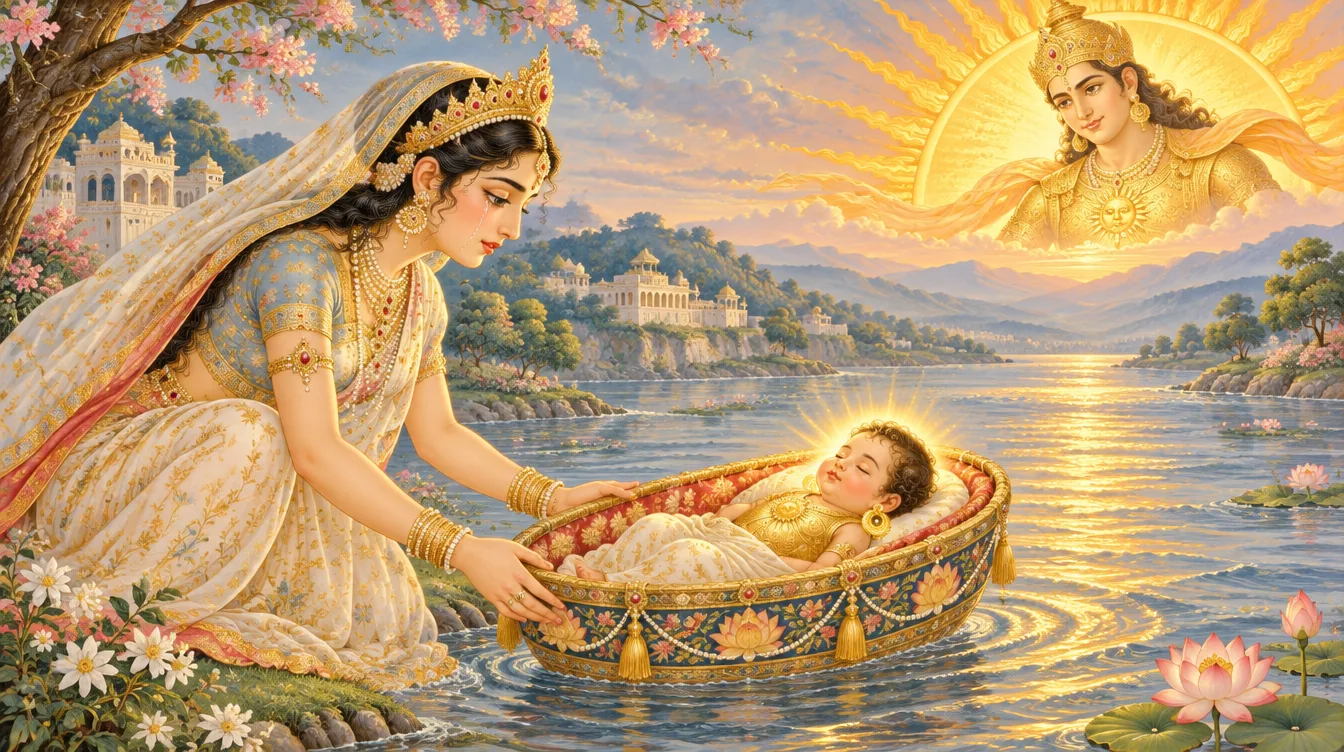
As a girl, Princess Kunti receives from the sage Durvasa a mantra to summon any god. Testing it, she calls the sun and bears a son born with golden armour and earrings. Afraid, she sets him afloat on the river. A charioteer, Adhiratha, and his wife Radha raise him as Karna.
Kunti marries Pandu, who also marries Madri. Pandu kills a sage who has taken the form of a deer and is cursed to die if he lies with a wife. Kunti uses her mantra: Dharma gives her Yudhishthira, the wind god Bhima and Indra Arjuna. She shares it with Madri, who bears the twins Nakula and Sahadeva by the Ashvins.
Gandhari, married to the blind Dhritarashtra, binds her own eyes for life. She bears a hundred sons, led by Duryodhana. When Pandu dies, Madri follows him, and Kunti brings the five boys to Hastinapura.
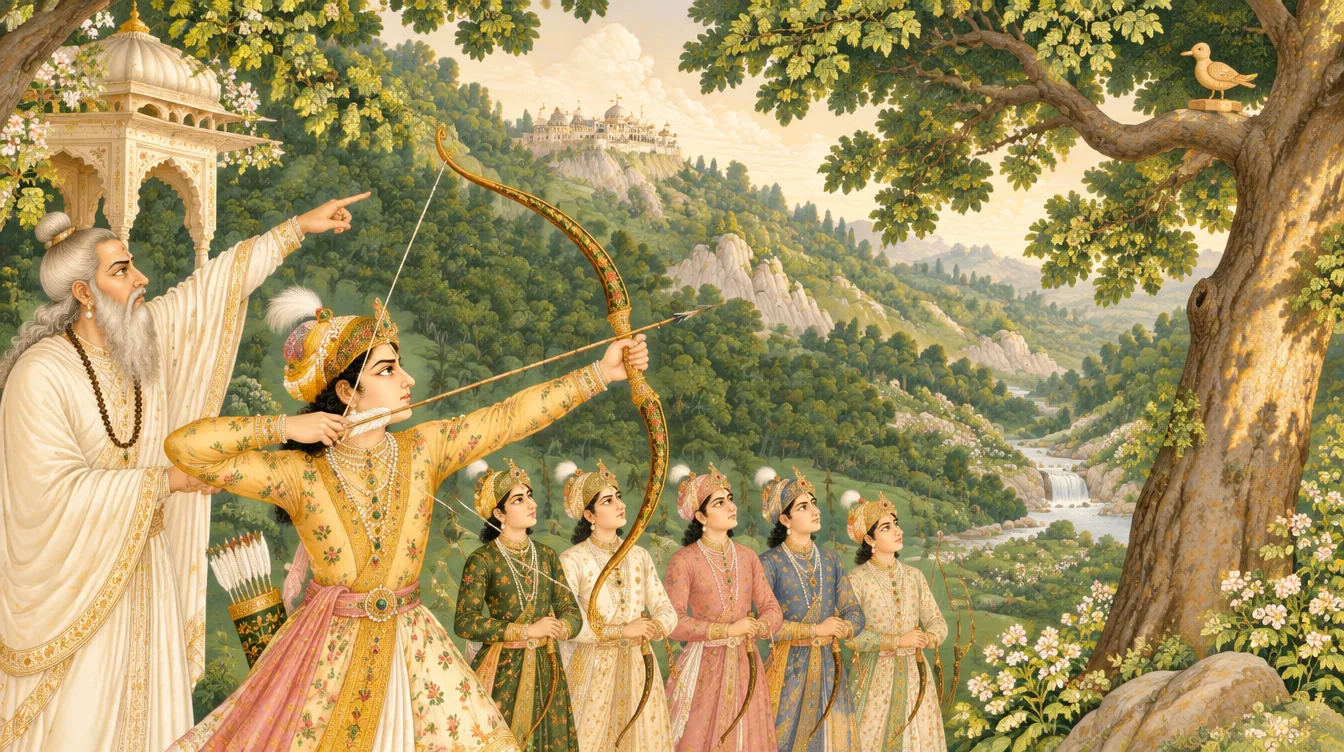
The cousins learn arms from Drona. Asked what he sees as he aims at a wooden bird, each pupil describes the tree, the sky, his brothers. Arjuna sees only the bird's eye. The forest prince Ekalavya, turned away, teaches himself before a clay image of Drona, and pays for it with his thumb.
At the graduation tournament Karna walks in and matches Arjuna feat for feat. Mocked as a charioteer's son, he is made king of Anga on the spot by Duryodhana, and the two become friends for life.
As his fee Drona asks his pupils to capture King Drupada, who once scorned him. Arjuna does. Humiliated, Drupada performs a sacrifice from which rise a son, Dhrishtadyumna, born to kill Drona, and a daughter, Draupadi.
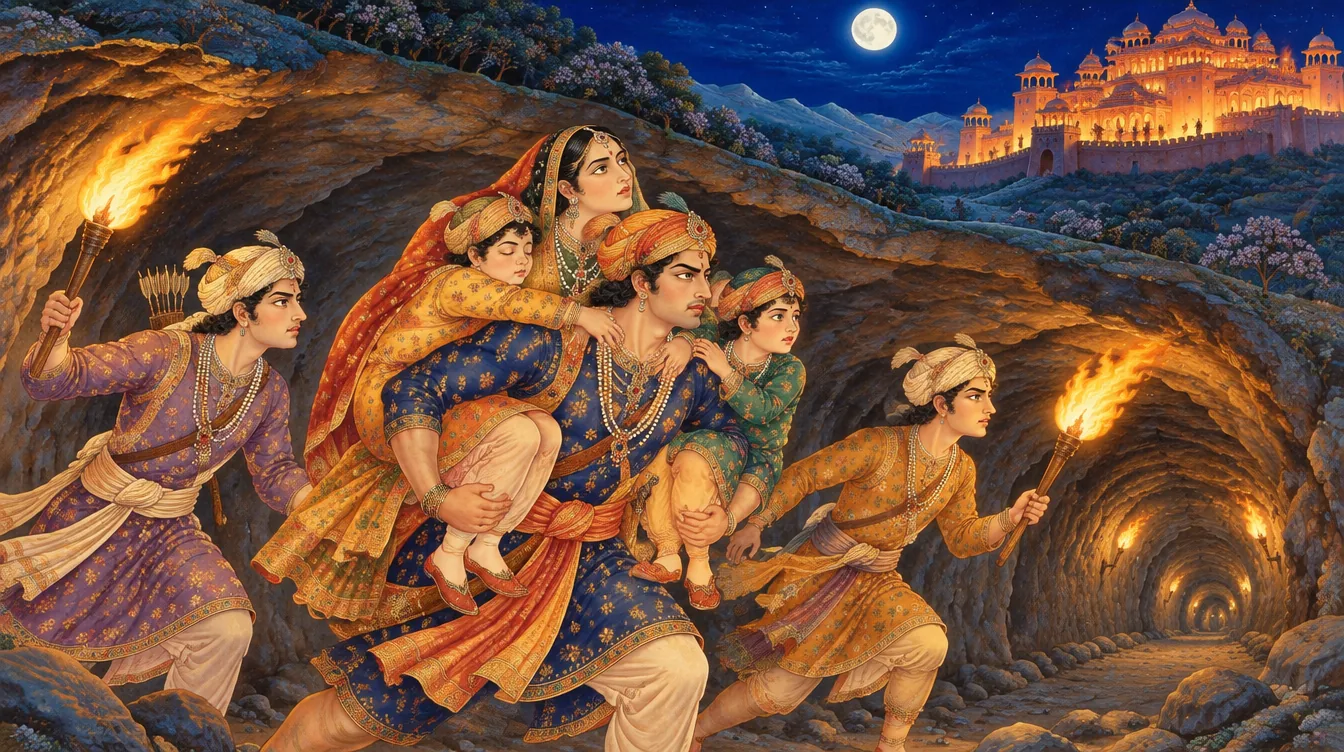
Duryodhana sends the Pandavas and Kunti to Varanavata, to a mansion built of lac and other flammable materials, planning to burn them inside. Vidura warns Yudhishthira in a riddle and sends a miner who digs an escape tunnel.
The house is fired, the Pandavas slip away, and Hastinapura believes them dead. In the forest Bhima kills the demon Hidimba and marries his sister Hidimbi, who bears Ghatotkacha. In the town of Ekachakra Bhima frees the people from the demon Baka.
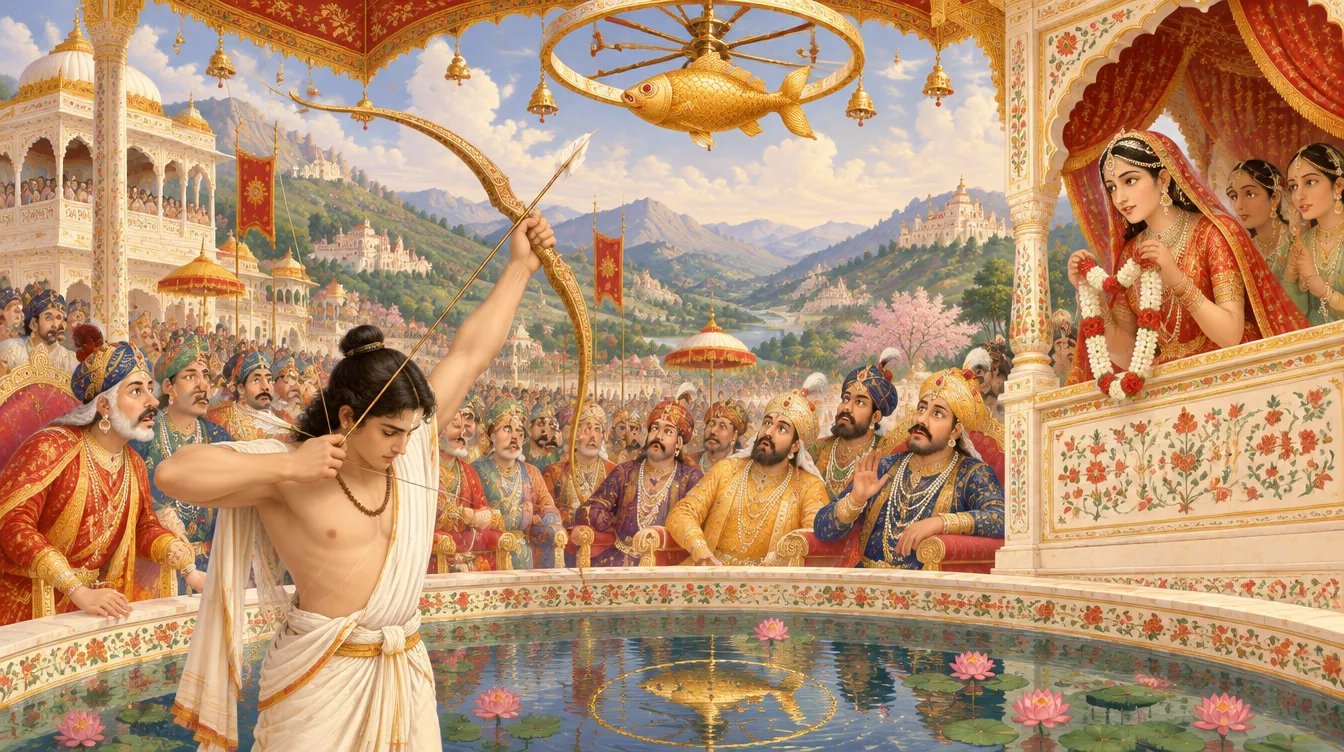
Drupada sets an almost impossible test: string a colossal bow and hit a target through a revolving device. In popular retellings it is a fish whose eye must be struck by watching its reflection. Kings fail. Arjuna, disguised as a brahmin, succeeds.
Popular versions add that Draupadi refused Karna as a charioteer's son, a scene the critical edition does not include. Home with their prize, the brothers call out to Kunti, who without looking tells them to share it equally. Draupadi becomes the wife of all five, and their cousin Krishna enters the story.
The elders divide the kingdom. The Pandavas receive the wild Khandava region, clear it with Krishna's help, and build Indraprastha. Arjuna gains the bow Gandiva and later marries Krishna's sister Subhadra.
A new palace, a royal sacrifice and a game that loses everything.
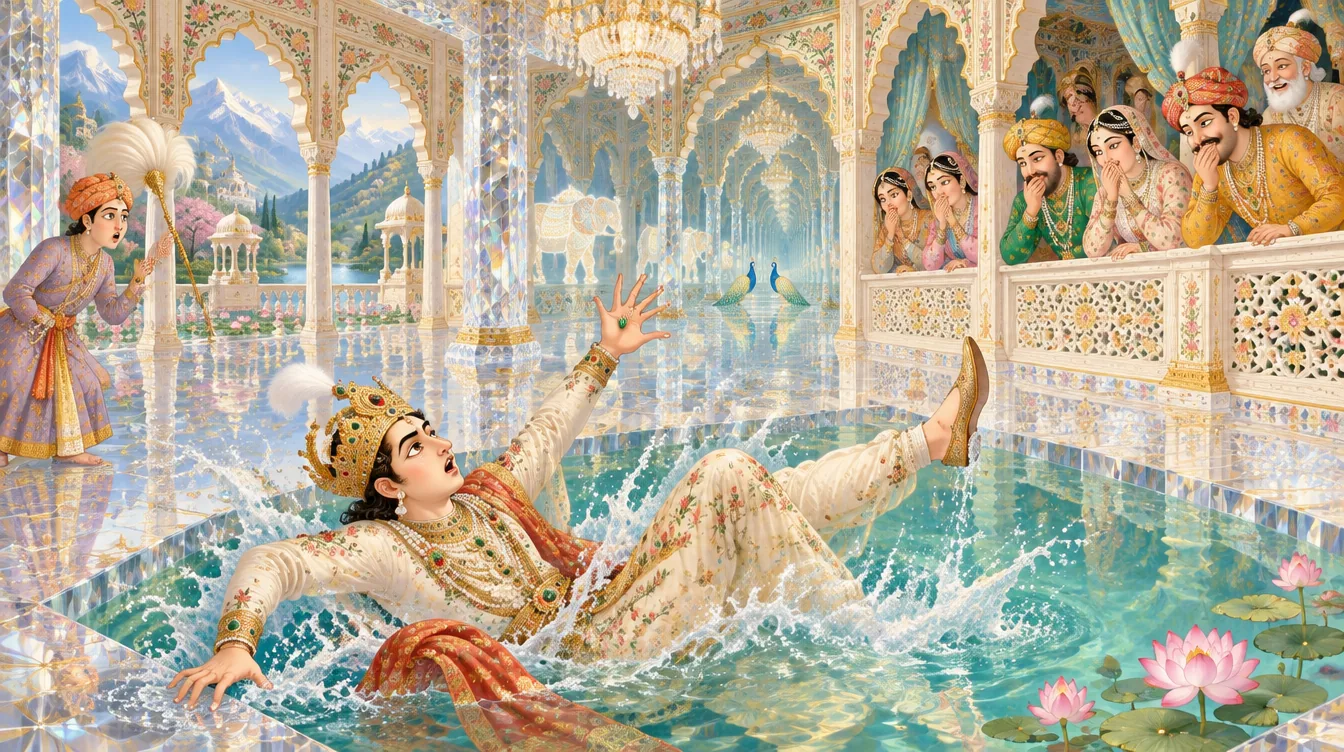
The demon architect Maya, spared in the Khandava fire, builds the Pandavas an assembly hall full of illusions. Yudhishthira performs the royal consecration sacrifice. When Krishna is honoured first, King Shishupala insults him a hundred times and Krishna kills him with his discus.
Duryodhana wanders the hall, mistakes a pool for a floor and falls in, then mistakes a floor for a pool. Bhima and the servants laugh. The famous line in which Draupadi mocks him as a blind man's son is a later addition. Duryodhana goes home burning with envy.
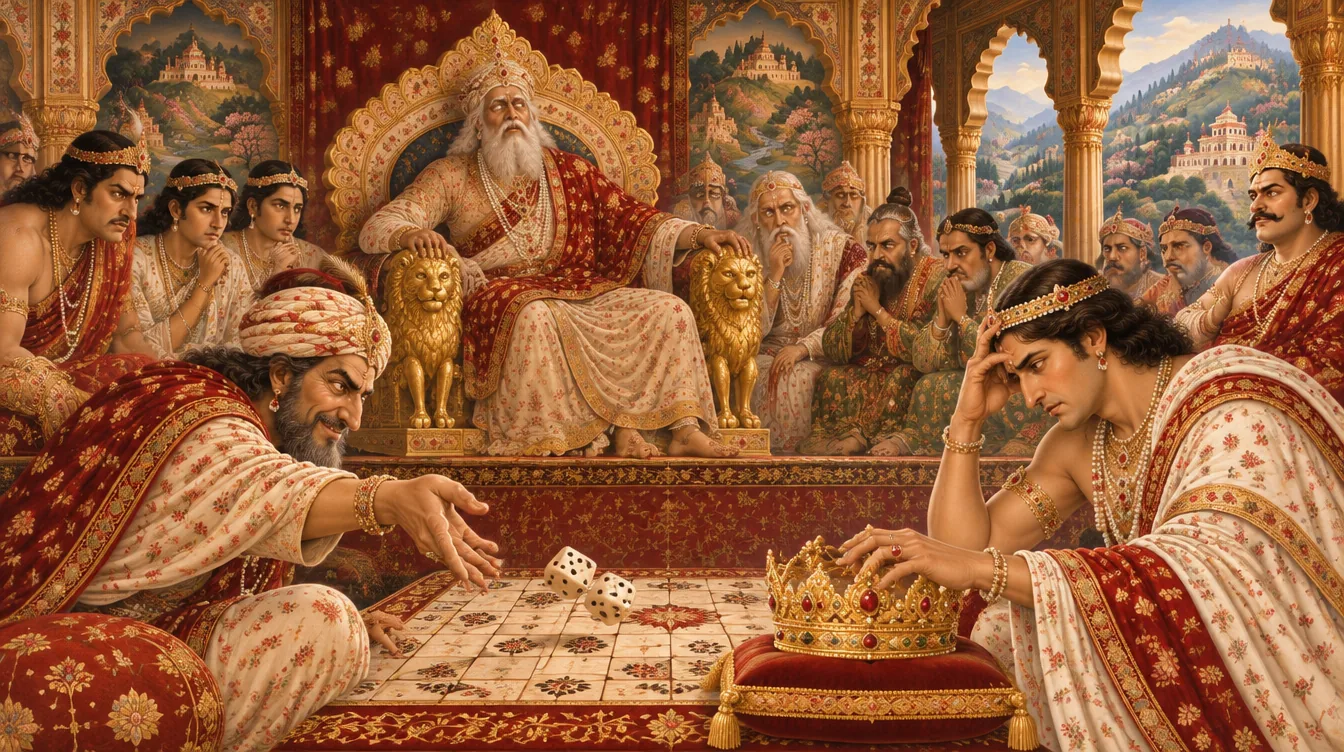
Duryodhana's uncle Shakuni, a master of dice, proposes a game. Dhritarashtra allows it, and Yudhishthira, who holds it a duty to accept a challenge, sits down to play.
He loses his wealth, his kingdom, his brothers one by one, and himself. Then Shakuni suggests one more stake, and Yudhishthira wagers Draupadi.
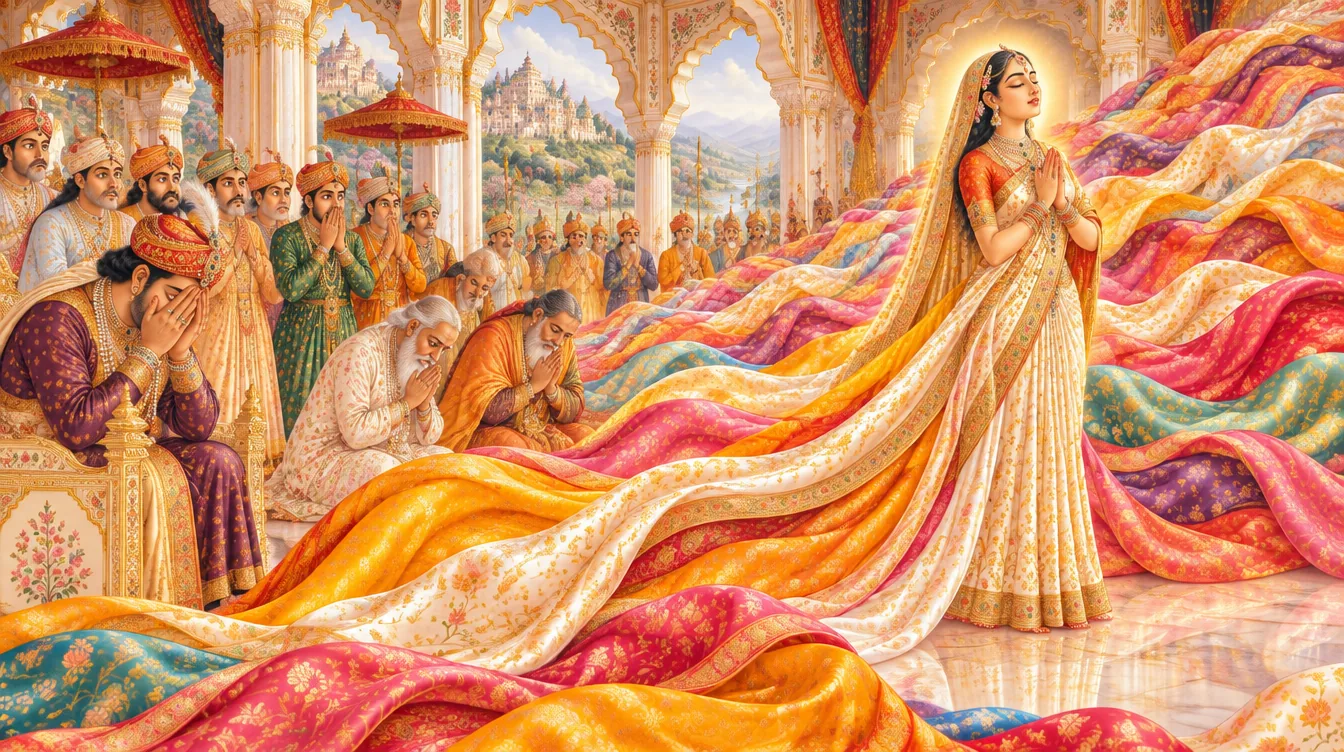
Duhshasana drags Draupadi into the hall by her hair. She asks the assembly a question of law: had Yudhishthira already lost himself when he staked her, and if so, how could he wager her at all? The elders fall silent. Only the young Kaurava Vikarna says she was not lawfully won.
Karna calls her a woman with five husbands and orders her stripped. In most tellings she prays to Krishna, and her garment is endlessly renewed until Duhshasana collapses in exhaustion. Bhima vows to break Duryodhana's thigh and to drink Duhshasana's blood.
Frightened by omens, Dhritarashtra grants Draupadi boons, and she frees her husbands. But they are called back to one more game, and lose: twelve years in the forest and a thirteenth in disguise.
Thirteen years away. The longest stretch of the epic, full of stories inside the story.
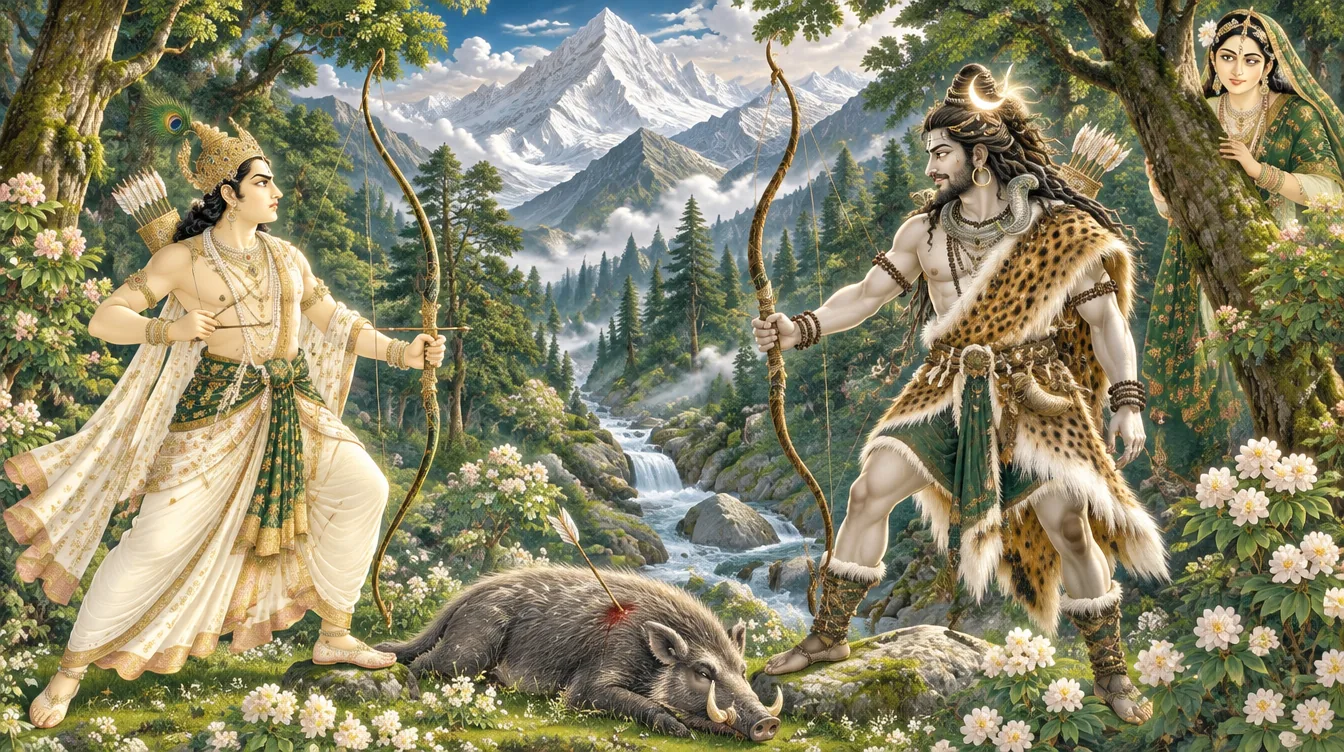
In the forest the sun god gives Yudhishthira a vessel that feeds everyone who comes to them each day. Arjuna goes to the Himalaya to win divine weapons. A wild hunter disputes a boar they both shot, and the two fight until Arjuna is beaten. The hunter is Shiva, who gives him the Pashupata weapon.
Arjuna visits Indra's heaven and learns music and dance. When he refuses the advances of the apsara Urvashi, whom he regards as an ancestress, she curses him to live a year as a eunuch. Indra makes the curse a gift: it will serve as his disguise.
Sages visit and tell stories to console the exiles, and many became classics in their own right. Nala and Damayanti: a king who gambles away his kingdom and the wife who finds him again. The story of Rama, told in brief.
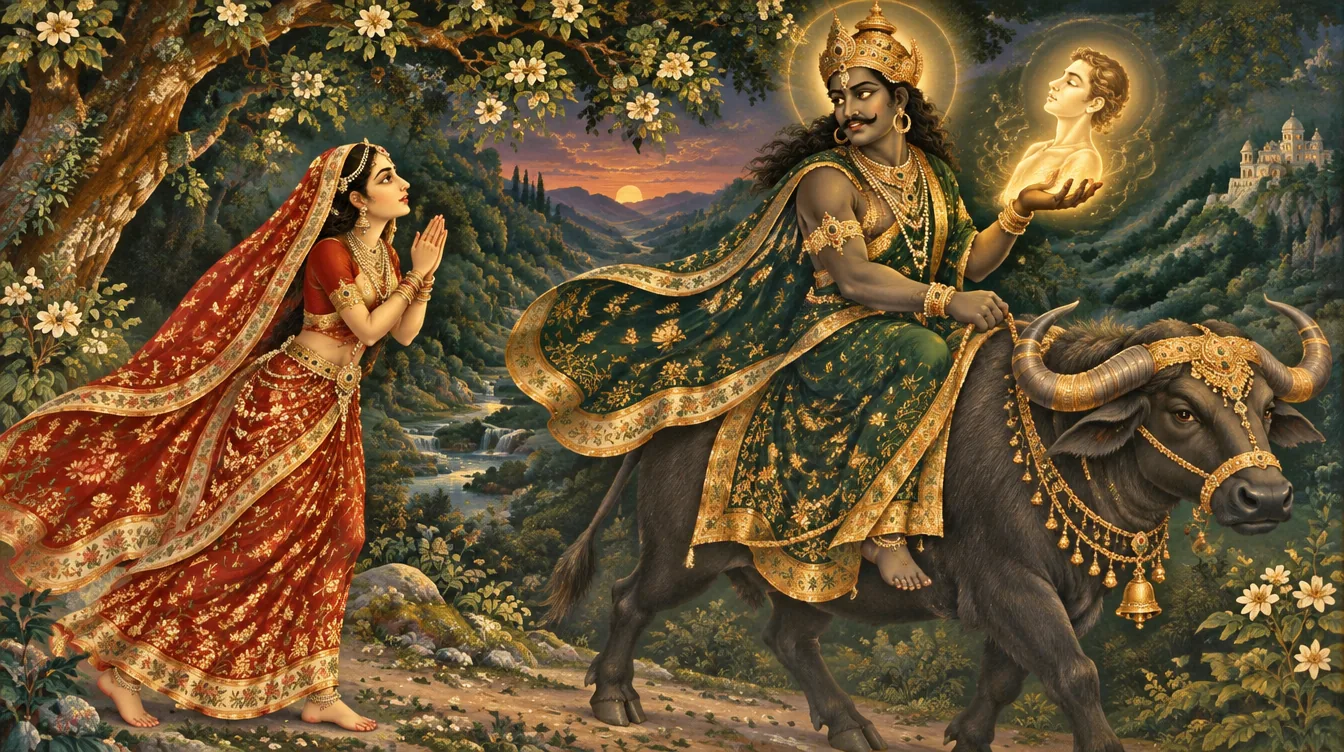
Savitri chooses a husband, Satyavan, who is fated to die within a year. When Yama, god of death, comes for him, she follows, and argues so well that Yama grants her boon after boon until he must return Satyavan's life.
On a search for a fragrant flower, Bhima finds an old monkey whose tail he cannot move. It is his half-brother Hanuman, who shows him the form in which he leapt to Lanka.
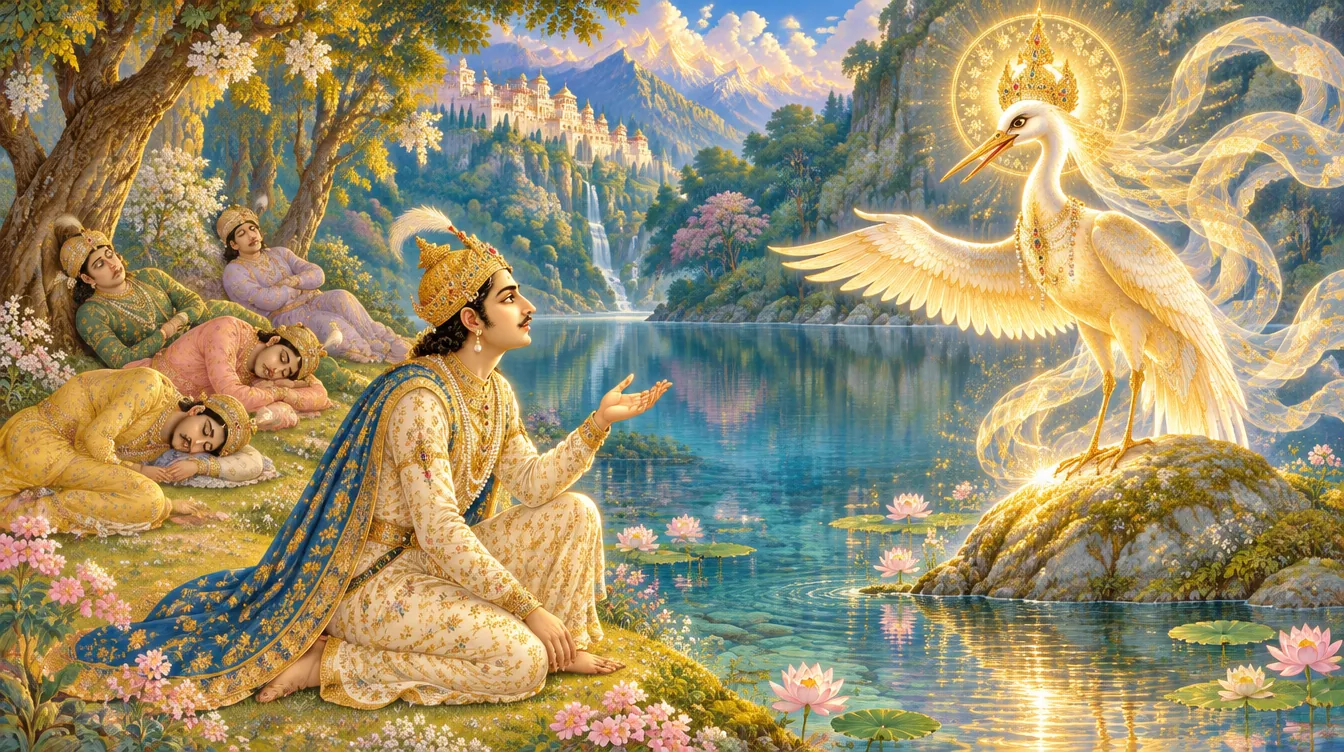
Searching for water, four brothers drink from a lake despite a voice forbidding it, and fall dead. Yudhishthira agrees to answer the voice's questions first. What is heavier than the earth? A mother. What is the greatest wonder? That every day people die, and the living act as if they never will.
Satisfied, the spirit offers to revive one brother. Yudhishthira chooses Nakula, so that Madri too has a living son. The spirit reveals himself as Dharma, Yudhishthira's father, and restores them all.
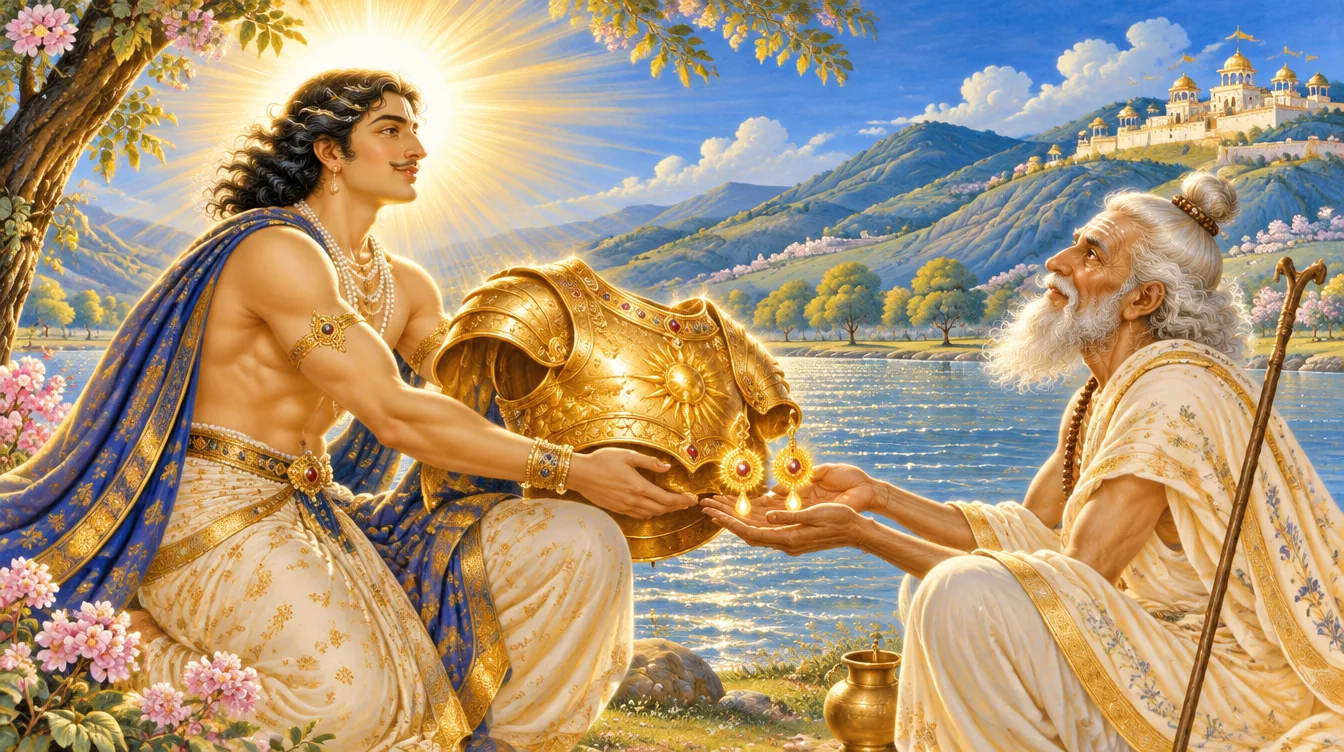
Karna is famous for never refusing a brahmin's request. The sun god warns him in a dream that Indra will come in disguise to ask for his armour and earrings, which make him invulnerable.
Indra comes. Karna gives them anyway, cutting them from his body. In return he asks for Indra's spear, a weapon that will kill any one enemy but return to Indra after a single use. He saves it for Arjuna.
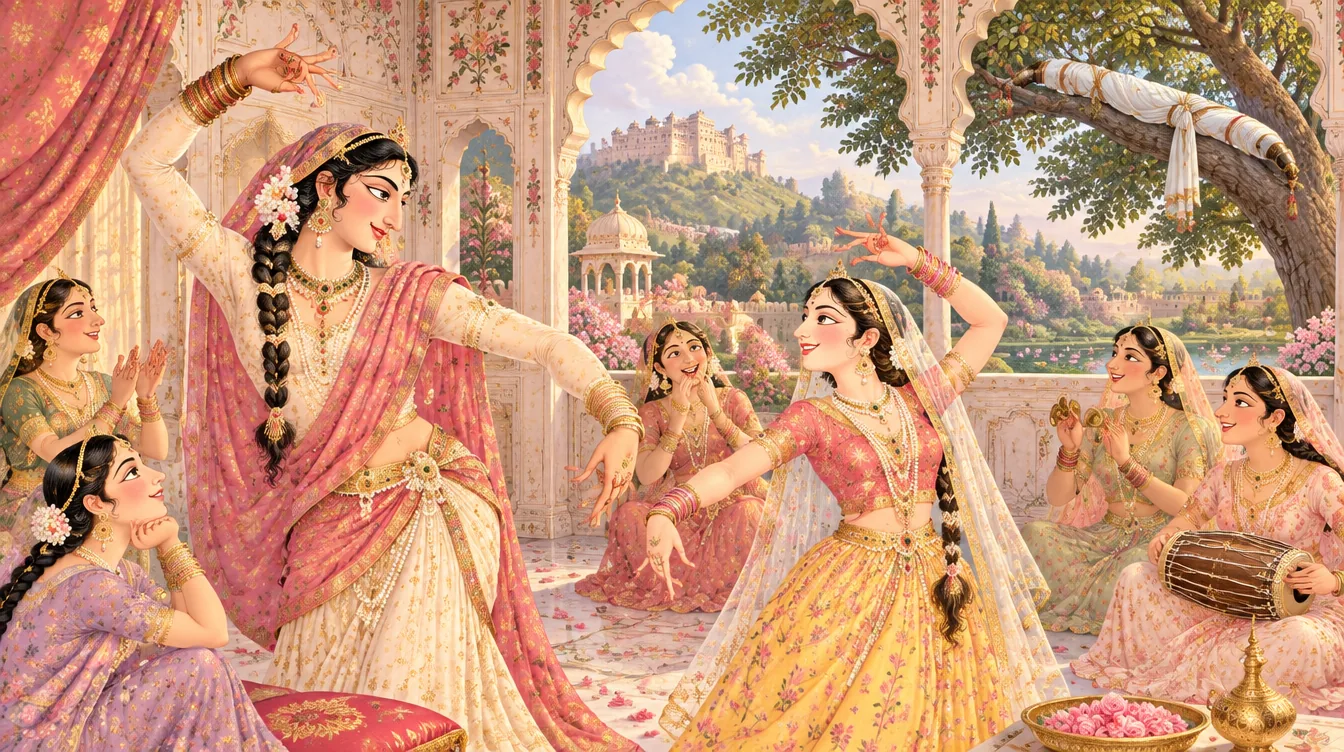
The thirteenth year is spent in King Virata's court. Yudhishthira is Kanka, a dice master. Bhima is Ballava, the cook. Arjuna, under Urvashi's curse, is Brihannala, dance teacher to the princess Uttara. Nakula tends horses, Sahadeva cattle, and Draupadi serves the queen as Sairandhri.
The queen's brother Kichaka harasses Draupadi, and Bhima kills him at night in the dance hall. When the Kauravas raid Virata's cattle at the end of the year, Arjuna takes his bow down from a tree and drives off the whole army with only Prince Uttara as charioteer.
The Pandavas reveal themselves, and Arjuna's son Abhimanyu marries Princess Uttara.
Peace is offered, refused and offered again. Everyone knows how it will end.
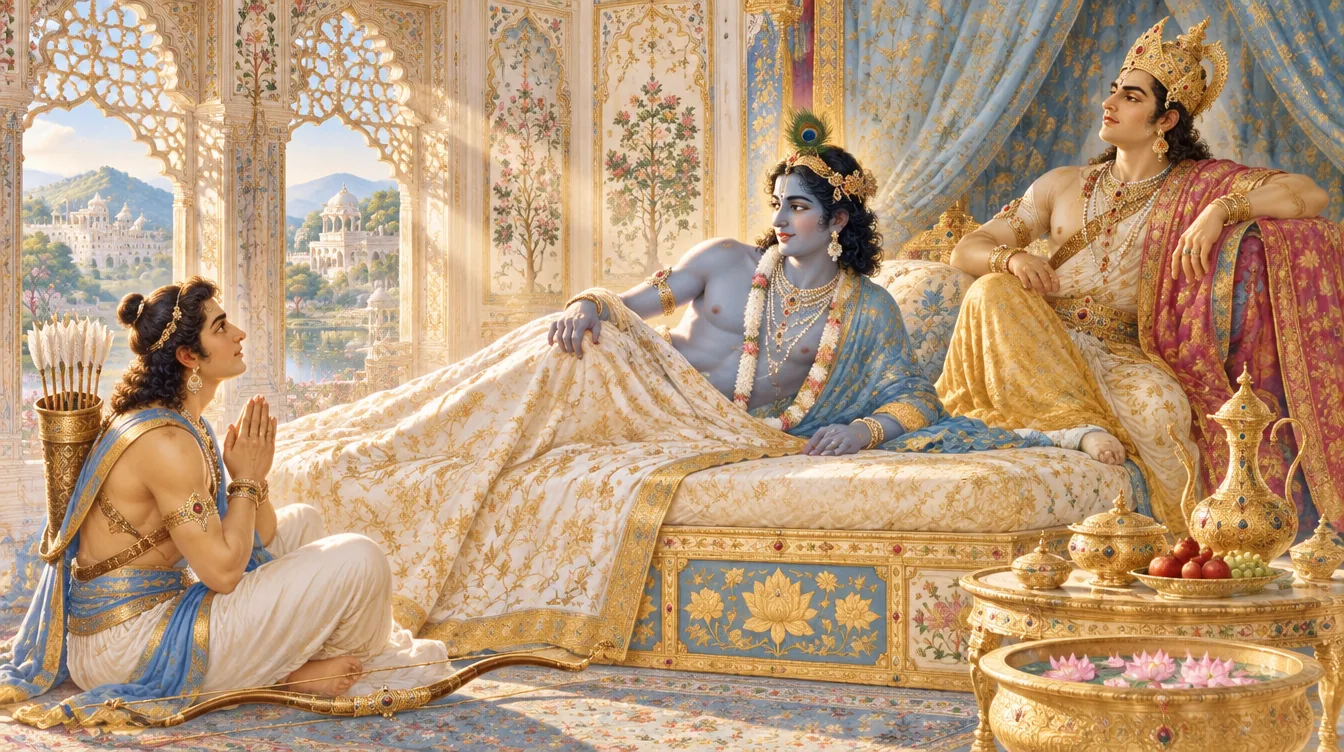
Arjuna and Duryodhana both go to Krishna for help and find him asleep. Duryodhana sits by his head, Arjuna at his feet. Krishna sees Arjuna first on waking and offers a choice: his vast Narayani army, or himself, unarmed, as a counsellor who will not fight.
Arjuna chooses Krishna. Duryodhana, delighted, takes the army. King Shalya, uncle of the twins, sets out to join the Pandavas but is won over by Duryodhana's lavish hospitality on the road.
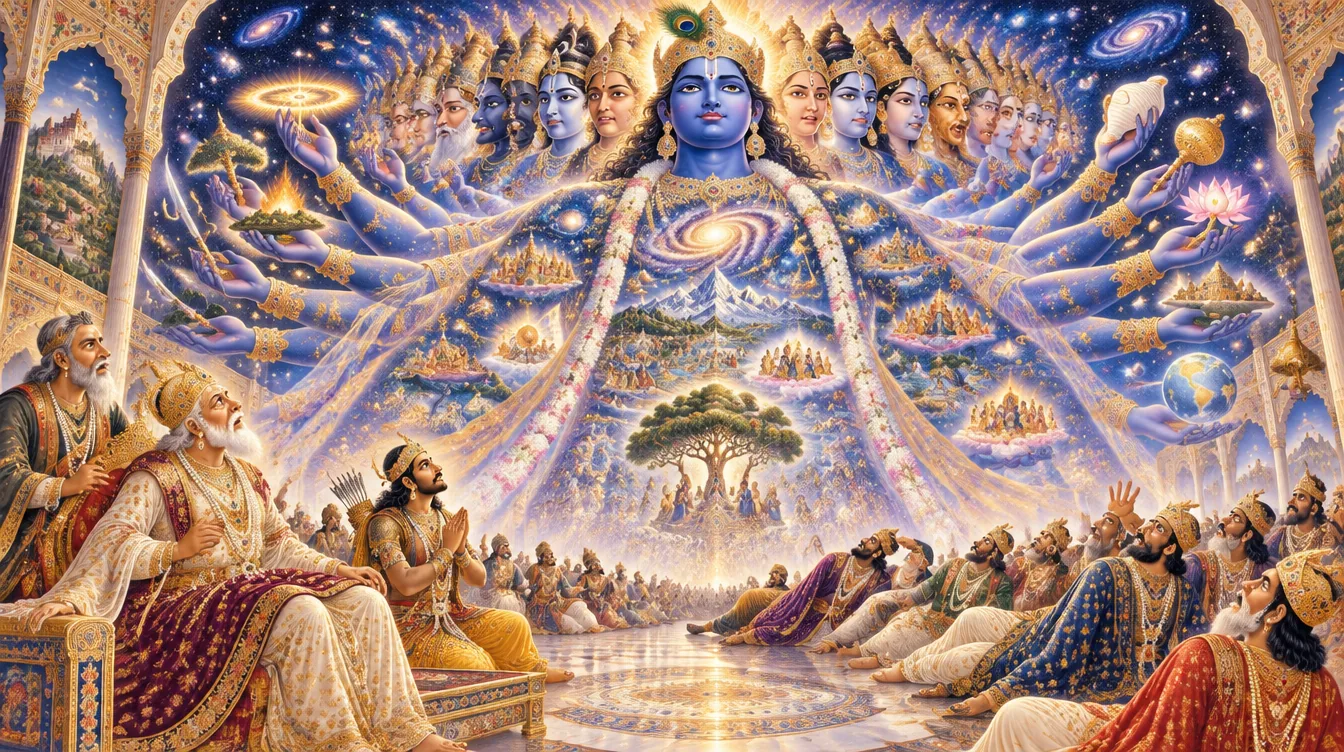
Krishna goes to Hastinapura as a peace envoy. The Pandavas will settle for just five villages. Duryodhana answers that he will not give them as much land as the point of a needle.
When Duryodhana plans to seize Krishna, Krishna reveals his cosmic form, filled with gods and worlds, and briefly grants the blind Dhritarashtra sight to see it. Then he walks out of the hall. The last chance has passed.
Krishna tells Karna the truth: he is Kunti's eldest son, the true elder brother of the Pandavas, and could be king. Karna refuses. Duryodhana stood by him when no one else did.
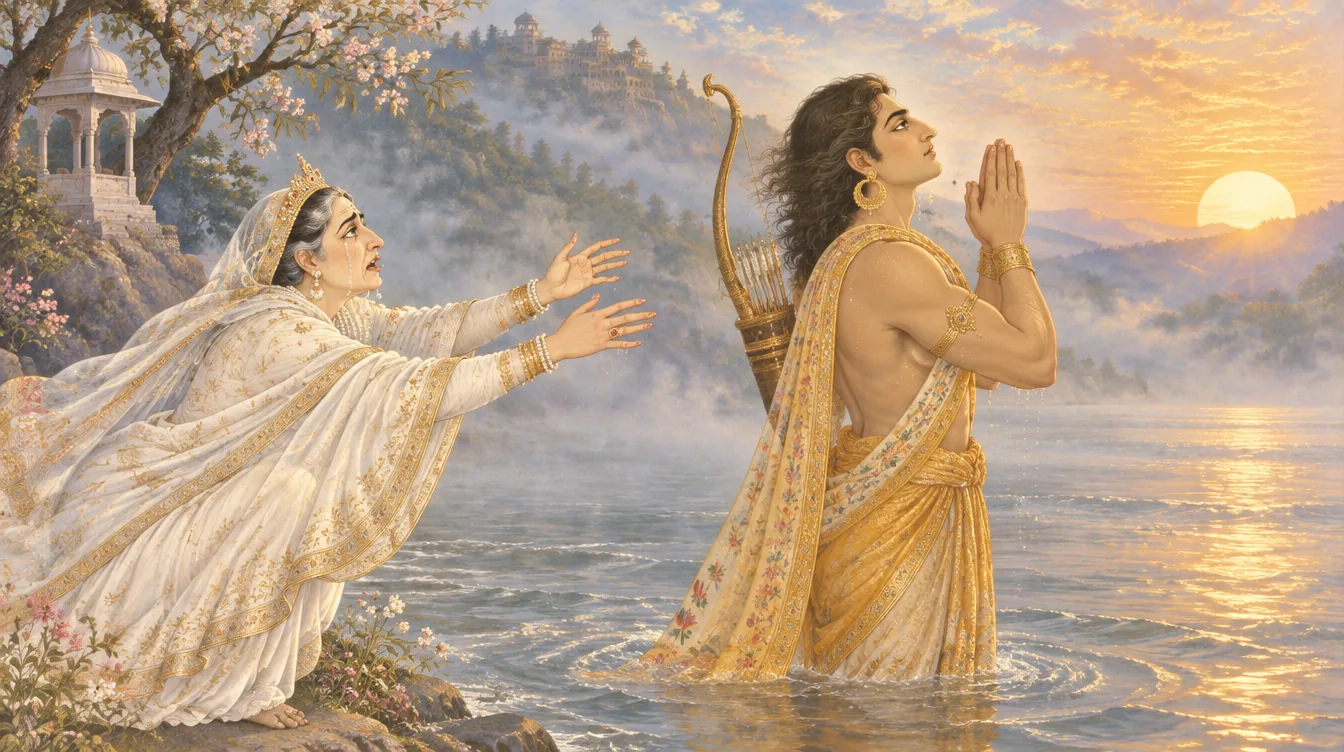
Kunti comes to him herself as he prays to the sun by the river. Karna gives her one promise: he will spare four of her sons and fight only Arjuna, so that either way she will still have five.
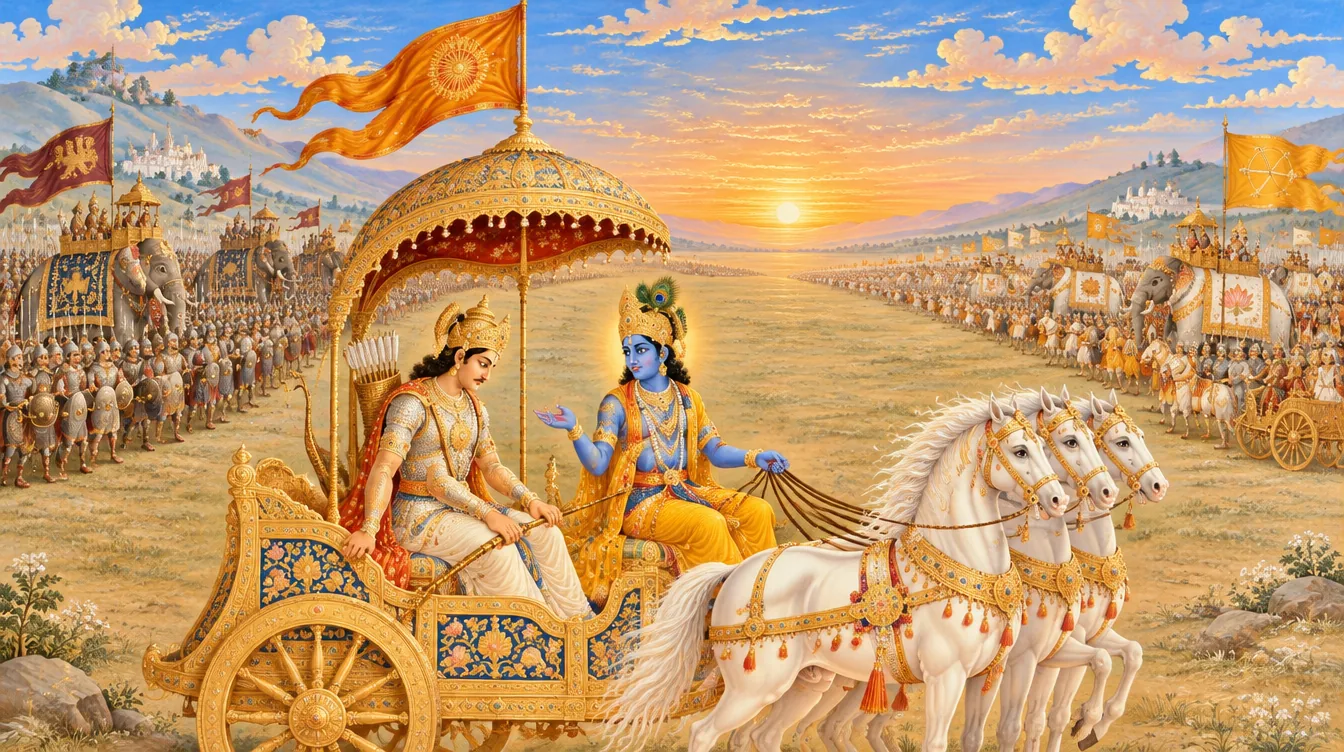
Eighteen great armies gather at Kurukshetra: seven for the Pandavas under Dhrishtadyumna, eleven for the Kauravas under Bhishma, who will not kill the Pandavas but will fight for the throne he swore to protect. Karna refuses to fight while Bhishma commands.
Vyasa offers Dhritarashtra sight to watch the war. He declines, and the gift goes to his minister Sanjaya, who will narrate every day of it to the blind king.
The war is fought with honour and then, increasingly, without it. Each great commander falls by a stratagem.
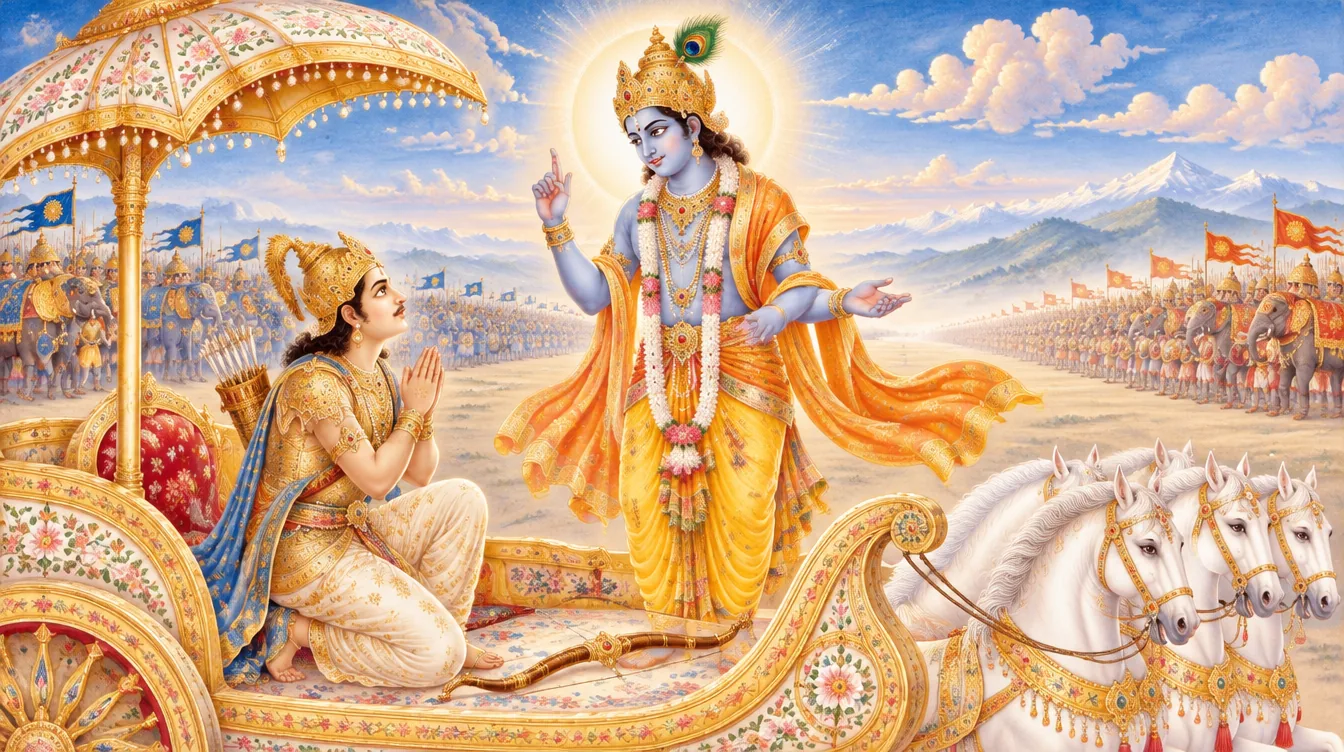
Arjuna asks Krishna to drive between the armies. He sees teachers, grandfathers, cousins and friends, drops his bow and says he will not fight.
Krishna answers in seven hundred verses, the Bhagavad Gita: on the self that does not die, on acting without clinging to results, on knowledge, devotion and discipline. He reveals his universal form. Arjuna picks up his bow.
For ten days Bhishma is unstoppable. Twice Krishna, sworn not to fight, leaps from the chariot with a wheel in his hand to charge him, and Arjuna pulls him back.
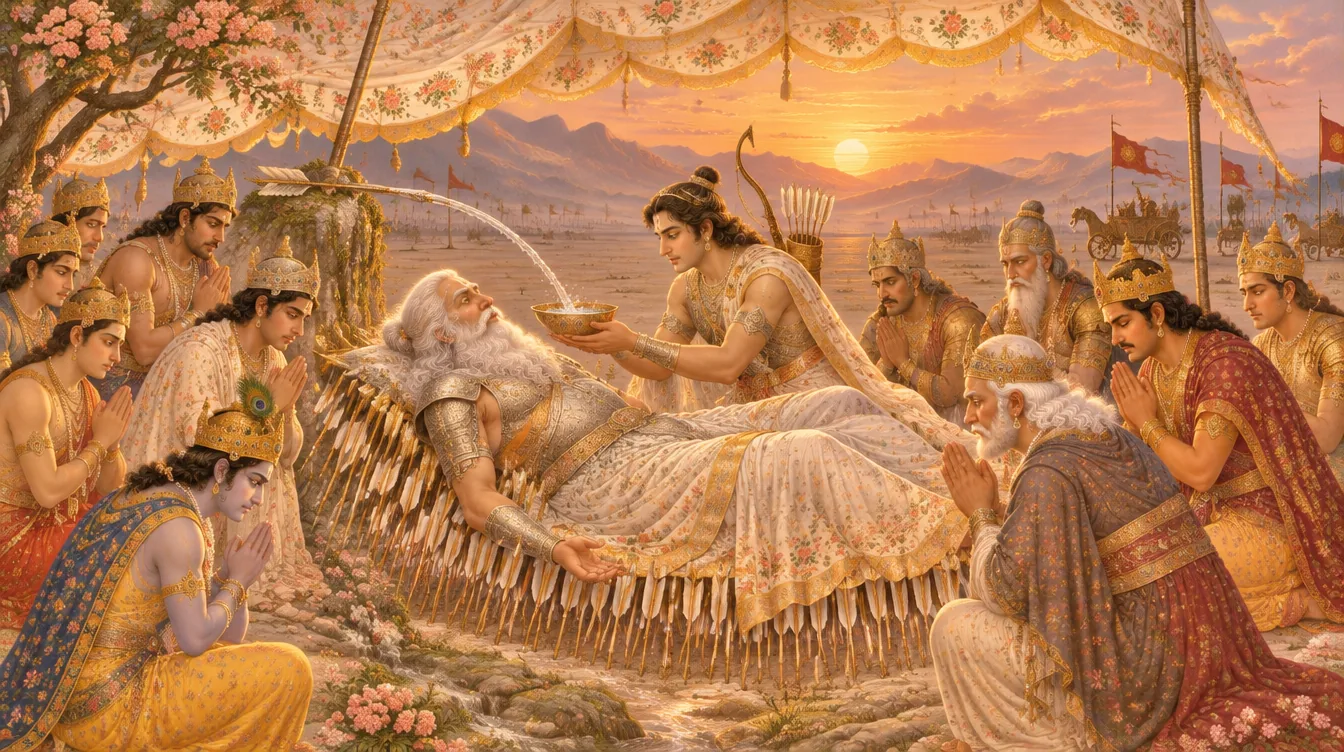
The Pandavas ask Bhishma himself how he can be defeated. He tells them: he will not fight Shikhandi, who was born a woman. On the tenth day Arjuna shoots from behind Shikhandi, and Bhishma falls, so pierced with arrows that he lies on them above the ground.
He chooses not to die yet but to wait for the sun's northern course. When he asks for water, Arjuna shoots an arrow into the earth and a spring rises to his lips.
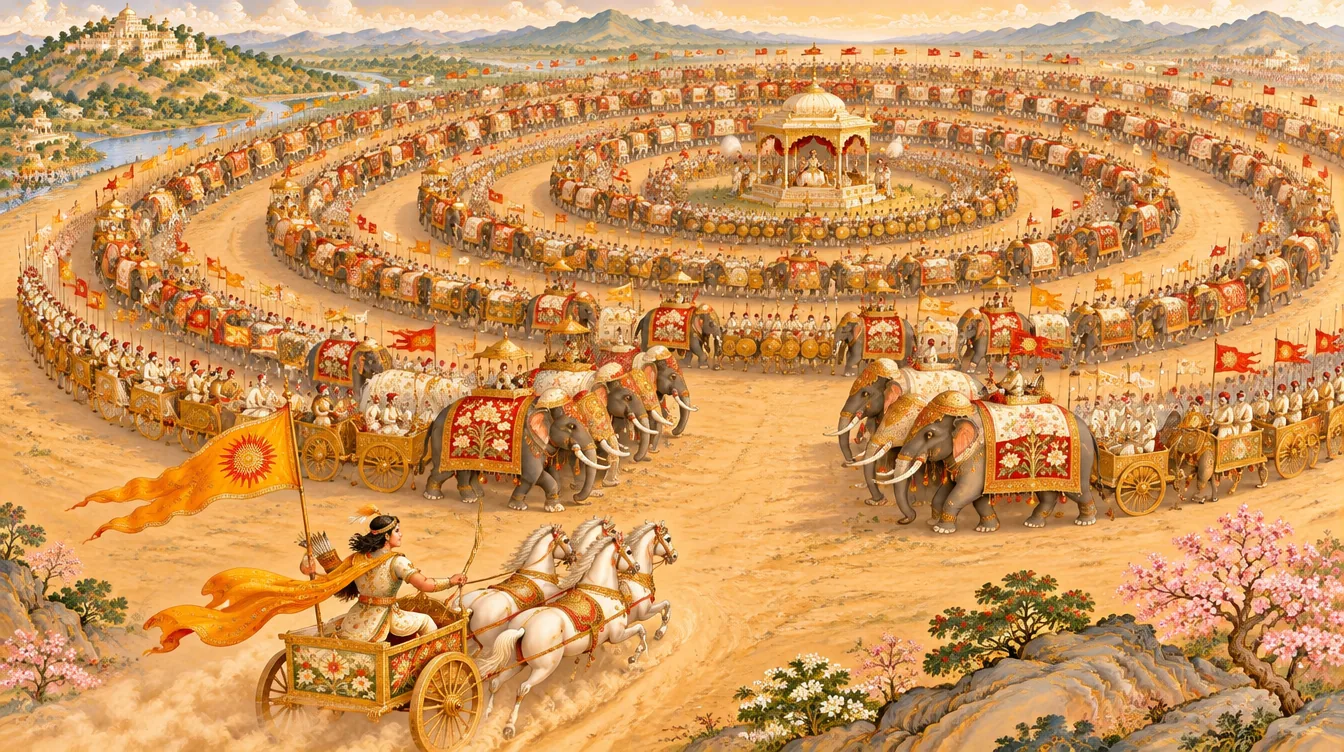
Drona takes command and on the thirteenth day arranges the army in a revolving wheel formation. Only Arjuna knows how to break it, and he has been lured away. The sixteen-year-old Abhimanyu knows how to enter but not how to leave.
He breaks in. Jayadratha, protected by a boon, holds the gap and blocks his uncles from following. Inside, Abhimanyu is surrounded by the greatest warriors of the Kaurava side and killed.
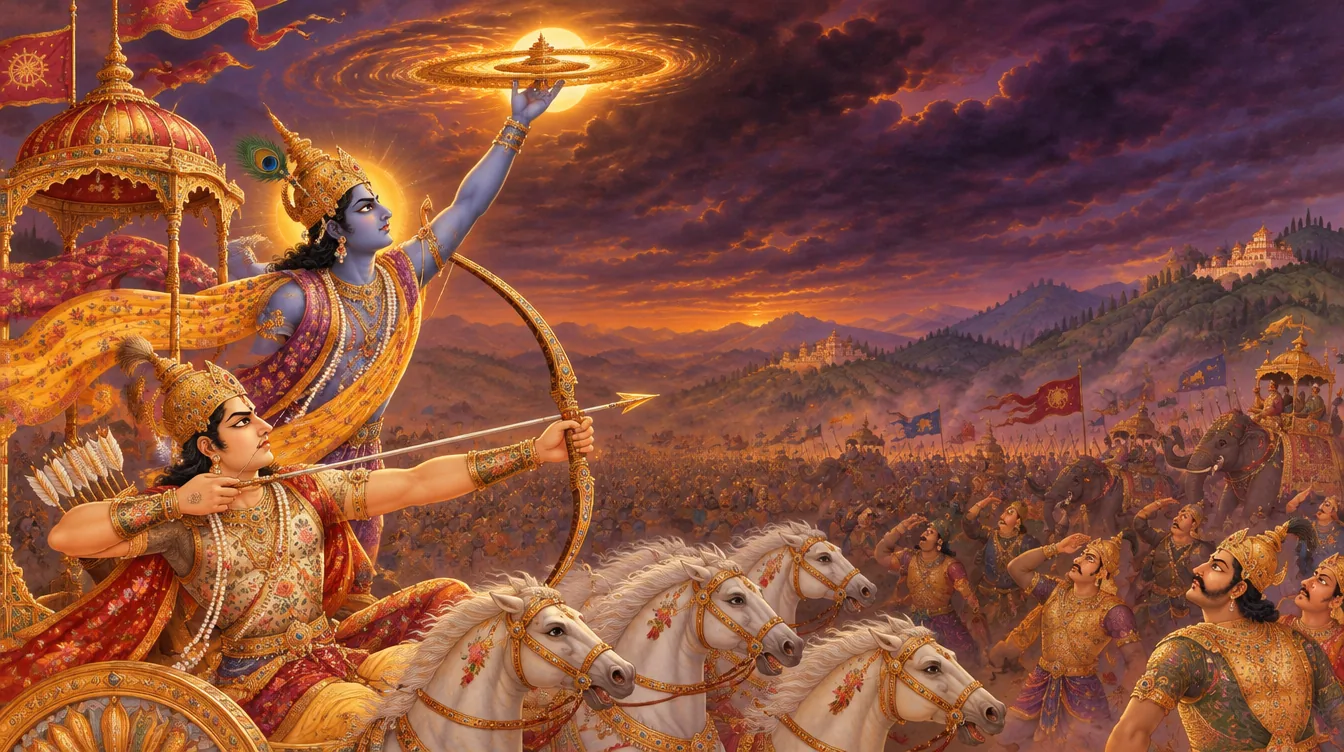
Arjuna swears to kill Jayadratha before sunset or walk into fire. The whole Kaurava army forms around Jayadratha to keep him away until dark.
In the best-known telling Krishna veils the sun so that it seems to set. Jayadratha steps out, and Arjuna strikes. Warned that whoever drops Jayadratha's head to the ground will die, Arjuna sends it flying into the lap of Jayadratha's father, praying far away, who startles and lets it fall.
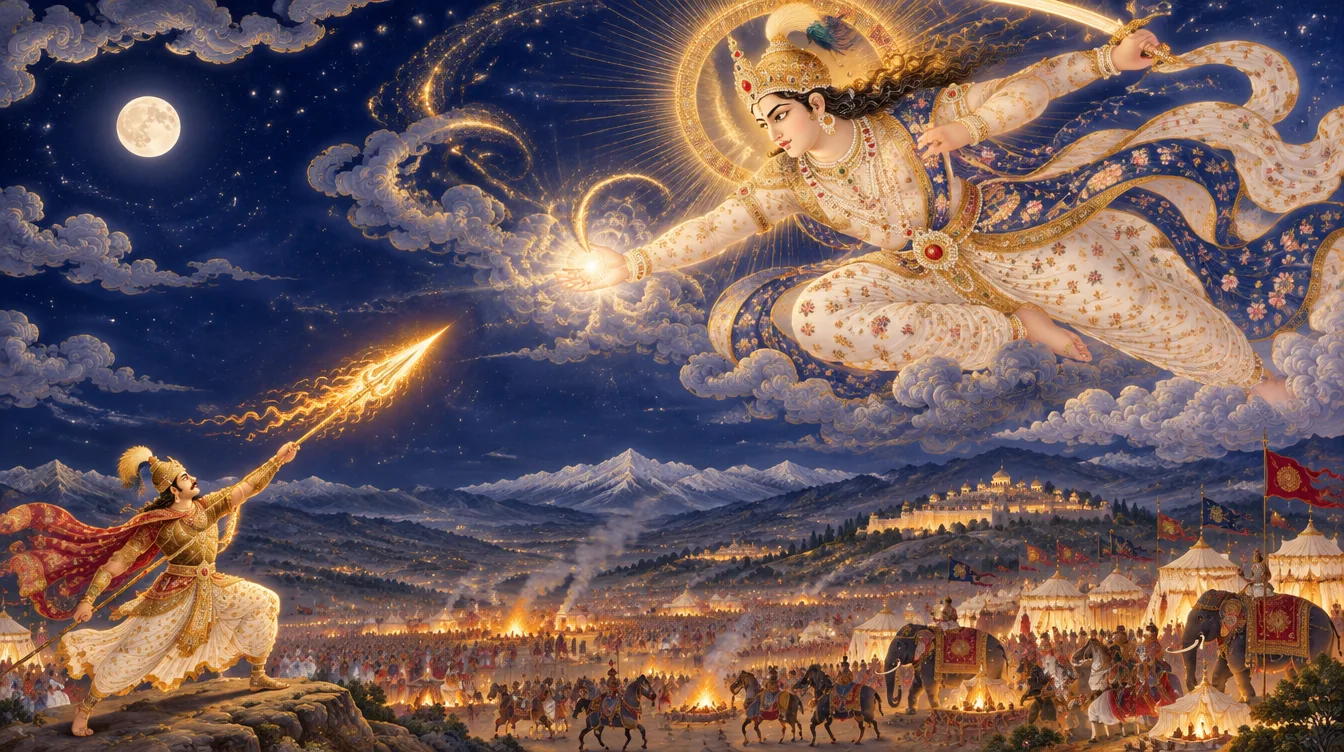
The fighting continues after dark. Bhima's son Ghatotkacha, half rakshasa, grows huge and fights from the sky, devastating the Kaurava ranks.
In desperation Duryodhana begs Karna to use Indra's spear, the weapon he has saved for Arjuna. Karna throws it, and Ghatotkacha falls on the enemy army as he dies. Krishna rejoices, because Arjuna is now safe.
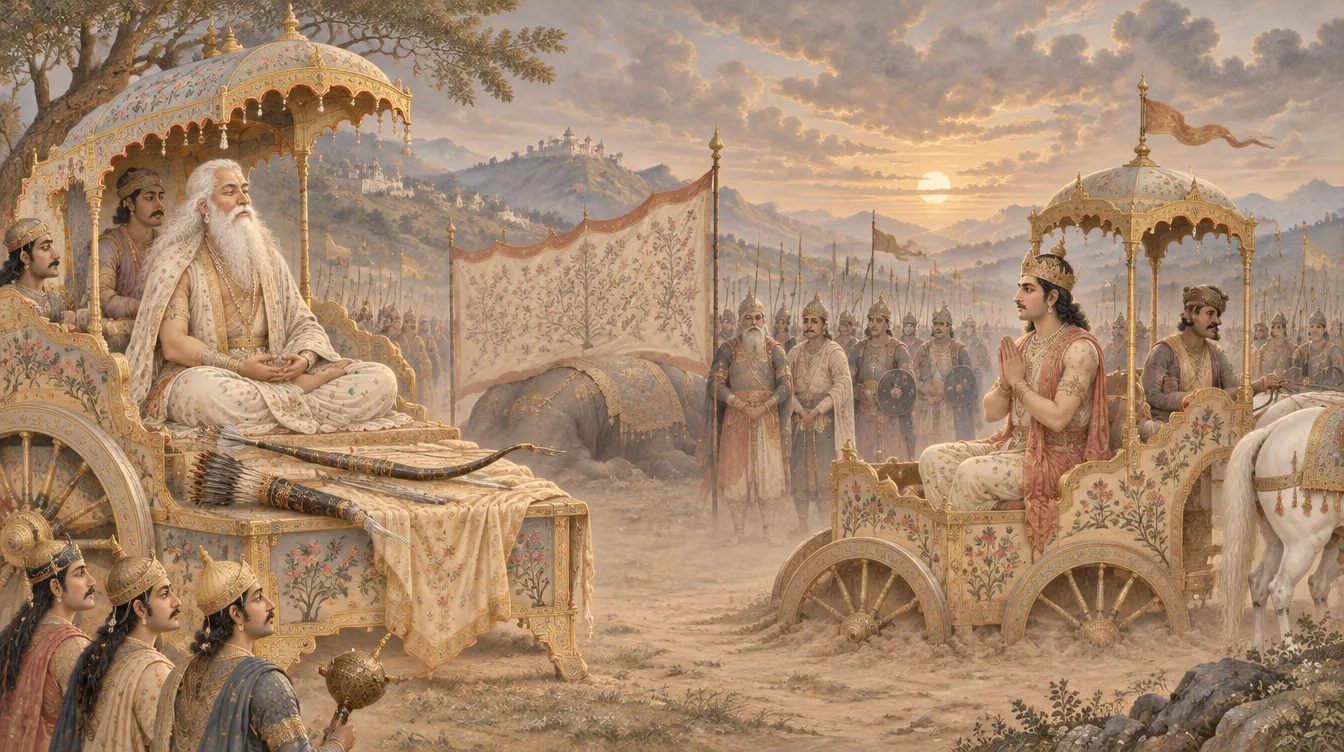
Drona cannot be beaten while he holds his weapons. Krishna proposes a lie: tell him his son Ashvatthama is dead. Bhima kills an elephant named Ashvatthama and shouts the news.
Drona will believe only Yudhishthira. Yudhishthira says "Ashvatthama is dead" and adds, too softly to hear, "the elephant". His chariot, which always rode a little above the ground, sinks to touch the earth.
Drona lays down his weapons and sits in meditation, and Dhrishtadyumna kills him.
With Karna now commanding the Kauravas, Bhima meets Duhshasana, who dragged Draupadi by the hair thirteen years before. He kills him and fulfils the terrible oath he swore in the dice hall, to the horror of both armies.
Draupadi, who has kept her hair unbound since that day, is now able to tie it again.
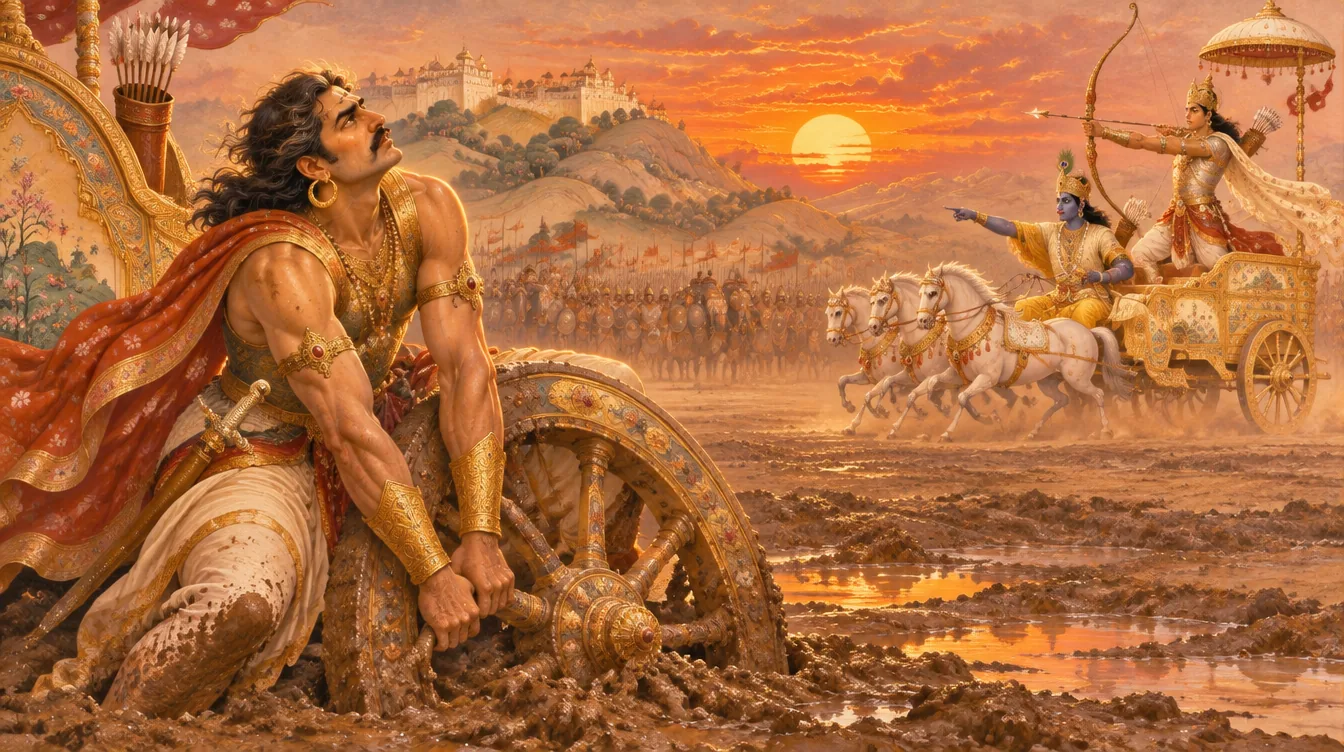
On the seventeenth day Karna faces Arjuna at last, with King Shalya as his charioteer, who mocks him at every turn. Old curses come due: his teacher Parashurama cursed him to forget his greatest weapon when he needed it most, and a brahmin whose cow he killed cursed his chariot wheel to sink in battle.
The wheel sinks. Karna climbs down to free it and appeals to the rules of war. Krishna reminds him of Draupadi in the hall and of Abhimanyu in the wheel. Arjuna shoots, and Karna falls.
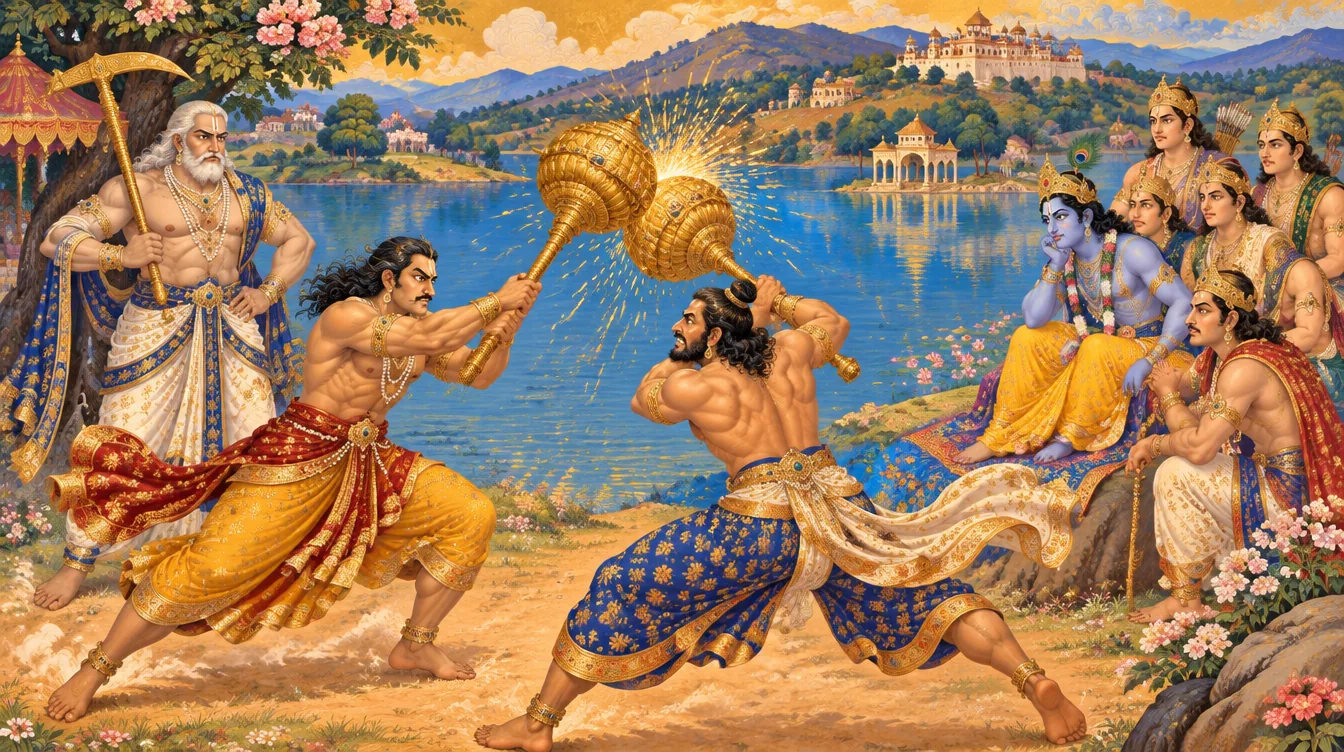
On the eighteenth day Yudhishthira kills Shalya, and Sahadeva kills Shakuni. Duryodhana flees and hides beneath the waters of a lake. Taunted, he comes out and agrees to fight one Pandava with the mace. He chooses Bhima.
They are evenly matched. Krishna signals to Bhima by striking his own thigh, and Bhima smashes Duryodhana's thigh, a blow below the navel forbidden in mace fighting, fulfilling his vow from the dice hall. Balarama, who taught them both, storms off in fury. The dying Duryodhana declares that he lived and dies a king.
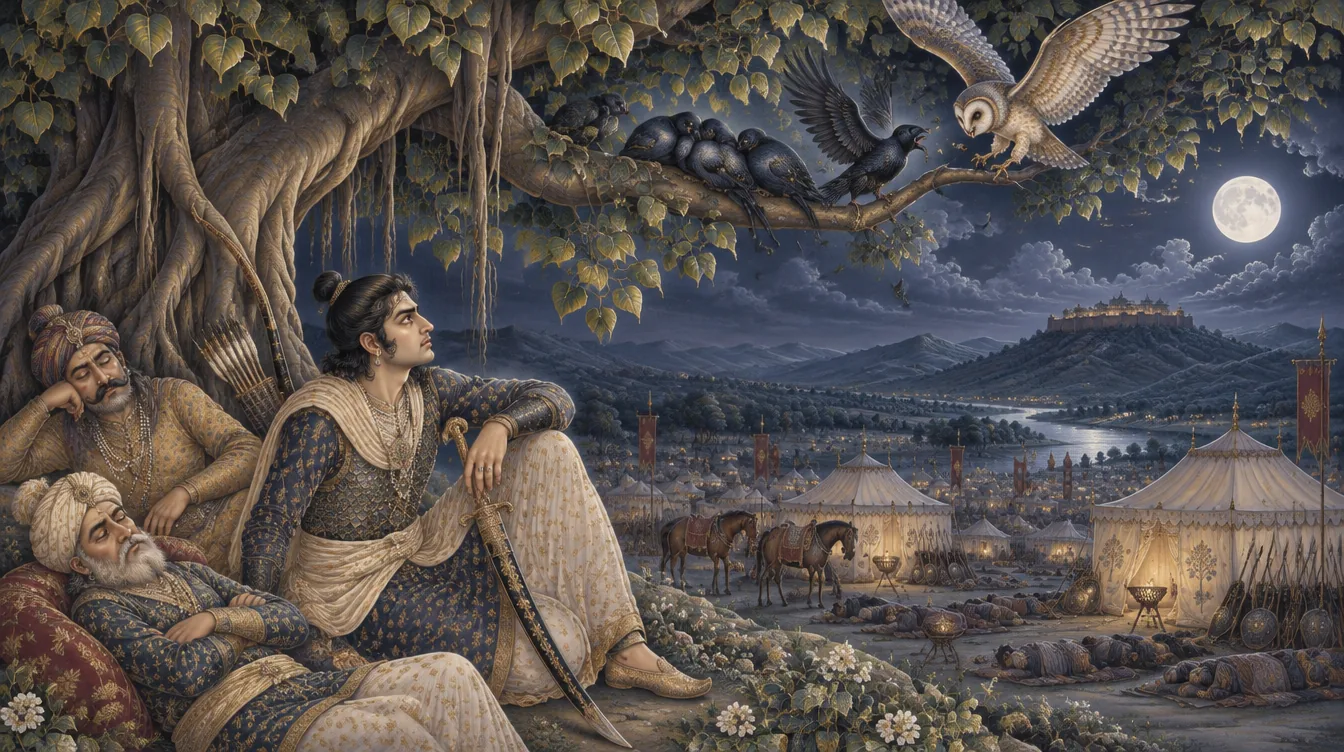
Drona's son Ashvatthama, with Kripa and Kritavarma, sits under a banyan tree in the dark. He watches an owl attack sleeping crows and decides what to do.
He enters the Pandava camp at night and kills Dhrishtadyumna, Shikhandi and all five sons of Draupadi in their sleep. Pursued, he releases a terrible weapon and turns it on the unborn child of Uttara. Krishna revives the child, Parikshit, and curses Ashvatthama to wander the earth for three thousand years.
The victors inherit a kingdom of widows. The epic gives the aftermath as much attention as the war.
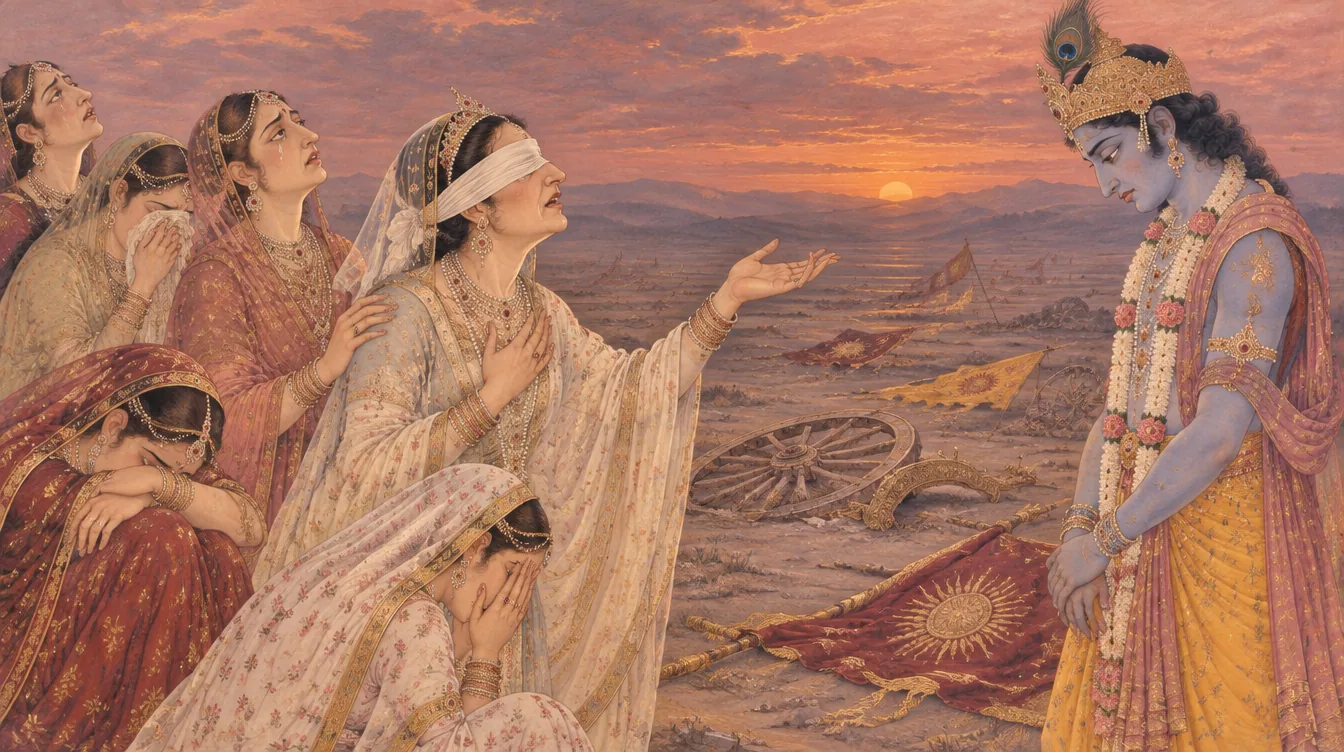
The women walk onto the battlefield to find their dead. Gandhari, who lost all hundred sons, turns her grief on Krishna: he could have stopped this. She curses him to see his own clan destroy itself in thirty-six years. Krishna accepts it calmly.
At the funeral rites Kunti tells her sons at last that Karna was their eldest brother. Yudhishthira is devastated.
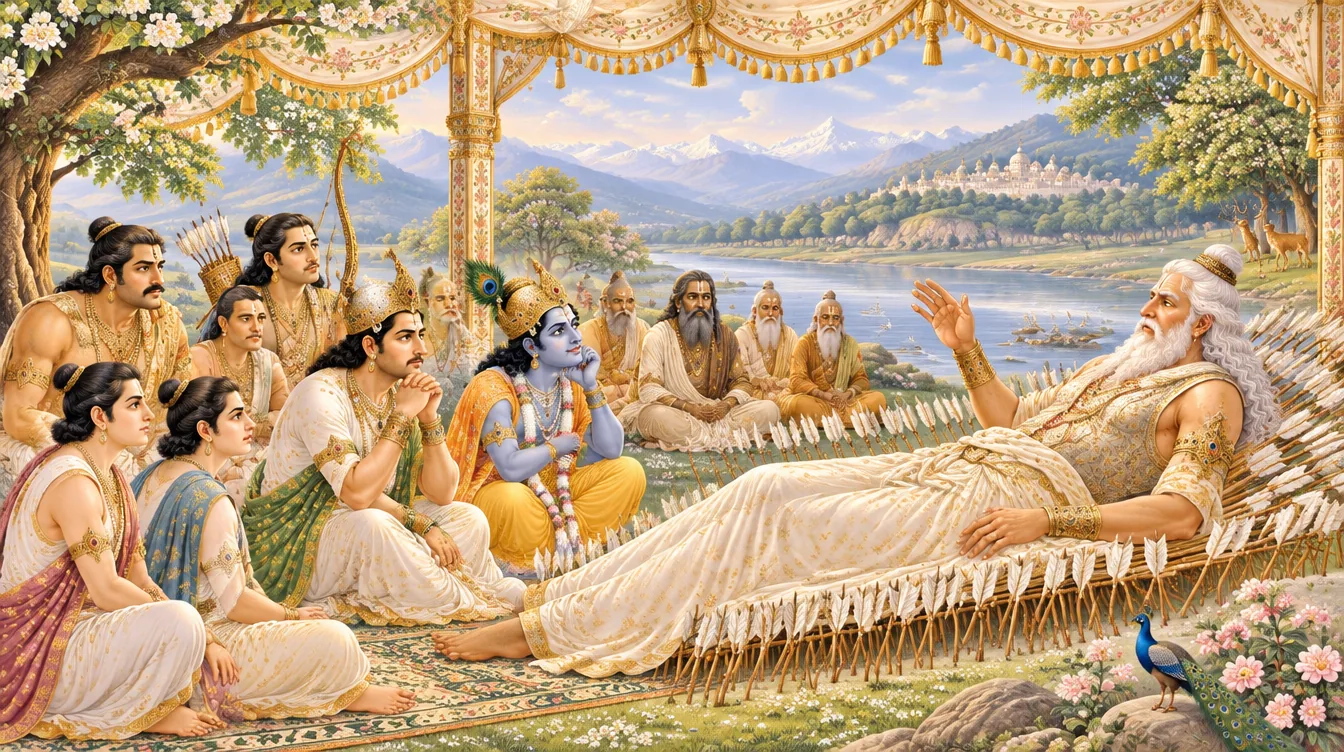
Yudhishthira wants to renounce the throne he has won at such a cost. His family and the sages argue with him, and Krishna sends him to Bhishma, still lying on his bed of arrows.
Over many days Bhishma teaches him the duties of kings, the law in times of crisis, and the path to liberation. These teachings fill two whole books of the epic, and include the Thousand Names of Vishnu. When the sun turns north, Bhishma chooses to die.
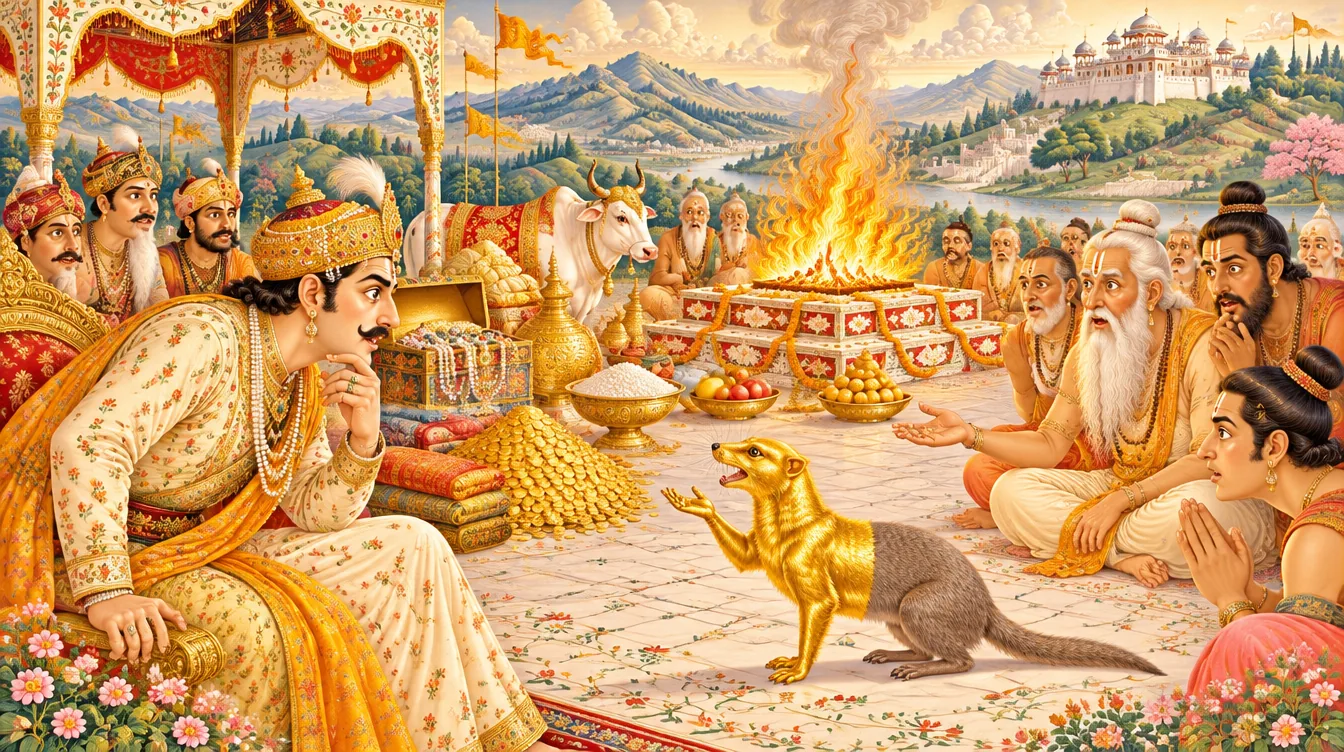
Yudhishthira performs a horse sacrifice. Arjuna follows the horse across the land and is defeated and killed by his own son Babhruvahana, then revived by the Naga princess Ulupi.
When the great sacrifice ends, a mongoose with half its body golden rolls in the ground and declares it less worthy than a gift he once saw: a starving family who gave their last flour to a guest. Rolling in its crumbs had turned half of him to gold.
Fifteen years after the war, Dhritarashtra and Gandhari retire to the forest, and Kunti chooses to go with them. Vidura dies there in meditation.
On one night Vyasa calls the dead warriors of both sides up out of the Ganga to spend a night with the living, free of enmity. Later, a forest fire takes Dhritarashtra, Gandhari and Kunti, who meet it in meditation.
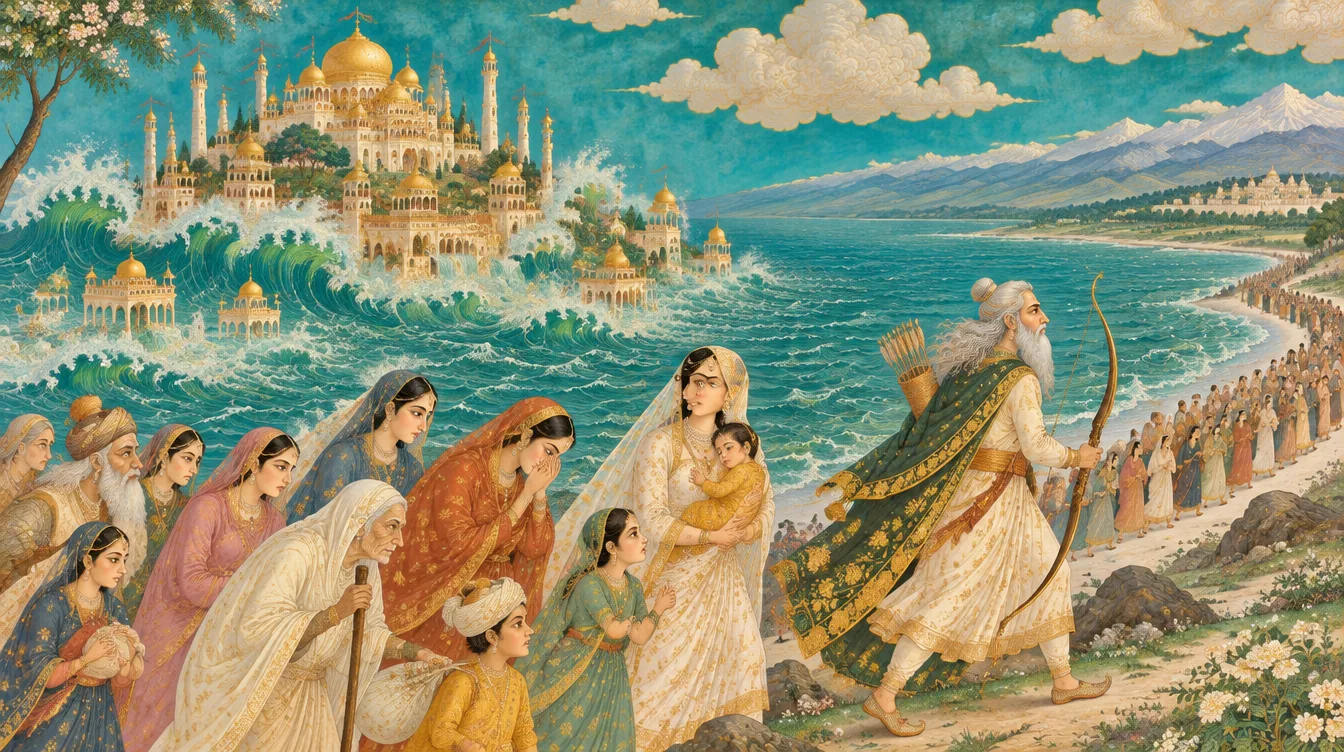
Thirty-six years after the war Gandhari's curse ripens. Young Yadavas mock visiting sages by dressing a youth as a pregnant woman, and are cursed: he will give birth to an iron club that destroys their clan.
The club is ground to powder and thrown into the sea, where it grows as reeds. At a drunken festival a quarrel breaks out, the reeds become clubs, and the Yadavas kill one another. Balarama leaves his body. A hunter mistakes Krishna's foot for a deer and his arrow ends Krishna's life on earth.
Arjuna arrives to lead the survivors away, and the sea swallows Dvaraka behind them. On the road he can barely lift the Gandiva. His time, too, has passed.
The shortest books and the most haunting. The epic ends with a test of loyalty and a vision of heaven.
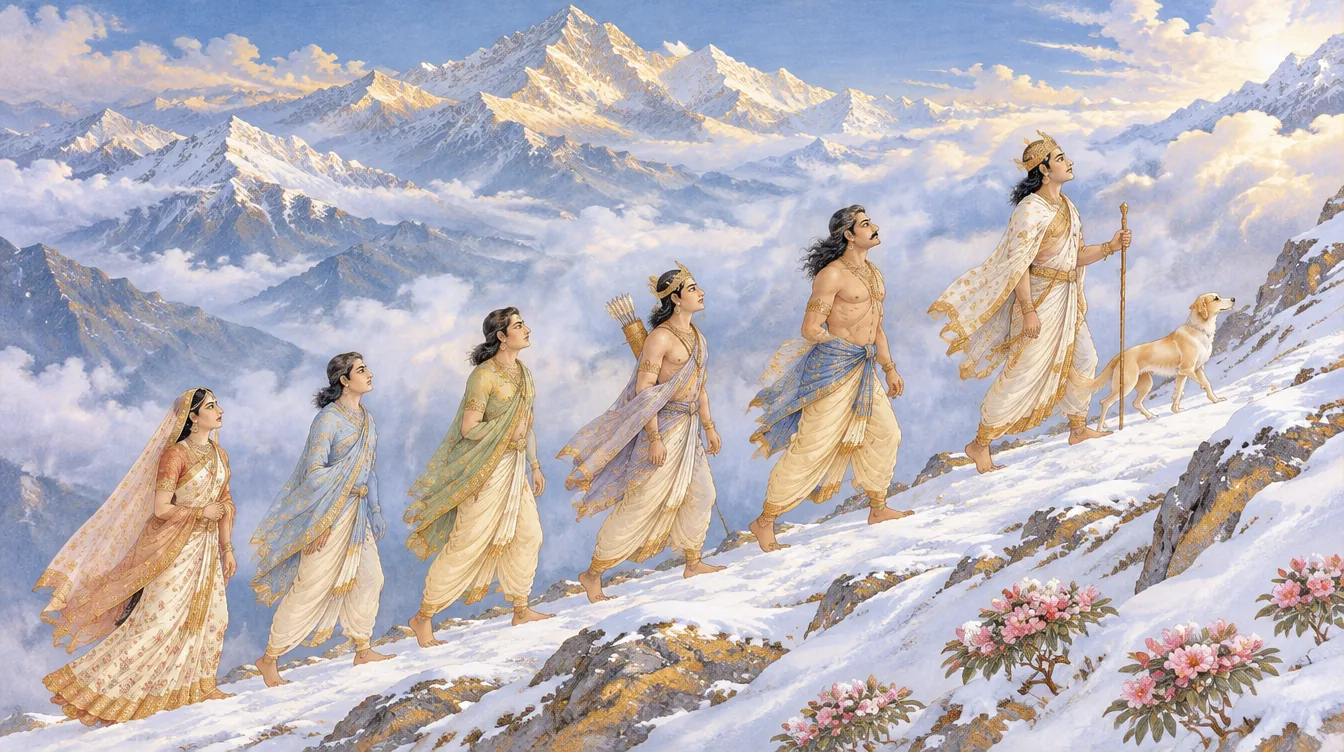
The Pandavas crown Parikshit and set out with Draupadi on a final pilgrimage toward the Himalaya. A dog follows them.
One by one they fall on the mountain path. Draupadi first, because she loved Arjuna more than the others. Then Sahadeva for pride in his wisdom, Nakula for pride in his beauty, Arjuna for pride in his skill, and Bhima for his appetite and boasting. Yudhishthira walks on without looking back. Only the dog remains.
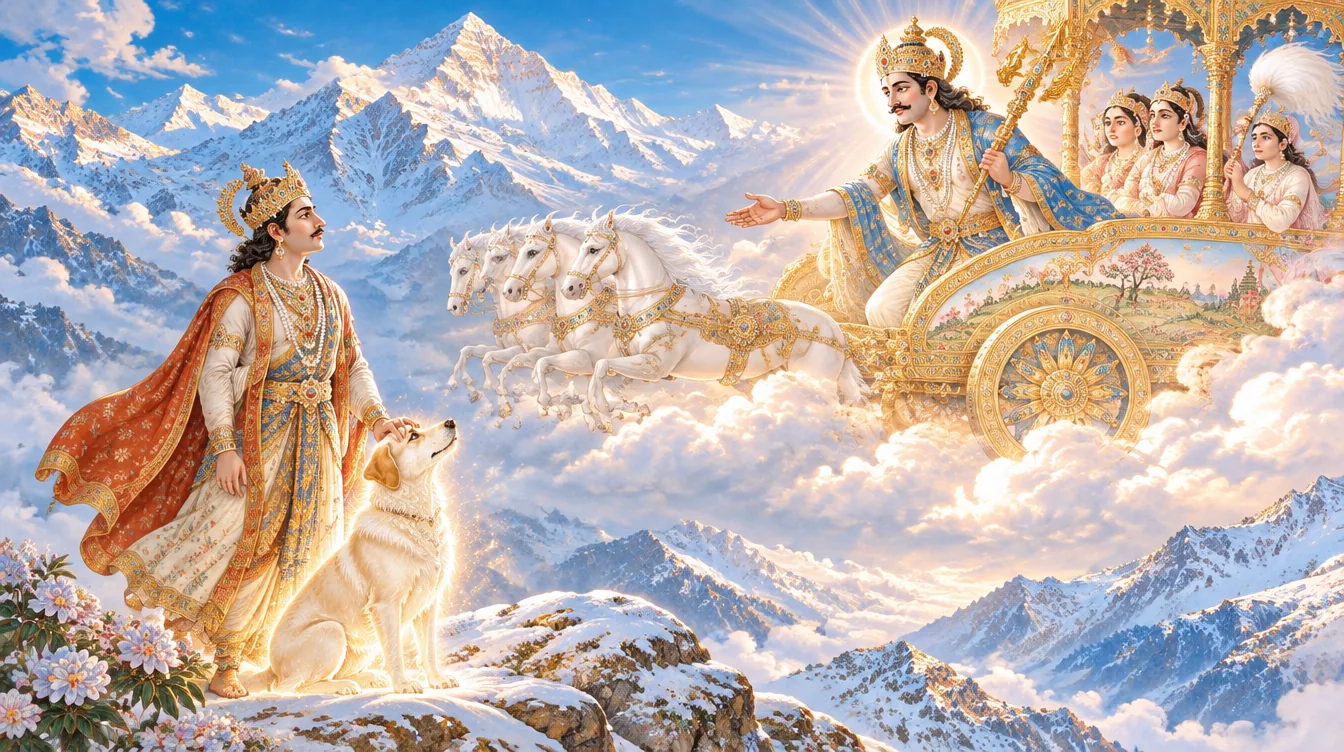
Indra arrives in his chariot to carry Yudhishthira to heaven in his own body, but not the dog. Yudhishthira refuses to abandon a creature that has been devoted to him. The dog changes form. It is Dharma, his father, testing him one last time.
In heaven Yudhishthira finds Duryodhana enthroned and his own brothers nowhere. Shown a place of suffering where he hears their voices, he chooses to stay with them. The vision dissolves: it was an illusion, a final purging. Bathing in the heavenly Ganga, Yudhishthira leaves his human body and joins his family, Karna among them.
Search by name or role. Choose “Find in the story” to jump to the first episode where they appear.
Composes the epic and fathers the Kuru princes.
Marries Ganga, then Satyavati.
Mother of Bhishma.
A fisherman's daughter whose sons were to inherit the throne.
Bound by his vow; commands the Kauravas for ten days.
Wronged by Bhishma; reborn as Shikhandi.
The warrior behind whom Arjuna shoots Bhishma.
Father of the Kauravas; loves his son more than justice.
Blindfolds herself for life; curses Krishna in grief.
Father of the Pandavas, cursed by a sage.
Mother of Karna and the three eldest Pandavas.
Mother of the twins.
Half-brother of Dhritarashtra and Pandu; the voice of conscience.
Son of Dharma; truthful, and fatally fond of dice.
Son of the wind; immense strength and terrible vows.
Son of Indra; the great archer and Krishna's friend.
Twin son of Madri; master of horses.
Twin son of Madri; wise and silent.
Born from fire; wife of the five Pandavas; asks the epic's sharpest question.
Cousin, counsellor and charioteer; the divine teacher of the Gita.
Teacher of the mace; refuses to take sides.
Wife of Arjuna, mother of Abhimanyu.
Dies inside the wheel formation.
Wife of Abhimanyu, mother of Parikshit.
Saved in the womb; father of Janamejaya, who hears the whole epic recited.
Half rakshasa; draws out Karna's divine spear.
Proud, loyal to his friends, unable to share.
Drags Draupadi into the hall.
The only Kaurava to defend Draupadi.
Master of the dice.
Kunti's first son; generous, wronged and loyal.
Teaches both sides and commands the Kauravas after Bhishma.
Leads the night raid; cursed to wander.
Survives the war.
Father of Draupadi and Dhrishtadyumna.
Born to kill Drona.
Self-taught archer who gives Drona his thumb.
Blocks the Pandavas on the day Abhimanyu dies.
Uncle of the twins; Karna's mocking charioteer.
Shelters the Pandavas in their year of disguise.
Sees the war with divine sight and tells it to Dhritarashtra.
Wins her husband back from Death in a forest story.
Hero of a forest story about loss and return.
Meets his half-brother Bhima in the forest.
What the story keeps returning to.
The epic says it outright: the truth of dharma is hidden in a cave. Every major choice, from Bhishma's vow to Yudhishthira's half-truth, shows the law straining against itself.
The Pandavas win and inherit grief. The last third of the epic is about mourning, renunciation and what victory is worth.
Satyavati, Amba, Kunti, Gandhari and above all Draupadi argue, curse, plan and refuse. Their questions drive the story.
Karna's loyalty to Duryodhana, Bhishma's to the throne, Drona's to his salt: each is admirable and each leads to ruin.
Curses, boons and prophecies hang over everyone, yet the characters keep choosing. The epic never settles which matters more.
At the moment of greatest crisis the story stops for a dialogue on duty, action and devotion that has been read on its own ever since.
The work behind this retelling, and where to read it for yourself.
Tradition names Vyasa, also called Krishna Dvaipayana, as the author. He is also a character: grandfather of both sides, and a visitor at key moments.
Traditionally about 100,000 verses in eighteen books (parvas), with the Harivamsha as a supplement. It is often called the longest poem ever composed.
The epic itself mentions shorter earlier versions. Scholars see it growing over several centuries, roughly between the middle of the first millennium BCE and the early centuries CE.
The Bhandarkar Oriental Research Institute in Pune compared hundreds of manuscripts between 1919 and 1966 to reconstruct the oldest common text. Several famous episodes, such as Ganesha as scribe, are in its appendices rather than its main text.
This storyline follows the order of the eighteen parvas and keeps to the events of the commonly read text. Wording is our own. Where a famous detail is missing from the critical edition or comes from later retellings, the episode says so. Illustrations are artist's impressions in the manner of Pahari miniature painting, not historical records.