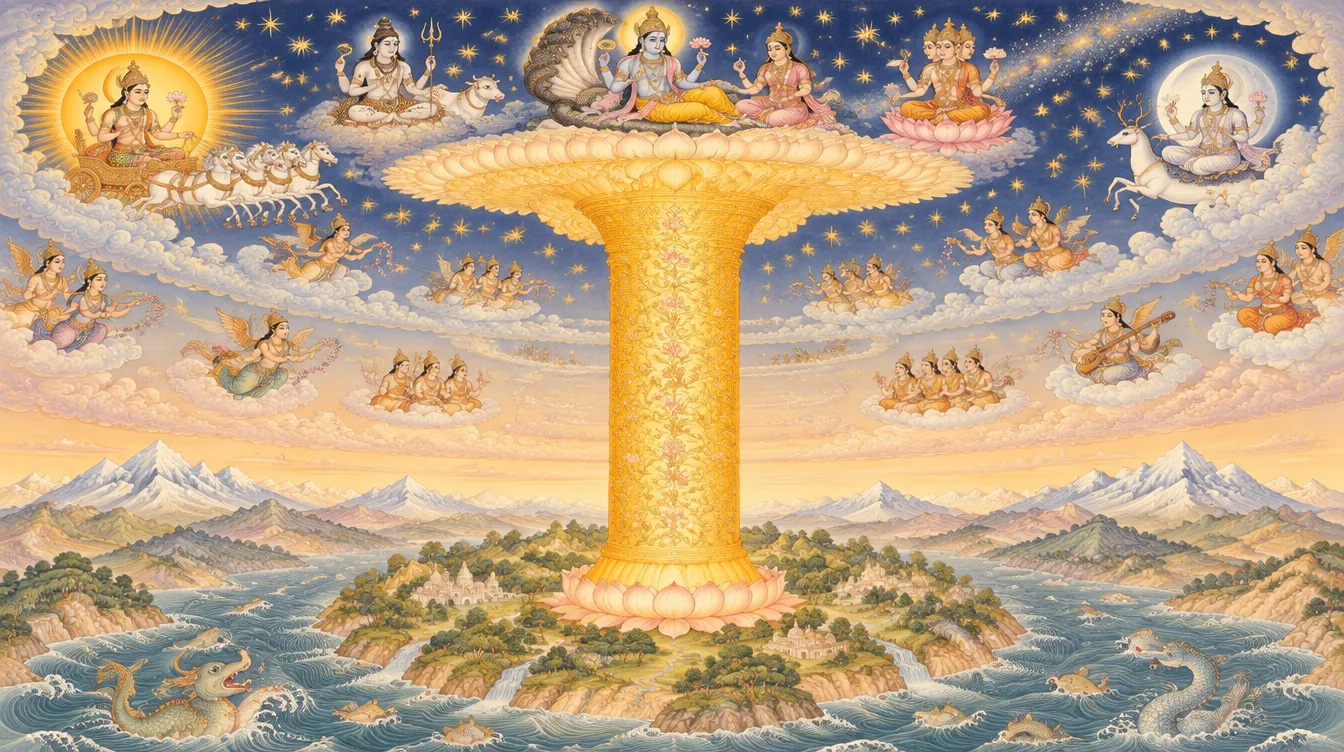
Skambha, the pillar
Ten long hymns: who made the human body, the cosmic pillar Skambha and the sacred cow.
Hymn 10.2 asks who made the human body: who set the heels, the knees, the eyes and the breath, and who put thought into it.
Hymns 10.7 and 10.8 describe Skambha, the frame or pillar on which earth, sky, time, the seasons and the gods all rest.
Hymns to read first
Read
book 10.
Sanskrit and English side by side, verse by verse. Choose what to show and how large.
Hymn 10.1A charm against witchcraft
1यां कल्पयन्ति वहतौ वधूमिव विश्वरूपां हस्तकृतां चिकित्सवः । सारादेत्वप नुदाम एनाम् ॥
1Afar let her depart: away we drive her whom, made with hands, all-beautiful, Skilled men prepare and fashion like a bride amid her nuptial train.
2शीर्षण्वती नस्वती कर्णिणी कृत्याकृता संभृता विश्वरूपा । सारादेत्वप नुदाम एनाम् ॥
2Complete, with head and nose and ears, all-beauteous, wrought with magic skill Afar let her depart: away we drive her.
3शूद्रकृता राजकृता स्त्रीकृता ब्रह्मभिः कृता । जाया पत्या नुत्तेव कर्तारं बन्ध्वृच्छतु ॥
3Made by a Sidra or a Prince, by priests or women let her go. Back to her maker as her kin, like a dame banished by her lord.
4अनयाहमोषध्या सर्वाः कृत्या अदूदुषम् । यां क्षेत्रे चक्रुर्यां गोषु यां वा ते पुरुषेषु ॥
4I with this salutary herb have ruined all their magic arts, The spell which they have cast upon thy field, thy cattle, or thy men.
5अघमस्त्वघकृते शपथः शपथीयते । प्रत्यक्प्रतिप्रहिण्मो यथा कृत्याकृतं हनत् ॥
5Ill fall on him who doeth ill, on him who curseth fall the curse! We drive her back that she may slay the man who wrought the witchery.
6प्रतीचीन आङ्गिरसोऽध्यक्षो नः पुरोहितः । प्रतीचीः कृत्या आकृत्यामून् कृत्याकृतो जहि ॥
6Against her comes the Angirasa, the Priest whose eye is over us. Turn back all witcheries and slay those practisers of magic arts.
7यस्त्वोवाच परेहीति प्रतिकूलमुदाय्यम् । तं कृत्येऽभिनिवर्तस्व मास्मान् इछो अनागसः ॥
7Whoever said to thee, Go forth against the foeman up the stream, To him, O Krityā, go thou back. Pursue not us, the sinless ones.
8यस्ते परूंषि संदधौ रथस्येव र्भुर्धिया । तं गच्छ तत्र तेऽयनमज्ञातस्तेऽयं जनः ॥
8He who composed thy limbs with thought as a deft joiner builds a car, Go to him: thither lies thy way. This man is all unknown to thee.
9ये त्वा कृत्वालेभिरे विद्वला अभिचारिणः । शंभ्विदं कृत्यादूषणं प्रतिवर्त्म पुनःसरं तेन त्वा स्नपयामसि ॥
9The cunning men, the sorcerers who fashioned thee and held thee fast,— This cures and mars their witchery, this, repellent, drives it back the way it came. With this we make thee swim.
10यद्दुर्भगां प्रस्नपितां मृतवत्सामुपेयिम । अपैतु सर्वं मत्पापं द्रविणं मोप तिष्ठतु ॥
10When we have found her ducked and drenched, a hapless cow whose calf hath died, Let all my woe depart and let abundant riches come to me.
11यत्ते पितृभ्यो ददतो यज्ञे वा नाम जगृहुः । संदेश्यात्सर्वस्मात्पापादिमा मुञ्चन्तु त्वौषधीः ॥
11If, as they gave thy parents aught, they named thee, or at sacrifice, From all their purposed evil let these healing herbs deliver thee.
12देवैनसात्पित्र्यान् नामग्राहात्संदेश्यादभिनिष्कृतात्। मुञ्चन्तु त्वा वीरुधो वीर्येण ब्रह्मणा ऋग्भिः पयसा ऋषीणाम् ॥
12From mention of thy name, from sin against the Fathers or the Gods, These herbs of healing shall by prayer release thee, by power, by holy texts, the milk of.Rishis.
13यथा वातश्च्यावयति भूम्या रेणुमन्तरिक्षाच्चाभ्रम् । एवा मत्सर्वं दुर्भूतं ब्रह्मनुत्तमपायति ॥
13As the wind stirs the dust from earth and drives the rain cloud from the sky, So, chased and banished by the spell, all misery departs from me.
14अप क्राम नानदती विनद्धा गर्दभीव । कर्तॄन् नक्षस्वेतो नुत्ता ब्रह्मणा वीर्यावता ॥
14Go with a resonant cry, depart, like a she-ass whose cords are loosed. Go to thy makers: hence! away! Go driven by the potent spell.
15अयं पन्थाः कृत्येति त्वा नयामोऽभिप्रहितां प्रति त्वा प्र हिण्मः । तेनाभि याहि भञ्जत्यनस्वतीव वाहिनी विश्वरूपा कुरूतिनी ॥
15This, Krityā, is thy path, we say, and guide thee. We drive thee back who hast been sent against us. Go by this pathway, breaking loose for onslaught even as a host complete with cars and horses.
16पराक्ते ज्योतिरपथं ते अर्वागन्यत्रास्मदयना कृणुष्व । परेणेहि नवतिं नाव्या अति दुर्गाः स्रोत्या मा क्षणिष्ठाः परेहि ॥
16No path leads hitherward for thee to travel. Turn thee from us: far off, thy light is yonder. Fly hence across the ninety floods, the rivers most hard to pass. Begone, and be not wounded.
17वात इव वृक्षान् नि मृणीहि पादय मा गामश्वं पुरुषमुच्छिष एषाम् । कर्तॄन् निवृत्येतः कृत्येऽप्रजास्त्वाय बोधय ॥
17As wind the trees, so smite and overthrow them: leave not cow, horse, or man of them surviving Return, O Krityā, unto those who made thee. Wake them from sleep to find that they are childless.
18यां ते बर्हिषि यां श्मशाने क्षेत्रे कृत्यां वलगं वा निचख्नुः । अग्नौ वा त्वा गार्हपत्येऽभिचेरुः पाकं सन्तं धीरतरा अनागसम् ॥
18The charm or secret power which they have buried for thee in sacred grass, field, cemetery, Or spell in household fire which men more cunning have wrought against thee innocent and simple,—
19उपाहृतमनुबुद्धं निखातं वैरं त्सार्यन्वविदाम कर्त्रम् । तदेतु यत आभृतं तत्राश्व इव वि वर्ततां हन्तु कृत्याकृतः प्रजाम् ॥
19That tool of hatred, understood, made ready, stealthy and buried deep, have we discovered, Let that go back to whence it came, turn thither like a horse and kill the children of the sorcerer.
20स्वायसा असयः सन्ति नो गृहे विद्मा ते कृत्ये यतिधा परूंषि । उत्तिष्ठैव परेहीतोऽज्ञाते किमिहेच्छसि ॥
20Within our house are swords of goodly iron. Krityā, we know thy joints and all their places. Arise this instant and begone! What, stranger! art thou seeking here?
21ग्रीवास्ते कृत्ये पादौ चापि कर्त्स्यामि निर्द्रव । इन्द्राग्नी अस्मान् रक्षतां यौ प्रजानां प्रजावती ॥
21O Krityā, I will cut thy throat and hew thy feet off. Run, begone! Indra and Agni, Guardian Lords of living creatures, shield us well!
22सोमो राजाधिपा मृडिता च भूतस्य नः पतयो मृडयन्तु ॥
22May Soma, gracious friend, imperial Sovran, and the world's Masters look on us with favour.
23भवाशर्वावस्यतां पापकृते कृत्याकृते । दुष्कृते विद्युतं देवहेतिम् ॥
23Bhava and Sarva cast the flash of lightning, the weapon of the Gods, against the sinner who made the evil thing, who deals in witchcraft!
24यद्येयथ द्विपदी चतुष्पदी कृत्याकृता संभृता विश्वरूपा । सेतोऽष्टापदी भूत्वा पुनः परेहि दुछुने ॥
24If thou hast come two-footed or four-footed, made by the sorcerer, wrought in perfect beauty, Become eight-footed and go hence. Speed back again, thou evil one.
25अभ्यक्ताक्ता स्वरंकृता सर्वं भरन्ती दुरितं परेहि । जानीहि कृत्ये कर्तारं दुहितेव पितरं स्वम् ॥
25Anointed, balmed, and well adorned, bearing all trouble with thee, go. Even as a daughter knows her sire, so know thy marker, Krityā, thou.
26परेहि कृत्ये मा तिष्ठो विद्धस्येव पदं नय । मृगः स मृगयुस्त्वं न त्वा निकर्तुमर्हति ॥
26Krityā, begone, stay not. Pursue as 'twere the wounded creature's track. He is the chase, the hunter thou he may not slight or humble thee.
27उत हन्ति पूर्वासिनं प्रत्यादायापर इष्वा । उत पूर्वस्य निघ्नतो नि हन्त्यपरः प्रति ॥
27He waits, and aiming with his shaft smites him who first would shoot at him, And, when the foeman deals a blow before him, following strikes him down.
28एतद्धि शृणु मे वचोऽथेहि यत एयथ । यस्त्वा चकार तं प्रति ॥
28Hearken to this my word; then go thither away whence thou hast come; to him who made thee go thou back.
29अनागोहत्या वै भीमा कृत्ये मा नो गामश्वं पुरुषं वधीः । यत्रयत्रासि निहिता ततस्त्वोत्थापयामसि पर्णाल्लघीयसी भव ॥
29The slaughter of an innocent, O Krityā, is an awful deed. Slay not cow, horse, or man of ours. In whatsoever place thou art concealed we rouse thee up therefrom: become thou lighter than a leaf.
30यदि स्थ तमसावृता जालेनभिहिता इव । सर्वाः संलुप्येतः कृत्याः पुनः कर्त्रे प्र हिण्मसि ॥
30If ye be girt about with clouds of darkness, bound as with a net. We rend and tear all witcheries hence and to their maker send them back.
31कृत्याकृतो वलगिनोऽभिनिष्कारिणः प्रजाम् । मृणीहि कृत्ये मोच्छिषोऽमून् कृत्याकृतो जहि ॥
31The brood of wizard, sorcerer, the purposer of evil deed. Crush thou, O Krityā spare not, kill those practisers of magic arts.
32यथा सूर्यो मुच्यते तमसस्परि रात्रिं जहात्युषसश्च केतून् । एवाहं सर्वं दुर्भूतं कर्त्रं कृत्याकृता कृतं हस्तीव रजो दुरितं जहामि ॥
32As Sūrya frees himself from depth of darkness, and casts away the night and rays of morning, So I repel each baleful charm which an enchanter hath prepared; And, as an elephant shakes off the dust, I cast the plague aside.
Hymn 10.2Purusha, Primeval Man or humanity personified
1केन पार्ष्णी आभृते पूरुषस्य केन मांसं संभृतं केन गुल्फौ । केनाङ्गुलीः पेशनीः केन खानि केनोच्छ्लङ्खौ मध्यतः कः प्रतिष्ठाम् ॥
1Who framed the heels of Pūrusha? Who fashioned the flesh of him? Who formed and fixed his ankles? Who made the openings and well-moulded fingers? Who gave him foot-soles and a central station?
2कस्मान् नु गुल्फावधरावकृण्वन्न् अष्ठीवन्तावुत्तरौ पूरुषस्य । जङ्घे निर्ऋत्य न्यदधुः क्व स्विज्जानुनोः संधी क उ तच्चिकेत ॥
2Whence did they make the ankles that are under, and the knee-bones of Pūrusha above them? What led them onward to the legs' construction? Who planned and formed the knees' articulations?
3चतुष्टयं युजते संहितान्तं जानुभ्यामूर्ध्वं शिथिरं कबन्धम् । श्रोणी यदूरू क उ तज्जजान याभ्यां कुसिन्धं सुदृढं बभूव ॥
3A fourfold frame is fixt with ends connected, and up above the knees a yielding belly. The hips and thighs, who was their generator, those props whereby the trunk grew firmly stablished?
4कति देवाः कतमे त आसन् य उरो ग्रीवाश्चिक्युः पुरुषस्य । कति स्तनौ व्यदधुः कः कफोदौ कति स्कन्धान् कति पृष्टीरचिन्वन् ॥
4Who and how many were those Gods who fastened the chest of Pūrusha and neck together? How many fixed his breasts? Who formed his elbows? How many joined together ribs and shoulders?
5को अस्य बाहू समभरद्वीर्यां करवादिति । अंसौ को अस्य तद्देवः कुसिन्धे अध्या दधौ ॥
5Who put together both his arms and said, Let him show manly strength? Who and what God was he who set the shoulderblades upon the trunk?
6कः सप्त खानि वि ततर्द शीर्षणि कर्णाविमौ नासिके चक्षणी मुखम् । येषां पुरुत्रा विजयस्य मह्ननि चतुष्पादो द्विपदो यन्ति यामम् ॥
6Who pierced the seven openings in the head? Who made these ears, these nostrils, eyes, and mouth, Through whose surpassing might in all directions bipeds and quadrupeds have power of motion?
7हन्वोर्हि जिह्वामदधात्पुरूचीमधा महीमधि शिश्राय वाचम् । स आ वरीवर्ति भुवनेष्वन्तरपो वसानः क उ तच्चिकेत ॥
7He set within the jaws the tongue that reaches far, and thereon placed Speech the mighty Goddess. He wanders to and fro mid living creatures, robed in the waters. Who hath understood it?
8मस्तिष्कमस्य यतमो ललाटं ककाटिकां प्रथमो यः कपालम् । चित्वा चित्यं हन्वोः पूरुषस्य दिवं रुरोह कतमः स देवः ॥
8Who was he, first, of all the Gods who fashioned his skull and brain and occiput and forehead, The pile that Pūrusha's two jaws supported? Who was that God who mounted up to heaven?
9प्रियाप्रियाणि बहुला स्वप्नं संबाधतन्द्र्यः । आनन्दान् उग्रो नन्दांश्च कस्माद्वहति पूरुषः ॥
9Whence bringeth mighty Pūrusha both pleasant and unpleasant things, Of varied sort, sleep, and alarm, fatigue, enjoyments and delights?
10आर्तिरवर्तिर्निर्ऋतिः कुतो नु पुरुषेऽमतिः । राद्धिः समृद्धिरव्यृद्धिर्मतिरुदितयः कुतः ॥
10Whence is there found in Pūrusha want, evil, suffering, distress? Whence come success, prosperity opulence, thought, and utterance?
11को अस्मिन्न् आपो व्यदधात्विषूवृतः पुरूवृतः सिन्धुसृत्याय जाताः । तीव्रा अरुणा लोहिनीस्ताम्रधूम्रा ऊर्ध्वा अवाचीः पुरुषे तिरश्चीः ॥
11Who stored in him floods turned in all directions, moving diverse and formed to flow in rivers, Hasty, red, copper-hued, and purple, running all ways in Purusha, upward and downward?
12को अस्मिन् रूपमदधात्को मह्मानं च नाम च । गातुं को अस्मिन् कः केतुं कश्चरित्रानि पूरुषे ॥
12Who gave him visible form and shape? Who gave him magnitude and name? Who gave him motion, consciousness? Who furnished Pūrusha with feet?
13को अस्मिन् प्राणमवयत्को अपानं व्यानमु । समानमस्मिन् को देवोऽधि शिश्राय पूरुषे ॥
13Who wove the vital air in him, who filled him with the down-ward breath? What God bestowed on Pūrusha the general pervading air?
14को अस्मिन् यज्ञमदधादेको देवोऽधि पूरुषे । को अस्मिन्त्सत्यं कोऽनृतं कुतो मृत्युः कुतोऽमृतम् ॥
14What God, what only Deity placed sacrifice in Pūrusha? Who gave him truth and falsehood? Whence came Death and immortality?
15को अस्मै वासः पर्यदधात्को अस्यायुरकल्पयत्। बलं को अस्मै प्रायच्छत्को अस्याकल्पयज्जवम् ॥
15Who wrapped a garment round him? Who arranged the life he hath to live? Who granted him the boon of speech? Who gave this fleetness to his feet?
16केनापो अन्वतनुत केनाहरकरोद्रुचे । उषसं केनान्वैन्द्ध केन सायंभवं ददे ॥
16Through whom did he spread waters out, through whom did he make Day to shine? Through whom did he enkindle Dawn and give the gift of even-tide?
17को अस्मिन् रेतो न्यदधात्तन्तुरा तायतामिति । मेधां को अस्मिन्न् अध्यौहत्को बाणं को नृतो दधौ ॥
17Who set the seed in him and said, Still be the thread of life spun out? Who gave him intellect besides? Who gave him voice and gestic power?
18केनेमां भूमिमौर्णोत्केन पर्यभवद्दिवम् । केनाभि मह्ना पर्वतान् केन कर्माणि पुरुषः ॥
18Through whom did he bedeck the earth, through whom did he encompass heaven? Whose might made Pūrusha surpass the mountains and created things?
19केन पर्जन्यमन्वेति केन सोमं विचक्षणम् । केन यज्ञं च श्रद्धां च केनास्मिन् निहितं मनः ॥
19Through whom seeks he Parjanya out, and Soma of the piercing sight? Through whom belief and sacrifice? Through whom was spirit laid in him?
20केन श्रोत्रियमाप्नोति केनेमं परमेष्ठिनम् । केनेममग्निं पूरुषः केन संवत्सरं ममे ॥
20What leads him to the learned priest? What leads him to this Lord Supreme? How doth he gain this Agni? By whom hath he measured out the year?
21ब्रह्म श्रोत्रियमाप्नोति ब्रह्मेमं परमेष्ठिनम् । ब्रह्मेममग्निं पूरुषो ब्रह्म संवत्सरं ममे ॥
21He, Brahma gains the learned priest, he Brahma, gains this Lord Supreme. As Brahma, Man wins Agni here Brahma hath measured out the year.
22केन देवामनु क्षियति केन दैवजनीर्विशः । केनेदमन्यन् नक्षत्रं केन सत्क्षत्रमुच्यते ॥
22Through whom doth he abide with Gods? Through whom with the Celestial Tribes? Why is this other called a star? Why is this called the Real Power?
23ब्रह्म देवामनु क्षियति ब्रह्म दैवजनीर्विशः । ब्रह्मेदमन्यन् नक्षत्रं ब्रह्म सत्क्षत्रमुच्यते ॥
23Brahma inhabits with the Gods, Brahma among the Heavenly Tribes. Brahma this other star is called. Brahma is called the Real Power.
24केनेयं भूमिर्विहिता केन द्यौरुत्तरा हिता । केनेदमूर्ध्वं तिर्यक्चान्तरिक्षं व्यचो हितम् ॥
24By whom was this our earth disposed? By whom was heaven placed over it? By whom was this expanse of air raised up on high and stretched across?
25ब्रह्मणा भूमिर्विहिता ब्रह्म द्यौरुत्तरा हिता । ब्रह्मेदमूर्ध्वं तिर्यक्चान्तरिक्षं व्यचो हितम् ॥
25By Brahma was this earth disposed: Brahma is sky arranged above. Brahma is this expanse of air lifted on high and stretched across.
26मूर्धानमस्य संसीव्याथर्वा हृदयं च यत्। मस्तिष्कादूर्ध्वः प्रैरयत्पवमानोऽधि शीर्षतः ॥
26Together, with his needle hath Atharvan sewn his head and heart. And Pavamāna hovered from his head on high above his brain.
27तद्वा अथर्वणः शिरो देवकोशः समुब्जितः । तत्प्राणो अभि रक्षति शिरो अन्नमथो मनः ॥
27That is indeed Atharvan's head, the well-closed casket of the Gods. Spirit and Food and Vital Air protect that head from injury.
28ऊर्ध्वो नु सृष्टा३ तिर्यङ्नु सृष्टा३ सर्वा दिशः पुरुष आ बभूवा३ । पुरं यो ब्रह्मणो वेद यस्याः पुरुष उच्यते ॥
28Stationed on high, Purusha hath pervaded all regions spread aloft and stretched transversely. He who knows Brahma's cattle, yea, the fort whence Purusha is named,
29यो वै तां ब्रह्मणो वेदामृतेनावृतां पुरम् । तस्मै ब्रह्म च ब्राह्माश्च चक्षुः प्राणं प्रजां ददुः ॥
29Yea, knows that fort of Brahma girt about with immortality, Brahma and Brāhmas have bestowed sight, progeny, and life on him.
30न वै तं चक्षुर्जहाति न प्राणो जरसः पुरा । पुरं यो ब्रह्मणो वेद यस्याः पुरुष उच्यते ॥
30Sight leaves him not, breath quits not him before life's natural decay, Who knows the fort of Brahma, yea, the fort whence Purusha is named.
31अष्टाचक्रा नवद्वारा देवानां पूरयोध्या । तस्यां हिरण्ययः कोशः स्वर्गो ज्योतिषावृतः ॥
31The fort of Gods, impregnable, with circles eight and portals nine, Contains a golden treasure-chest, celestial, begirt with light.
32तस्मिन् हिरण्यये कोशे त्र्यरे त्रिप्रतिष्ठिते । तस्मिन् यद्यक्षमात्मन्वत्तद्वै ब्रह्मविदो विदुः ॥
32Men deep in lore of Brahma know that Animated Being which Dwells in the golden treasure-chest that hath three spokes and three supports.
33प्रभ्राजमानां हरिणीं यशसा संपरीवृताम् । पुरं हिरण्ययीं ब्रह्मा विवेशापराजिताम् ॥
33Brahma hath passed within the fort, the golden castle; ne'er subdued, Bright with excessive brilliancy, compassed with glory round about.
Hymn 10.3Purusha, Primeval Man or humanity personified
1अयं मे वरणो मणिः सपत्नक्षयणो वृषा । तेना रभस्व त्वं शत्रून् प्र मृणीहि दुरस्यतः ॥
1Here is my charm the Varana, slayer of rivals, strong in act. With this grasp thou thine enemies, crush those who fain would injure thee.
2प्रैणान् छृणीहि प्र मृणा रभस्व मणिस्ते अस्तु पुरएता पुरस्तात्। अवारयन्त वरणेन देवा अभ्याचारमसुराणां श्वःश्वः ॥
2Break them in pieces; grasp them and destroy them. This Amulet shall go before and lead thee. With Varana the Gods, from morn to morning, have warded off the Asuras' enchantment.
3अयं मणिर्वरणो विश्वभेषजः सहस्राक्षो हरितो हिरण्ययः । स ते शत्रून् अधरान् पादयाति पूर्वस्तान् दभ्नुहि ये त्वा द्विषन्ति ॥
3This charm, this Varana healeth all diseases, bright with a thousand eyes and golden glister. This charm shall conquer and cast down thy foemen. Be thou the first to slay the men who hate thee.
4अयं ते कृत्यां विततां पौरुषेयादयं भयात्। अयं त्वा सर्वस्मात्पापाद्वरणो वारयिष्यते ॥
4This will stay witchcraft wrought for thee, will guard thee from the fear of man: From all distress and misery this Varana will shield thee well.
5वरणो वारयाता अयं देवो वनस्पतिः । यक्ष्मो यो अस्मिन्न् आविष्टस्तमु देवा अवीवरन् ॥
5Guard against ill of varied kind is Varana this heavenly Plant. The Gods have stayed and driven off Consumption which had seized this man.
6स्वप्नं सुप्त्वा यदि पश्यासि पापं मृगः सृतिं यति धावादजुष्टाम् । परिक्षवाच्छकुनेः पापवादादयं मणिर्वरणो वारयिष्यते ॥
6If in thy sleep thou see an evil vision, oft as the beast repeats his loathed approaches, This Amulet, this Varana will guard thee from sneeze, and from the bird's ill-omened message.
7अरात्यास्त्वा निर्ऋत्या अभिचारादथो भयात्। मृत्योरोजीयसो वधाद्वरणो वारयिष्यते ॥
7From Mischief, from Malignity, from incantation, from alarm, From death, from stronger foeman's stroke the Varana will guard thee well.
8यन् मे माता यन् मे पिता भ्रातरो यच्च मे स्वा यदेनश्चकृमा वयम् । ततो नो वारयिष्यतेऽयं देवो वनस्पतिः ॥
8Each sinful act that we have done,—my mother, father, and my friends,— From all the guilt this heavenly Plant will be our guard and sure defence.
9वरणेन प्रव्यथिता भ्रातृव्या मे सबन्धवः । असूर्तं रजो अप्यगुस्ते यन्त्वधमं तमः ॥
9Affrighted by the Varana let my rivals near akin to me Pass to the region void of light: to deepest darkness let them go.
10अरिष्टोऽहमरिष्टगुरायुष्मान्त्सर्वपूरुषः । तं मायं वरणो मणिः परि पातु दिशोदिशः ॥
10Safe are my cattle, safe am I, long-lived with all my men around. This Varana, mine Amulet, shall guard me well on every side.
11अयं मे वरण उरसि राजा देवो वनस्पतिः । स मे शत्रून् वि बाधतामिन्द्रो दस्यून् इवासुरान् ॥
11This Varana is on my breast, the sovran, the celestial Plant. Let it afflict my foemen as Indra quelled fiends and Asuras.
12इमं बिभर्मि वरणमायुष्मान् छतशारदः । स मे राष्ट्रं च क्षत्रं च पशून् ओजश्च मे दधत् ॥
12Through hundred autumn seasons, long to live, I wear this Varana. May it bestow on me great strength, cattle, and royalty and power.
13यथा वातो वनस्पतीन् वृक्षान् भनक्त्योजसा । एवा सपत्नान् मे भङ्ग्धि पूर्वान् जातामुतापरान् वरणस्त्वाभि रक्षतु ॥
13As with its might the wind breaks down the trees, the sovrans of the wood, So break and rend my rivals, born before me and born after. Let the Varana protect thee well.
14यथा वातश्चाग्निश्च वृक्षान् प्सातो वनस्पतीन् । एवा सपत्नान् मे प्साहि पूर्वान् जातामुतापरान् वरणस्त्वाभि रक्षतु ॥
14As Agni and the wind devour the trees, the sovrans of the wood, Even so devour my rivals, born before me and born after. Let the Varana protect thee well.
15यथा वातेन प्रक्षीणा वृक्षाः शेरे न्यर्पिताः । एवा सपत्नांस्त्वं मम प्र क्षिणीहि न्यर्पय । पूर्वान् जातामुतापरान् वरणस्त्वाभि रक्षतु ॥
15As, shattered by the tempest, trees lie withering ruined on the ground. Thus over throw my rivals thou, so crush them down and ruin. them, those born before and after. Let this Varana protect thee well.
16तांस्त्वं प्र छिन्द्धि वरण पुरा दिष्टात्पुरायुषः । य एनं पशुषु दिप्सन्ति ये चास्य राष्ट्रदिप्सवः ॥
16Cut them in pieces, Varana! before their destined term of life, Those who would hurt his cattle, those who fain would harm. the realm he rules.
17यथा सूर्यो अतिभाति यथास्मिन् तेज आहितम् । एवा मे वरणो मणिः कीर्तिं भूतिं नि यच्छतु । तेजसा मा समुक्षतु यशसा समनक्तु मा ॥
17As Sūrya shines with brightest sheen, as splendour hath been stored in him, So may the Charm, the Varana, give me prosperity and fame. With lustre let it sprinkle me, and balm me with magnificence.
18यथा यशश्चन्द्रमस्यादित्ये च नृचक्षसि । एवा मे वरणो मणिः कीर्तिं भूतिं नि यच्छतु । तेजसा मा समुक्षतु यशसा समनक्तु मा ॥
18As glory dwelleth in the Moon and in the Sun who vieweth men, So may the Charm, etc.
19यथा यशः पृथिव्यां यथास्मिन् जातवेदसि । एवा मे वरणो मणिः कीर्तिं भूतिं नि यच्छतु । तेजसा मा समुक्षतु यशसा समनक्तु मा ॥
19As glory dwelleth in the Earth, and in this Jātavedas here, So may the Charm etc.
20यथा यशः कन्यायां यथास्मिन्त्संभृते रथे । एवा मे वरणो मणिः कीर्तिं भूतिं नि यच्छतु । तेजसा मा समुक्षतु यशसा समनक्तु मा ॥
20As glory dwelleth in a maid, and in this well-constructed car, So may the Charm, etc.
21यथा यशः सोमपीथे मधुपर्के यथा यशः । एवा मे वरणो मणिः कीर्तिं भूतिं नि यच्छतु । तेजसा मा समुक्षतु यशसा समनक्तु मा ॥
21As glory dwelleth in the draught of Soma and the honeyed. drink, So may the Charm, etc.
22यथा यशोऽग्निहोत्रे वषट्कारे यथा यशः । एवा मे वरणो मणिः कीर्तिं भूतिं नि यच्छतु । तेजसा मा समुक्षतु यशसा समनक्तु मा ॥
22As glory dwells in sacrifice to Agni, and the hallowing word, So may the Charm, etc.
23यथा यशो यजमाने यथास्मिन् यज्ञ आहितम् । एवा मे वरणो मणिः कीर्तिं भूतिं नि यच्छतु । तेजसा मा समुक्षतु यशसा समनक्तु मा ॥
23As glory is bestowed upon the patron and this sacrifice, So may the Charm, etc.
24यथा यशः प्रजापतौ यथास्मिन् परमेष्ठिनि । एवा मे वरणो मणिः कीर्तिं भूतिं नि यच्छतु । तेजसा मा समुक्षतु यशसा समनक्तु मा ॥
24As glory dwelleth in the Lord of Life and in this God Supreme,. So may the Charm, etc.
25यथा देवेष्वमृतं यथैषु सत्यमाहितम् । एवा मे वरणो मणिः कीर्तिं भूतिं नि यच्छतु । तेजसा मा समुक्षतु यशसा समनक्तु मा ॥
25As immortality and truth have been established in the Gods, So may the Charm, the Varana, give me prosperity and fame. With lustre let it sprinkle me, and balm me with magnificence.
Hymn 10.4A charm to destroy venomous serpents
1इन्द्रस्य प्रथमो रथो देवानामपरो रथो वरुणस्य तृतीय इत्। अहीनामपमा रथ स्थानुमारदथार्षत् ॥
1The first of all is Indra's car, next is the chariot of the Gods the third is Varuna's alone. The last, the Serpents' chariot, struck the pillar and then sped away.
2दर्भः शोचिस्तरूणकमश्वस्य वारः परुषस्य वारः । रथस्य बन्धुरम् ॥
2Their lustre is the Darbha-grass, its young shoots are their horse's tail: the reed's plume is their chariot seat.
3अव श्वेत पदा जहि पूर्वेण चापरेण च । उदप्लुतमिव दार्वहीनामरसं विषं वारुग्रम् ॥
3Strike out, white courser! with thy foot, strike both with fore and hinder foot, Stay the dire poison of the Snakes, and make it weak as soaking wood. -4. Loud neighing he hath dived below, and rising up again replied, Stayed the dire poison of the Snakes, and made it weak as soaking wood.
4अरंघुषो निमज्योन्मज पुनरब्रवीत्। उदप्लुतमिव दार्वहीनामरसं विषं वारुग्रम् ॥
4Paidva kills Kasarnila, kills both the white Serpent and the black, Paidva hath struck and cleft in twain Ratharvi's and the Viper's head.
5पैद्वो हन्ति कसर्णीलं पैद्वः श्वित्रमुतासितम् । पैद्वो रथर्व्याः शिरः सं बिभेद पृदाक्वाः ॥
5Go onward, horse of Pedu! go thou first: we follow after thee. Cast thou aside the Serpents from the pathway whereupon we tread.
6पैद्व प्रेहि प्रथमोऽनु त्वा वयमेमसि । अहीन् व्यस्यतात्पथो येन स्मा वयमेमसि ॥
6Here was the horse of Pedu born: this is the way that takes him hence. These are the tracks the courser left, the mighty slayer of the Snakes.
7इदं पैद्वो अजायतेदमस्य परायणम् । इमान्यर्वतः पदाहिघ्न्यो वाजिनीवतः ॥
7Let him not close the opened mouth, nor open that which now is closed. Two snakes are in this field, and both, female and male, are powerless.
8संयतं न वि ष्परद्व्यात्तं न सं यमत्। अस्मिन् क्षेत्रे द्वावही स्त्री च पुमांश्च तावुभावरसा ॥
8Powerless are the serpents here, those that are near and those afar. I kill the scorpion with a club, and with a staff the new-come snake.
9अरसास इहाहयो ये अन्ति ये च दूरके । घनेन हन्मि वृश्चिकमहिं दण्डेनागतम् ॥
9This is the remedy against Aghāsva and the adder, both: Indra and Paidva have subdued and tamed the vicious snake for me.
10अघाश्वस्येदं भेषजमुभयो स्वजस्य च । इन्द्रो मेऽहिमघायन्तमहिं पैद्वो अरन्धयत् ॥
10We fix our thoughts on Pedu's horse, strong, off-spring of a stedfast line. Behind our backs the vipers here crouch down and lie in wait for us.
11पैद्वस्य मन्महे वयं स्थिरस्य स्थिरधाम्नः । इमे पश्चा पृदाकवः प्रदीध्यत आसते ॥
11Bereft of life and poison they lie slain by bolt-armed Indra's hand. Indra and we have slaughtered them.
12नष्टासवो नष्टविषा हता इन्द्रेण वज्रिणा । जघानेन्द्रो जघ्निमा वयम् ॥
1213. Tiraschirājis have been slain, and vipers crushed and brayed to bits. Slay Darvi in the Darbha-grass, Karikrata, and White and Black.
13हतास्तिरश्चिराजयो निपिष्टासः पृदाकवः । दर्विं करिक्रतं श्वित्रं दर्भेष्वसितं जहि ॥
13The young maid of Kirāta race, a little damsel, digs the drug, Digs it with shovels wrought of gold on the high ridges of the hills.
14कैरातिका कुमारिका सका खनति भेषजम् । हिरण्ययीभिरभ्रिभिर्गिरीनामुप सानुषु ॥
14Hither the young uuconquered leech who slays the speckled snake hath come. He verily demolishes adder and scorpion; both of them.
15आयमगन् युवा भिषक्पृश्निहापराजितः । स वै स्वजस्य जम्भन उभयोर्वृश्चिकस्य च ॥
15Indra, Mitra and Varuna, and Vāta and Parjanya both have given the serpent up to me.
16इन्द्रो मेऽहिमरन्धयन् मित्रश्च वरुणश्च । वातापर्जन्योभा ॥
16Indra hath given him up to me, the female viper and the male, The adder, him with stripes athwart. Kasarnila, Dasonasi.
17इन्द्रो मेऽहिमरन्धयत्पृदाकुं च पृदाक्वम् । स्वजं तिरश्चिराजिं कसर्णीलं दशोनसिम् ॥
17O Serpent, Indra hath destroyed the sire who first engendered thee: And when these snakes are pierced and bored what sap and vigour will be theirs?
18इन्द्रो जघान प्रथमं जनितारमहे तव । तेषामु तृह्यमाणानां कः स्वित्तेषामसद्रसः ॥
18Their heads have I seized firmly as a fisher grasps the spotted prey, Waded half through the stream and washed the poison of the serpents off.
19सं हि शीर्षाण्यग्रभं पौञ्जिष्ठ इव कर्वरम् । सिन्धोर्मध्यं परेत्य व्यनिजमहेर्विषम् ॥
19Let the floods hurry on and bear the poison of all snakes afar. Tiraschirājis have been slain and vipers crushed and brayed to bits.
20अहीनां सर्वेषां विषं परा वहन्तु सिन्धवः । हतास्तिरश्चिराजयो निपिष्टासः पृदाकवः ॥
20As from the salutary plants I deftly pick the fibres out, And guide them skilfully like mares, so let thy venom, Snake! depart,
21ओषधीनामहं वृण उर्वरीरिव साधुया । नयाम्यर्वतीरिवाहे निरैतु विषम् ॥
21All poison that the sun and fire, all that the earth and plants contain, Poison of most effectual power—let all thy venom pass away.
22यदग्नौ सूर्ये विषं पृथिव्यामोषधीषु यत्। कान्दाविषं कनक्नकं निरैत्वैतु ते विषम् ॥
22Serpents which fire or plants have generated, those which have sprung from waters or the lightning, Whose mighty broods are found in many places, these serpents we will reverently worship.
23ये अग्निजा ओषधिजा अहीनां ये अप्सुजा विद्युत आबभूवुः । येषां जातानि बहुधा महान्ति तेभ्यः सर्पेभ्यो नमसा विधेम ॥
23Thou art a maid called Taudi, or Ghritāchi is thy name. Thy place; Is underneath my foot. I take the poison-killing remedy.
24तौदी नामासि कन्या घृताची नाम वा असि । अधस्पदेन ते पदमा ददे विषदूषणम् ॥
24From every member drive away the venom, and avoid the heart. Then let the poison's burning heat pass downward and away from thee.
25अङ्गादङ्गात्प्र च्यावय हृदयं परि वर्जय । अधा विषस्य यत्तेजोऽवाचीनं तदेतु ते ॥
25The bane hath fled afar. It wept, and asked the poison how it fared.
26आरे अभूद्विषमरौद्विषे विषमप्रागपि । अग्निर्विषमहेर्निरधात्सोमो निरणयीत्। दंष्टारमन्वगाद्विषमहिरमृत ॥
26Agni hath found the venom of the serpent, Soma drawn it out. Back to the biter hath returned the poison, and the snake hath died.
Hymn 10.5A charm to overthrow a rival and gain strength, dignity, long life, children, and general prosperity
The Sanskrit has 50 verses and Griffith 24, so the two are shown as whole columns. Griffith's own verse numbers for the English verses: 1, 6, 7, 15, 22, 23, 24, 25, 26, 36, 37, 38, 39, 40, 41, 42, 43, 44, 45, 46, 47, 48, 49, 50 (he condenses or omits the verses in between).
1इन्द्रस्यौज स्थेन्द्रस्य सह स्थेन्द्रस्य बलं स्थेन्द्रस्य वीर्यं स्थेन्द्रस्य नृम्णं स्थ । जिष्णवे योगाय ब्रह्मयोगैर्वो युनज्मि ॥
2इन्द्रस्यौज स्थेन्द्रस्य सह स्थेन्द्रस्य बलं स्थेन्द्रस्य वीर्यं स्थेन्द्रस्य नृम्णं स्थ । जिष्णवे योगाय क्षत्रयोगैर्वो युनज्मि ॥
3इन्द्रस्यौज स्थेन्द्रस्य सह स्थेन्द्रस्य बलं स्थेन्द्रस्य वीर्यं स्थेन्द्रस्य नृम्णं स्थ । जिष्णवे योगायेन्द्रयोगैर्वो युनज्मि ॥
4इन्द्रस्यौज स्थेन्द्रस्य सह स्थेन्द्रस्य बलं स्थेन्द्रस्य वीर्यं स्थेन्द्रस्य नृम्णं स्थ । जिष्णवे योगाय सोमयोगैर्वो युनज्मि ॥
5इन्द्रस्यौज स्थेन्द्रस्य सह स्थेन्द्रस्य बलं स्थेन्द्रस्य वीर्यं स्थेन्द्रस्य नृम्णं स्थ । जिष्णवे योगायाप्सुयोगैर्वो युनज्मि ॥
6इन्द्रस्यौज स्थेन्द्रस्य सह स्थेन्द्रस्य बलं स्थेन्द्रस्य वीर्यं स्थेन्द्रस्य नृम्णं स्थ । जिष्णवे योगाय विश्वानि मा भूतान्युप तिष्ठन्तु युक्ता म आप स्थ ॥
7अग्नेर्भाग स्थ अपां शुक्रमापो देवीर्वर्चो अस्मासु धत्त । प्रजापतेर्वो धाम्नास्मै लोकाय सादये ॥
8इन्द्रस्य भाग स्थ अपां शुक्रमापो देवीर्वर्चो अस्मासु धत्त । प्रजापतेर्वो धाम्नास्मै लोकाय सादये ॥
9सोमस्य भाग स्थ अपां शुक्रमापो देवीर्वर्चो अस्मासु धत्त । प्रजापतेर्वो धाम्नास्मै लोकाय सादये ॥
10वरुणस्य भाग स्थ अपां शुक्रमापो देवीर्वर्चो अस्मासु धत्त । प्रजापतेर्वो धाम्नास्मै लोकाय सादये ॥
11मित्रावरुणयोर्भाग स्थ अपां शुक्रमापो देवीर्वर्चो अस्मासु धत्त । प्रजापतेर्वो धाम्नास्मै लोकाय सादये ॥
12यमस्य भाग स्थ अपां शुक्रमापो देवीर्वर्चो अस्मासु धत्त । प्रजापतेर्वो धाम्नास्मै लोकाय सादये ॥
13पितॄणां भाग स्थ अपां शुक्रमापो देवीर्वर्चो अस्मासु धत्त । प्रजापतेर्वो धाम्नास्मै लोकाय सादये ॥
14देवस्य सवितुर्भाग स्थ अपां शुक्रमापो देवीर्वर्चो अस्मासु धत्त । प्रजापतेर्वो धाम्नास्मै लोकाय सादये ॥
15यो व आपोऽपां भागोऽप्स्वन्तर्यजुष्यो देवयजनः । इदं तमति सृजामि तं माभ्यवनिक्षि । तेन तमभ्यतिसृजामो योऽस्मान् द्वेष्टि यं वयं द्विष्मः । तं वधेयं तं स्तृषीयानेन ब्रह्मणानेन कर्मणानया मेन्या ॥
16यो व आपोऽपामूर्मिरप्स्वन्तर्यजुष्यो देवयजनः । इदं तमति सृजामि तं माभ्यवनिक्षि । तेन तमभ्यतिसृजामो योऽस्मान् द्वेष्टि यं वयं द्विष्मः । तं वधेयं तं स्तृषीयानेन ब्रह्मणानेन कर्मणानया मेन्या ॥
17यो व आपोऽपां वत्सोऽप्स्वन्तर्यजुष्यो देवयजनः । इदं तमति सृजामि तं माभ्यवनिक्षि । तेन तमभ्यतिसृजामो योऽस्मान् द्वेष्टि यं वयं द्विष्मः । तं वधेयं तं स्तृषीयानेन ब्रह्मणानेन कर्मणानया मेन्या ॥
18यो व आपोऽपां वृषभोऽप्स्वन्तर्यजुष्यो देवयजनः ॥ इदं तमति सृजामि तं माभ्यवनिक्षि । तेन तमभ्यतिसृजामो योऽस्मान् द्वेष्टि यं वयं द्विष्मः ॥ तं वधेयं तं स्तृषीयानेन ब्रह्मणानेन कर्मणानया मेन्या ॥
19यो व आपोऽपां हिरण्यगर्भोऽप्स्वन्तर्यजुष्यो देवयजनः । इदं तमति सृजामि तं माभ्यवनिक्षि । तेन तमभ्यतिसृजामो योऽस्मान् द्वेष्टि यं वयं द्विष्मः । तं वधेयं तं स्तृषीयानेन ब्रह्मणानेन कर्मणानया मेन्या ॥
20यो व आपोऽपामश्मा पृश्निर्दिव्योऽप्स्वन्तर्यजुष्यो देवयजनः । इदं तमति सृजामि तं माभ्यवनिक्षि । तेन तमभ्यतिसृजामो योऽस्मान् द्वेष्टि यं वयं द्विष्मः । तं वधेयं तं स्तृषीयानेन ब्रह्मणानेन कर्मणानया मेन्या ॥
21यो व आपोऽपामग्नयोऽप्स्वन्तर्यजुष्यो देवयजनः । इदं तमति सृजामि तं माभ्यवनिक्षि । तेन तमभ्यतिसृजामो योऽस्मान् द्वेष्टि यं वयं द्विष्मः । तं वधेयं तं स्तृषीयानेन ब्रह्मणानेन कर्मणानया मेन्या ॥
22यदर्वाचीनं त्रैहायणादनृतं किं चोदिम । आपो मा तस्मात्सर्वस्माद्दुरितात्पान्त्वंहसः ॥
23समुद्रं वः प्र हिणोमि स्वां योनिमपीतन । अरिष्टाः सर्वहायसो मा च नः किं चनाममत् ॥
24अरिप्रा आपो अप रिप्रमस्मत्। प्रास्मदेनो दुरितं सुप्रतीकाः प्र दुष्वप्न्यं प्र मलं वहन्तु ॥
25विष्णोः क्रमोऽसि सपत्नहा पृथिवीसंशितोऽग्नितेजाः । पृथिवीमनु वि क्रमेऽहं पृथिव्यास्तं निर्भजामो योऽस्मान् द्वेष्टि यं वयं द्विष्मः । स मा जीवीत्तं प्राणो जहातु ॥
26विष्णोः क्रमोऽसि सपत्नहान्तरिक्षसंशितो वायुतेजाः । अन्तरिक्षमनु वि क्रमेऽहमन्तरिक्षात्तं निर्भजामो योऽस्मान् द्वेष्टि यं वयं द्विष्मः । स मा जीवीत्तं प्राणो जहातु ॥
27विष्णोः क्रमोऽसि सपत्नहा द्यौसंशितः सूर्यतेजाः । दिवमनु वि क्रमेऽहं दिवस्तं निर्भजामो योऽस्मान् द्वेष्टि यं वयं द्विष्मः । स मा जीवीत्तं प्राणो जहातु ॥
28विष्णोः क्रमोऽसि सपत्नहा दिक्संशितो मनस्तेजाः । दिशो अनु वि क्रमेऽहं दिग्भ्यस्तं निर्भजामो योऽस्मान् द्वेष्टि यं वयं द्विष्मः । स मा जीवीत्तं प्राणो जहातु ॥
29विष्णोः क्रमोऽसि सपत्नहाशासंशितो वाततेजाः । आशा अनु वि क्रमेऽहमाशाभ्यस्तं निर्भजामो योऽस्मान् द्वेष्टि यं वयं द्विष्मः । स मा जीवीत्तं प्राणो जहातु ॥
30विष्णोः क्रमोऽसि सपत्नहा ऋक्संशितो सामतेजाः । ऋचोऽनु वि क्रमेऽहमृग्भ्यस्तं निर्भजामो योऽस्मान् द्वेष्टि यं वयं द्विष्मः । स मा जीवीत्तं प्राणो जहातु ॥
31विष्णोः क्रमोऽसि सपत्नहा यज्ञसंशितो ब्रह्मतेजाः । यज्ञमनु वि क्रमेऽहं यज्ञात्तं निर्भजामो योऽस्मान् द्वेष्टि यं वयं द्विष्मः । स मा जीवीत्तं प्राणो जहातु ॥
32विष्णोः क्रमोऽसि सपत्नहौषधीसंशितो सोमतेजाः । ओषधीरनु वि क्रमेऽहमोषधीभ्यस्तं निर्भजामो योऽस्मान् द्वेष्टि यं वयं द्विष्मः । स मा जीवीत्तं प्राणो जहातु ॥
33विष्णोः क्रमोऽसि सपत्नहाप्सुसंशितो वरुणतेजाः । अपोऽनु वि क्रमेऽहमद्भ्यस्तं निर्भजामो योऽस्मान् द्वेष्टि यं वयं द्विष्मः । स मा जीवीत्तं प्राणो जहातु ॥
34विष्णोः क्रमोऽसि सपत्नहा कृषिसंशितोऽन्नतेजाः । कृषिमनु वि क्रमेऽहं कृष्यास्तं निर्भजामो योऽस्मान् द्वेष्टि यं वयं द्विष्मः । स मा जीवीत्तं प्राणो जहातु ॥
35विष्णोः क्रमोऽसि सपत्नहा प्राणसंशितः पुरुषतेजाः । प्राणमनु वि क्रमेऽहं प्राणात्तं निर्भजामो योऽस्मान् द्वेष्टि यं वयं द्विष्मः । स मा जीवीत्तं प्राणो जहातु ॥
36जितमस्माकमुद्भिन्नमस्माकमभ्यष्ठां विश्वाः पृतना अरातीः । इदमहमामुष्यायणस्यामुष्याः पुत्रस्य वर्चस्तेजः प्राणमायुर्नि वेष्टयामीदमेनमधराञ्चं पादयामि ॥
37सूर्यस्यावृतमन्वावर्ते दक्षिणामन्वावृतम् । सा मे द्रविणं यच्छतु सा मे ब्राह्मणवर्चसम् ॥
38दिशो ज्योतिष्मतीरभ्यावर्ते । ता मे द्रविणं यच्छन्तु ता मे ब्राह्मणवर्चसम् ॥
39सप्तऋषीन् अभ्यावर्ते । ते मे द्रविणं यच्छन्तु ते मे ब्राह्मणवर्चसम् ॥
40ब्रह्माभ्यावर्ते । तन् मे द्रविणं यच्छन्तु तन् मे ब्राह्मणवर्चसम् ॥
41ब्राह्मणामभ्यावर्ते । ते मे द्रविणं यच्छन्तु ते मे ब्राह्मणवर्चसम् ॥
42यं वयं मृगयामहे तं वधै स्तृणवामहै । व्यात्ते परमेष्ठिनो ब्रह्मणापीपदाम तम् ॥
43वैश्वानरस्य दंष्ट्राभ्यां हेतिस्तं समधादभि । इयं तं प्सात्वाहुतिः समिद्देवी सहीयसी ॥
44राज्ञो वरुणस्य बन्धोऽसि । सोऽमुमामुष्यायणममुष्याः पुत्रमन्ने प्राणे बधान ॥
45यत्ते अन्नं भुवस्पत आक्षियति पृथिवीमनु । तस्य नस्त्वं भुवस्पते संप्रयच्छ प्रजापते ॥
46अपो दिव्या अचायिषं रसेन समपृक्ष्महि । पयस्वान् अग्न आगमं तं मा सं सृज वर्चसा ॥
47सं माग्ने वर्चसा सृज सं प्रजया समायुषा । विद्युर्मे अस्य देवा इन्द्रो विद्यात्सह ऋषिभिः ॥
48यदग्ने अद्य मिथुना शपतो यद्वाचस्तृष्टं जनयन्त रेभाः । मन्योर्मनसः शरव्या जायते या तया विध्य हृदये यातुधानान् ॥
49परा शृणीहि तपसा यातुधानान् पराग्ने रक्षो हरसा शृणीहि । परार्चिषा मूरदेवां छृणीहि परासुतृपः शोशुचतः शृणीहि ॥
50अपामस्मै वज्रं प्र हरामि चतुर्भृष्टिं शीर्षभिद्याय विद्वान् । सो अस्याङ्गानि प्र शृणातु सर्वा तन् मे देवा अनु जानन्तु विश्वे ॥
1Ye are the power of Indra, ye the force and strength of Indra, ye his hero might and manliness. I join you with the bonds of Prayer to the victorious enterprise.
2For the victorious enterprise let all creation stand by me. For me ye, Waters, are prepared.
3Ye are the share of Agni. Grant, O heavenly Waters unto us the Waters' brilliant energy. By statute of Prajāpati I set you down for this our world.
4Waters, your ceremonial share of Waters which the waters hold, which aids our sacrifice to Gods, This as a remnant here I leave. Do not thou wash it clean away. With this we let the man go by who hates us and whom we abhor. Him would I fain o'erthrow and slay with this our ceremonial act, with this our prayer, our thunder-bolt.
5Whatever evil I have done within this last triennium, From all that woe and misery let the waters shield and guard me well.
6Onward I urge your gathered floods: enter your own abiding-place, Uninjured and with all your strength. Let nothing bend or bow us down.
7May the pure Waters cleanse us from defilement, Fair to behold remove our sin and trouble, and bear away ill-dream and all pollution.
8Thou art the step of Vishnu, rival-slayer, sharpened by earth, aglow with fire of Agni, Earth have I ranged: from earth we bar him who hates us and whom we hate.
9Ours is superior place and ours is conquest: may I in all fights tread down spite and malice. Let him not live, let vital breath desert him.
10With this I here invest the power and splendour, the life of that man and his vital breathing, the son of such a sire and such a woman, here do I overthrow and cast him downward.
11I follow Sūrya's course in heaven, the course that takes him to the South. May that bestow upon me wealth and glory of a Brāhman's rank.
12I turn me to the regions bright with splendour. May they bestow upon me wealth and glory of a Brāhman's rank.
13I turn me to the Rishis Seven. May they, etc.
14I turn me unto Prayer. May that, etc.
15I turn me unto Brāhmans. May they etc.
16We hunt that man, we beat him down and slay him with our murderous blows. We with the spell have hurried him to Parameshthin's opened jaws.
17Let the shot missile catch him with Vaisvānara's two mighty fangs. This offering, and the mightiest Goddess, the Fuel, eat him up!
18Thou art the bound of Varuna the King. Bind, such an one, the son of such a woman, in vital breath and in the food that feeds him.
19All food of thine, O Lord of Life, that lies, upon the face of earth, Thereof bestow thou upon us. O Lord of Life, Prajāpati!
20Celestial Waters have I sought: with juice have I besprinkled them. With milk, O Agni, have I come; bestow upon me splendid strength.
21Give me the boon of splendid strength; give, Agni! progeny and life. May the Gods know this prayer of mine, may Indra with the Rishis know.
22What curse soever couples launch against us, whatever bitter speech the chatterers utter, With Manyu's arrow, offspring of the spirit, transfix thou to the heart the Yātudhānas,
23Destroy the Yātudhānas with thy fervour, consume the demons with thy wrath, O Agni. Destroy the fool's gods with thy fiery splendour, destroy the blazing ones, the insatiable.
24Well-skilled, against this man I hurl the Water's bolt with four spikes, to cleave his head asunder. May it destroy all members of his body. Let the whole host of Gods approve my purpose.
Hymn 10.6The glorification of an all-powerful amulet
1अरातीयोर्भ्रातृव्यस्य दुर्हार्दो द्विषतः शिरः । अपि वृश्चाम्योजसा ॥
1With power I cut away the head of my malignant rival, of mine evil-hearted enemy.
2वर्म मह्यमयं मणिः फालाज्जातः करिष्यति । पूर्णो मन्थेन मागमद्रसेन सह वर्चसा ॥
2This Amulet of citron-wood shall make for me a trusty shield Filled with the mingled beverage, with sap and vigour hath it come.
3यत्त्वा शिक्वः परावधीत्तक्षा हस्तेन वास्या । आपस्त्वा तस्मज्जीवलाः पुनन्तु शुचयः शुचिम् ॥
3What though the strong-armed carpenter have cleft thee with his hand and axe. Pure animating waters shall cleanse thee and make thee bright again.
4हिरण्यस्रगयं मणिः श्रद्धां यज्ञं महो दधत्। गृहे वसतु नोऽतिथिः ॥
4This Amulet, decked with chain of gold, shall give faith, sacrifice, and might, and dwell as guest within our house.
5तस्मै घृतं सुरं मध्वन्नमन्नं क्षदामहे । स नः पितेव पुत्रेभ्यः श्रेयःश्रेयश्चिकित्सतु भूयोभूयः श्वःश्वो देवेभ्यो मणिरेत्य ॥
5To this we give apportioned food, clarified butter, wine, and meath. May it provide each boon for us as doth a father for his sons. Again, again, from morn to morn, having approached the deities.
6यमबध्नाद्बृहस्पतिर्मणिं फालं घृतश्चुतमुग्रं खदिरमोजसे । तमग्निः प्रत्यमुञ्चत सो अस्मै दुह आज्यं भूयोभूयः श्वःश्वस्तेन त्वं द्विषतो जहि ॥
6The Charm Brihaspati hath bound, the fatness-dropping citron-wood, the potent Khadira for strength, This Agni hath put on: it yields clarified butter for this man. Again, again, from morn to morn. With this subdue thine enemies.
7यमबध्नाद्बृहस्पतिर्मणिं फालं घृतश्चुतमुग्रं खदिरमोजसे । तमिन्द्रः प्रत्यमुञ्चतौजसे वीर्याय कम् । सो अस्मै बलमिद्दुहे भूयोभूयः श्वःश्वस्तेन त्वं द्विषतो जहि ॥
7The Charm Brihaspati hath bound, the fatness-dropping citron-wood, the potent Khadira, for strength, This Charm hath Indra put on him for power and manly puissance. It yieldeth strength to strengthen him, again, again, from morn to morn, having approached the deities.
8यमबध्नाद्बृहस्पतिर्मणिं फालं घृतश्चुतमुग्रं खदिरमोजसे । तं सोमः प्रत्यमुञ्चत महे श्रोत्राय चक्षसे । सो अस्मै वर्च इद्दुहे भूयोभूयः श्वःश्वस्तेन त्वं द्विषतो जहि ॥
8The Charin Brihaspati, etc. This Charm hath Soma put on him for might, for hearing, and for sight. This yields him energy indeed, again, again, etc.
9यमबध्नाद्बृहस्पतिर्मणिं फालं घृतश्चुतमुग्रं खदिरमोजसे । तं सूर्यः प्रत्यमुञ्चत तेनेमा अजयद्दिशः । सो अस्मै भूतिमिद्दुहे भूयोभूयः श्वःश्वस्तेन त्वं द्विषतो जहि ॥
9The Charm Brihaspati, etc. This Sūrya put on him, with this conquered the regions of the sky. This yieldeth him ability, again, etc.
10यमबध्नाद्बृहस्पतिर्मणिं फालं घृतश्चुतमुग्रं खदिरमोजसे । तं बिभ्रच्चन्द्रमा मणिमसुराणां पुरोऽजयद्दानवानां हिरण्ययीः । सो अस्मै श्रियमिद्दुहे भूयोभूयः श्वःश्वस्तेन त्वं द्विषतो जहि ॥
10The Charm Brihaspati, etc. This Charm did Chandra wear, with this conquered the forts of Asuras, the golden forts of Dānavas. This yields him glory and renown, again, etc.
11यमबध्नाद्बृहस्पतिर्वाताय मणिमाशवे । सो अस्मै वाजिनमिद्दुहे भूयोभूयः श्वःश्वस्तेन त्वं द्विषतो जहि ॥
11The Amulet Brihaspati bound on the swiftly-moving Wind. This yieldeth him a vigorous steed, again, etc.
12यमबध्नाद्बृहस्पतिर्वाताय मणिमाशवे । तेनेमां मणिना कृषिमश्विनावभि रक्षतः । स भिषग्भ्यां महो दुहे भूयोभूयः श्वःश्वस्तेन त्वं द्विषतो जहि ॥
12The Asvins with this Amulet protect this culture of our fields. This yields the two Physicians might, again, etc.
13यमबध्नाद्बृहस्पतिर्वाताय मणिमाशवे । तं बिभ्रत्सविता मणिं तेनेदमजयत्स्वः । सो अस्मै सूनृतां दुहे भूयोभूयः श्वःश्वस्तेन त्वं द्विषतो जहि ॥
13Savitar wore this Amulet: herewith he won this lucid heaven. This yields him glory and delight, again, etc.
14यमबध्नाद्बृहस्पतिर्वाताय मणिमाशवे । तमापो बिभ्रतीर्मणिं सदा धावन्त्यक्षिताः । स आभ्योऽमृतमिद्दुहे भूयोभूयः श्वःश्वस्तेन त्वं द्विषतो जहि ॥
14Wearing this Charm the Waters flow eternally inviolate. This yieldeth them ambrosia, again etc.
15यमबध्नाद्बृहस्पतिर्वाताय मणिमाशवे । तं राजा वरुणो मणिं प्रत्यमुञ्चत शंभुवम् । सो अस्मै सत्यमिद्दुहे भूयोभूयः श्वःश्वस्तेन त्वं द्विषतो जहि ॥
15King Varuna assumed and wore this salutary Amulet. This yieldeth him his truthfulness, again, etc.
16यमबध्नाद्बृहस्पतिर्वाताय मणिमाशवे । तं देवा बिभ्रतो मणिं सर्वांल्लोकान् युधाजयन् । स एभ्यो जितिमिद्दुहे भूयोभूयः श्वःश्वस्तेन त्वं द्विषतो जहि ॥
16Wearing this Amulet the Gods conquered in battle all the worlds. This yieldeth victory for them, again, etc.
17यमबध्नाद्बृहस्पतिर्वाताय मणिमाशवे । तमिमं देवता मणिं प्रत्यमुञ्चन्त शम्भुवम् । स आभ्यो विश्वमिद्दुहे भूयोभूयः श्वःश्वस्तेन त्वं द्विषतो जहि ॥
17The Amulet Brihaspati formed for the swiftly-moving Wind, This salutary Amulet the Deities assumed and wore. This yieldeth them the universe, again, again, from morn to morn. With this subdue thine enemies.
18ऋतवस्तमबध्नतार्तवास्तमबध्नत । संवत्सरस्तं बद्ध्वा सर्वं भूतं वि रक्षति ॥
18The seasons formed that Amulet, the Groups of Seasons fashioned it. The Year having constructed it preserveth everything that is.
19अन्तर्देशा अबध्नत प्रदिशस्तमबध्नत । प्रजापतिसृष्टो मणिर्द्विषतो मेऽधरामकः ॥
19The regions of the heaven, the points that lie between them fashioned it. Created by Prajāpati, may the Charm cast my foemen down.
20अथर्वाणो अबध्नताथर्वणा अबध्नत । तैर्मेदिनो अङ्गिरसो दस्यूनां बिभिदुः पुरस्तेन त्वं द्विषतो जहि ॥
20Atharvan made the Amulet, Atharvan's children fashioned it. With them the sage Angirases broke through the Dasyus' fortresses. With this subdue thine enemies.
21तं धाता प्रत्यमुञ्चत स भूतं व्यकल्पयत्। तेन त्वं द्विषतो जहि ॥
21Dhātar bound on this Amulet: he ranged and ordered all that is. With this do thou subdue thy foes.
22यमबध्नाद्बृहस्पतिर्देवेभ्यो असुरक्षितिम् । स मायं मणिरागमद्रसेन सह वर्चसा ॥
22The Amulet Brihaspati formed for the Gods, that slew the fiends. That Amulet here hath come to me combined with sap and energy.
23यमबध्नाद्बृहस्पतिर्देवेभ्यो असुरक्षितिम् । स मायं मणिरागमत्सह गोभिरजाविभिरन्नेन प्रजया सह ॥
23The Amulet, etc. That Amulet here hath come to me, hath come with cows, and goats, and sheep, hath come with food and progeny.
24यमबध्नाद्बृहस्पतिर्देवेभ्यो असुरक्षितिम् । स मायं मणिरागमत्सह व्रीहियवाभ्यां महसा भूत्या सह ॥
24The Amulet, etc. That Amulet here hath come to me with store of barley and of rice, with greatness and prosperity.
25यमबध्नाद्बृहस्पतिर्देवेभ्यो असुरक्षितिम् । स मायं मणिरागमन् मधोर्घृतस्य धारया कीलालेन मणिः सह ॥
25The Amulet, etc. That Amulet here hath come to me with streams of butter and of mead, with sweet delicious beverage.
26यमबध्नाद्बृहस्पतिर्देवेभ्यो असुरक्षितिम् । स मायं मणिरागमदूर्जया पयसा सह द्रविणेन श्रिया सह ॥
26The Amulet, etc. That Amulet here hath come to me with power and abundant strength, hath come with glory and with wealth.
27यमबध्नाद्बृहस्पतिर्देवेभ्यो असुरक्षितिम् । स मायं मणिरागमत्तेजसा त्विष्या सह यशसा कीर्त्या सह ॥
27The Amulet, etc.. That Amulet here hath come to me with splendour and a blaze of light, with honour and illustrious fame.
28यमबध्नाद्बृहस्पतिर्देवेभ्यो असुरक्षितिम् । स मायं मणिरागमत्सर्वाभिर्भूतिभिः सह ॥
28The Amulet Brihaspati made for the Gods, that slew the fiends, That Amulet here hath come to me combined with all prosperities.
29तमिमं देवता मणिं मह्यं ददतु पुष्टये । अभिभुं क्षत्रवर्धनं सपत्नदम्भनं मणिम् ॥
29That Amulet may the Deities bestow on me to win success, The conquering, strength-increasing Charm, the damager of enemies.
30ब्रह्मणा तेजसा सह प्रति मुञ्चामि मे शिवम् । असपत्नः सपत्नहा सपत्नान् मेऽधरामकः ॥
30I bind on me my happy fate with holy prayer and energy. Foeless destroyer of the foe, it hath subdued mine enemies.
31उत्तरं द्विषतो मामयं मणिः कृणोतु देवजाः । यस्य लोका इमे त्रयः पयो दुग्धमुपासते । स मायमधि रोहतु मणिः श्रैष्ठ्याय मूर्धतः ॥
31May this Chaim, offspring of the Gods, make me superior to my foe. So may this charm whose milk expressed these three worlds longingly await, Be fastened on me here, that it may crown me with surpassing power.
32यं देवाः पितरो मनुष्या उपजीवन्ति सर्वदा । स मायमधि रोहतु मणिः श्रैष्ठ्याय मूर्धतः ॥
32The Charm to which men, Fathers, Gods look ever for their maintenance, May this be fastened on me here, to crown me with surpassing power
33यथा बीजमुर्वरायां कृष्टे फालेन रोहति । एवा मयि प्रजा पशवोऽन्नमन्नं वि रोहतु ॥
33As, when the plough hath tilled the soil, the seed springs up in. fertile land, Let cattle, progeny, and food of every kind spring up with me.
34यस्मै त्वा यज्ञवर्धन मणे प्रत्यमुचं शिवम् । तं त्वं शतदक्षिण मणे श्रैष्ठ्याय जिन्वतात् ॥
34Charm, forwarder of sacrifice, who hast a hundred priestly fees. Speed to preeminence him to whom I have attached thy happy fate.
35एतमिध्मं समाहितं जुषणो अग्ने प्रति हर्य होमैः । तस्मिन् विधेम सुमतिं स्वस्ति प्रजां चक्षुः पशून्त्समिद्धे जातवेदसि ब्रह्मणा ॥
35Love thou, O Agni, pleased with burnt oblations, this sacred fuel that is ranged in order. In him may we find grace and loving-kindness, happiness, progeny, and sight and cattle, in Jātavedas kindled with devotion.
Hymn 10.7Skambha, the Pillar or Fulcrum of all existence
1कस्मिन्न् अङ्गे तपो अस्याधि तिष्ठति कस्मिन्न् अङ्ग ऋतमस्याध्याहितम् । क्व व्रतं क्व श्रद्धास्य तिष्ठति कस्मिन्न् अङ्गे सत्यमस्य प्रतिष्ठितम् ॥
1Which of his members is the seat of Fervour: Which is the base of Ceremonial Order? Where in him standeth Faith? Where Holy Duty? Where, in what part of him is truth implanted?
2कस्मादङ्गाद्दीप्यते अग्निरस्य कस्मादङ्गात्पवते मातरिश्व । कस्मादङ्गाद्वि मिमीतेऽधि चन्द्रमा मह स्कम्भस्य मिमानो अङ्गम् ॥
2Out of which member glows the light of Agni? Form which proceeds the breath of Mātarisvan? From which doth Chandra measure out his journey, travelling over Skambha's mighty body?
3कस्मिन्न् अङ्गे तिष्ठति भूमिरस्य कस्मिन्न् अङ्गे तिष्ठत्यन्तरिक्षम् । कस्मिन्न् अङ्गे तिष्ठत्याहिता द्यौः कस्मिन्न् अङ्गे तिष्ठत्युत्तरं दिवः ॥
3Which of his members is the earth's upholder? Which gives the middle air a base to rest on? Where, in which member is the sky established? Where hath the space above the sky its dwelling?
4क्व प्रेप्सन् दीप्यत ऊर्ध्वो अग्निः क्व प्रेप्सन् पवते मातरिश्वा । यत्र प्रेप्सन्तीरभियन्त्यावृतः स्कम्भं तं ब्रूहि कतमः स्विदेव सः ॥
4Whitherward yearning blazeth Agni upward? Whitherward yearning bloweth Mātarisvan? Who out of many, tell me, is that Skambha to whom with longing go the turning pathways?
5क्वार्धमासाः क्व यन्ति मासाः संवत्सरेण सह संविदानाः । यत्र यन्त्यृतवो यत्रार्तवाः स्कम्भं तं ब्रूहि कतमः स्विदेव सः ॥
5Whitheward go the half-months, and, accordant with the full year, the months in their procession? Who out of many, tell me, is that Skambha to whom go seasons and the groups of seasons?
6क्व प्रेप्सन्ती युवती विरूपे अहोरात्रे द्रवतः संविदाने । यत्र प्रेप्सन्तीरभियन्त्यापः स्कम्भं तं ब्रूहि कतमः स्विदेव सः ॥
6Whitherward yearning speed the two young Damsels, accordant, Day and Night, of different colour? Who out of many, tell me, is that Skambha to whom the Waters take their way with longing?
7यस्मिन्त्स्तब्ध्वा प्रजापतिर्लोकान्त्सर्वामधारयत्। स्कम्भं तं ब्रूहि कतमः स्विदेव सः ॥
7Who out of many, tell me, is that Skambha, On whom Prajāpati set up and firmly stablished all the worlds?
8यत्परममवमं यच्च मध्यमं प्रजापतिः ससृजे विश्वरूपम् । कियता स्कम्भः प्र विवेश तत्र यन् न प्राविशत्कियत्तद्बभूव ॥
8That universe which Prajāpati created, wearing all forms,, the highest, midmost, lowest, How far did Skambha penetrate within it? What portion did he leave unpenetrated?
9कियता स्कम्भः प्र विवेश भूतं कियद्भविष्यदन्वाशयेऽस्य । एकं यदङ्गमकृणोत्सहस्रधा कियता स्कम्भः प्र विवेश तत्र ॥
9How far within the past hath Skambha entered? How much of him hath reached into the future? That one part which he set in thousand places,—how far did Skambha penetrate within it?
10यत्र लोकाम्श्च कोशांश्चापो ब्रह्म जना विदुः । असच्च यत्र सच्चान्त स्कम्भं तं ब्रूहि कतमः स्विदेव सः ॥
10Who out of many, tell me, is that Skambha in whom men recognize the Waters, Brahma, In whom they know the worlds and their enclosures, in whom are non-existence and existence?
11यत्र तपः पराक्रम्य व्रतं धारयत्युत्तरम् । ऋतं च यत्र श्रद्धा चापो ब्रह्म समाहिताः स्कम्भं तं ब्रूहि कतमः स्विदेव सः ॥
11Declare that. Skambha, who is he of many, In whom, exerting every power, Fervour maintains her loftiest vow; In whom are comprehended Law, Waters, Devotion and Belief
12यस्मिन् भूमिरन्तरिक्षं द्यौर्यस्मिन्न् अध्याहिता । यत्राग्निश्चन्द्रमाः सूर्यो वातस्तिष्ठन्त्यार्पिताः स्कम्भं तं ब्रूहि कतमः स्विदेव सः ॥
12Who out of many, tell me, is that Skambha On whom as their foundation earth and firmament and sky are set; In whom as their appointed place rest Fire and Moon and Sun and Wind?
13यस्य त्रयस्त्रिंशद्देवा अङ्गे सर्वे समाहिताः । स्कम्भं तं ब्रूहि कतमः स्विदेव सः ॥
13Who out of many, tell me, is that Skambha He in whose body are contained all three-and-thirty Deities?
14यत्र ऋषयः प्रथमजा ऋचः साम यजुर्मही । एकर्षिर्यस्मिन्न् आर्पितः स्कम्भं तं ब्रूहि कतमः स्विदेव सः ॥
14Who out of many, tell me, is that Skambha. In whom the Sages earliest born, the Richas, Sāman, Yajus, Earth, and the one highest Sage abide?
15यत्रामृतं च मृत्युश्च पुरुषेऽधि समाहिते । समुद्रो यस्य नाड्यः पुरुषेऽधि समाहिताः स्कम्भं तं ब्रूहि कतमः स्विदेव सः ॥
15Who out of many, tell me, is the Skambha. Who comprehendeth, for mankind, both immortality and death, He who containeth for mankind the gathered waters as his veins?
16यस्य चतस्रः प्रदिशो नाड्यस्तिष्ठन्ति प्रथमाः । यज्ञो यत्र पराक्रान्तः स्कम्भं तं ब्रूहि कतमः स्विदेव सः ॥
16Who out of many, tell me, is that Skambha, He whose chief arteries stand there, the sky's four regions, he irk whom Sacrifice putteth forth its might?
17ये पुरुषे ब्रह्म विदुस्ते विदुः परमेष्ठिनम् । यो वेद परमेष्ठिनं यश्च वेद प्रजापतिम् । ज्येष्ठं ये ब्राह्मणं विदुस्ते स्कम्भमनुसंविदुः ॥
17They who in Purusha understand Brahma know Him who is. Supreme. He who knows Him who is Supreme, and he who knows the Lord of Life, These know the loftiest Power Divine, and thence know Skambha thoroughly.
18यस्य शिरो वैश्वानरश्चक्षुरङ्गिरसोऽभवन् । अङ्गानि यस्य यातवः स्कम्भं तं ब्रूहि कतमः स्विदेव सः ॥
18Who out of many, tell me, is that Skambha Of whom Vaisvānara became the head, the Angirases his eye, and Yātus his corporeal parts?
19यस्य ब्रह्म मुखमाहुर्जिह्वां मधुकशामुत । विराजमूधो यस्याहुः स्कम्भं तं ब्रूहि कतमः स्विदेव सः ॥
19Who out of many, tell me, is that Skambha Whose mouth they say is Holy Lore, his tongue the Honey-sweetened Whip, his udder is Virāj, they say?
20यस्मादृचो अपातक्षन् यजुर्यस्मादपाकषन् । सामानि यस्य लोमान्यथर्वाङ्गिरसो मुखं स्कम्भं तं ब्रूहि कतमः स्विदेव सः ॥
20Who out of many, tell me, is that Skambha From whom they hewed the lichas off, from whom they chipped the Yajus, he Whose hairs are Sāma-verses and his mouth the Atharvāngirases?
21असच्शाखां प्रतिष्ठन्तीं परममिव जना विदुः । उतो सन्मन्यन्तेऽवरे ये ते शाखामुपासते ॥
21Men count as 'twere a thing supreme nonentity's conspicuous branch; And lower man who serve thy branch regard it as an entity.
22यत्रादित्याश्च रुद्राश्च वसवश्च समाहिताः । भूतं च यत्र भव्यं च सर्वे लोकाः प्रतिष्ठिताः स्कम्भं तं ब्रूहि कतमः स्विदेव सः ॥
22Who out of many, tell me, is that Skambha In whom Ādityas dwell, in whom Rudras and Vasus are contained, In whom the future and the past and all the worlds are firmly set;
23यस्य त्रयस्त्रिंशद्देवा निधिं रक्षन्ति सर्वदा । निधिं तमद्य को वेद यं देवा अभिरक्षथ ॥
23Whose secret treasure evermore the three-and thirty Gods protect? Who knoweth now the treasure which, O Deities ye watch and guard?
24यत्र देवा ब्रह्मविदो ब्रह्म ज्येष्ठमुपासते । यो वै तान् विद्यात्प्रत्यक्षं स ब्रह्मा वेदिता स्यात् ॥
24Where the Gods, versed in Sacred Lore, worship the loftiest Power Divine The priest who knows them face to face may be a sage who knows the truth.
25बृहन्तो नाम ते देवा येऽसतः परि जज्ञिरे । एकं तदङ्गं स्कम्भस्यासदाहुः परो जनाः ॥
25Great, verily, are those Gods who sprang from non-existence into life. Further, men say that that one part of Skambha is nonentity.
26यत्र स्कम्भः प्रजनयन् पुराणं व्यवर्तयत्। एकं तदङ्गं स्कम्भस्य पुराणमनुसंविदुः ॥
26Where Skambha generating gave the Ancient World its shape and form, They recognized that single part of Skambha as the Ancient World,
27यस्य त्रयस्त्रिंशद्देवा अङ्गे गात्रा विभेजिरे । तान् वै त्रयस्त्रिंशद्देवान् एके ब्रहमविदो विदुः ॥
27The three-and-thirty Gods within his body were disposed as limbs: Some, deeply versed in Holy Lore, some know those three-and-thirty Gods.
28हिरण्यगर्भं परममनत्युद्यं जना विदुः । स्कम्भस्तदग्रे प्रासिञ्चद्धिरण्यं लोके अन्तरा ॥
28Men know Hiranyagarbha as supreme and inexpressible: In the beginning, in the midst of the world, Skambha poured that gold.
29स्कम्भे लोकाः स्कम्भे तपः स्कम्भेऽध्यृतमाहितम् । स्कम्भ त्वा वेद प्रत्यक्षमिन्द्रे सर्वं समाहितम् ॥
29On Skambha Fervour rests, the worlds and Holy Law repose on him. Skambha, I clearly know that all of thee on Indra is imposed.
30इन्द्रे लोका इन्द्रे तप इन्द्रेऽध्यृतमाहितम् । इन्द्रं त्वा वेद प्रत्यक्षं स्कम्भे सर्वं प्रतिष्ठितम् ॥
30On Indra Fervour rests, on him the worlds and Holy Law recline. Indra, I clearly know that all of thee on Skambha findeth rest.
31नाम नाम्ना जोहवीति पुरा सूर्यात्पुरोषसः । यदजः प्रथमं संबभूव स ह तत्स्वराज्यमियाय यस्मान् नान्यत्परमस्ति भूतम् ॥
31Ere sun and dawn man calls and calls one Deity by the other's name. When the Unborn first sprang into existence he reached that independent sovran lordship; than which aught higher never hath arisen.
32यस्य भूमिः प्रमान्तरिक्षमुतोदरम् । दिवं यश्चक्रे मूर्धानं तस्मै ज्येष्ठाय ब्रह्मणे नमः ॥
32Be reverence paid to him, that highest Brahma, whose base is Earth, his belly Air, who made the sky to be his head.
33यस्य सूर्यश्चक्षुश्चन्द्रमाश्च पुनर्णवः । अग्निं यश्चक्र आस्यं तस्मै ज्येष्ठाय ब्रह्मणे नमः ॥
33Homage to highest Brahma, him whose eye is Sūrya and the Moon who groweth young and new again, him who made Agni for his mouth.
34यस्य वातः प्राणापानौ चक्षुरङ्गिरसोऽभवन् । दिशो यश्चक्रे प्रज्ञानीस्तस्मै ज्येष्ठाय ब्रह्मणे नमः ॥
34Homage to highest Brahma, him whose two life-breathings were the Wind, The Angirases his sight: who made the regions be his means of sense.
35स्कम्भो दाधार द्यावापृथिवी उभे इमे स्कम्भो दाधारोर्वन्तरिक्षम् । स्कम्भो दाधार प्रदिशः षडुर्वीः स्कम्भ इदं विश्वं भुवनमा विवेश ॥
35Skambha set fast these two, the earth and heaven, Skambha maintained the ample air between them. Skambha established the six spacious regions: this whole world Skambha entered and pervaded.
36यः श्रमात्तपसो जातो लोकान्त्सर्वान्त्समानशे । सोमं यश्चक्रे केवलं तस्मै ज्येष्ठाय ब्रह्मणे नमः ॥
36Homage to highest Brahma, him who, sprung from Fervour and from toil, Filled all the worlds completely, who made Soma for himself alone.
37कथं वातो नेलयति कथं न रमते मनः । किमापः सत्यं प्रेप्सन्तीर्नेलयन्ति कदा चन ॥
37Why doth the Wind move ceaselessly? Why doth the spirit take no rest? Why do the Waters, seeking truth, never at any time repose?
38महद्यक्षं भुवनस्य मध्ये तपसि क्रान्तं सलिलस्य पृष्ठे । तस्मिन् छ्रयन्ते य उ के च देवा वृक्षस्य स्कन्धः परित इव शाखाः ॥
38Absorbed in Fervour, is the mighty Being, in the world's centre, on the waters' surface. To him the Deities, one and all betake them. So stand the tree-trunk with the branches round it.
39यस्मै हस्ताभ्यां पादाभ्यां वाचा श्रोत्रेण चक्षुषा । यस्मै देवाः सदा बलिं प्रयच्छन्ति विमितेऽमितं स्कम्भं तं ब्रूहि कतमः स्विदेव सः ॥
39Who out of many, tell me, is that Skambha. To whom the Deities with hands, with feet, and voice, and ear, and eye. Present unmeasured tribute in the measured hall of sacrifice?
40अप तस्य हतं तमो व्यावृत्तः स पाप्मना । सर्वाणि तस्मिन् ज्योतींषि यानि त्रीणि प्रजापतौ ॥
40Darkness is chased away from him: he is exempt from all distress. In him are all the lights, the three abiding in Prajāpati.
41यो वेतसं हिरण्ययं तिष्ठन्तं सलिले वेद । स वै गुह्यः प्रजापतिः ॥
41He verily who knows the Reed of Gold that stands amid the flood, is the mysterious Lord of Life.
42तन्त्रमेके युवती विरूपे अभ्याक्रामं वयतः षण्मयूखम् । प्रान्या तन्तूंस्तिरते धत्ते अन्या नाप वृञ्जाते न गमातो अन्तम् ॥
42Singly the two young Maids of different colours approach the six-pegged warp in turns and weave it. The one draws out the threads, the other lays them: they break them not, they reach no end of labour.
43तयोरहं परिनृत्यन्त्योरिव न वि जानामि यतरा परस्तात्। पुमान् एनद्वयत्युद्गृणन्ति पुमान् एनद्वि जभाराधि नाके ॥
43Of these two, dancing round as 'twere, I cannot distinguish whether ranks before the other. A Male in weaves this web, a Male divides it: a Male hath stretched it to the cope of heaven
44इमे मयूखा उप तस्तभुर्दिवं सामानि चक्रुस्तसराणि वातवे ॥
44These pegs have buttressed up the sky. The Sāmans have turned them into shuttles for the weaving.
Hymn 10.8Speculations on the Supreme Being and Cosmogonical and theological subjects
Verse division restored for this edition: the sacred-texts transcription runs stanza 40 into 39 with a stray '-40.'; split at that number
1यो भूतं च भव्यं च सर्वं यश्चाधितिष्ठति । स्वर्यस्य च केवलं तस्मै ज्येष्ठाय ब्रह्मणे नमः ॥
1Worship to loftiest Brahma, Lord of what hath been and what shall be, To him who rules the universe, and heavenly light is all his own!
2स्कम्भेनेमे विष्टभिते द्यौश्च भूमिश्च तिष्ठतः । स्कम्भ इदं सर्वमात्मन्वद्यत्प्राणन् निमिषच्च यत् ॥
2Upheld by Skambha's power these two, the heaven and the earth, stand fast. Skambha is all this world of life, whatever breathes or shuts an. eye.
3तिस्रो ह प्रजा अत्यायमायन् न्यन्या अर्कमभितोऽविशन्त । बृहन् ह तस्थौ रजसो विमानो हरितो हरिणीरा विवेश ॥
3Three generations have gone by and vanished and others near have entered into sunlight. There stood on high he who metes out the region into green, plants hath passed the Golden-coloured.
4द्वादश प्रधयश्चक्रमेकं त्रीणि नभ्यानि क उ तच्चिकेत । तत्राहतास्त्रीणि शतानि शङ्कवः षष्टिश्च खीला अविचाचला ये ॥
4One is the wheel, the tires are twelve in number, the naves are three What man hath understood it? Three hundred spokes have thereupon been hammered, and sixty pins set firmly in their places.
5इदं सवितर्वि जानीहि षड्यमा एक एकजः । तस्मिन् हापित्वमिच्छन्ते य एषामेक एकजः ॥
5Discern thou this, O Savitar. Six are the twins, one singly born. They claim relationship in that among them which is born alone.
6आविः सन् निहितं गुहा जरन् नाम महत्पदम् । तत्रेदं सर्वमार्पितमेजत्प्राणत्प्रतिष्ठितम् ॥
6Though manifest, it lies concealed in the vast place they call the old: Therein is firmly stationed all the moving, breathing universe.
7एकचक्रं वर्तत एकनेमि सहस्राक्षरं प्र पुरो नि पश्चा । अर्धेन विश्वं भुवनं जजान यदस्यार्धं क्व तद्बभूव ॥
7Up, eastward downward in the west, ‘it rolleth, with countless elements, one-wheeled, single-fellied. With half it hath begotten all creation. Where hath the other half become unnoticed?
8पञ्चवाही वहत्यग्रमेषां प्रष्टयो युक्ता अनुसंवहन्ति । अयातमस्य ददृशे न यातं परं नेदीयोऽवरं दवीयः ॥
8In front of these the five-horsed car moves onward: side-horses, harnessed with the others draw it. No one hath seen its hither course untravelled; the height sees it more near, the depth more distant.
9तिर्यग्बिलश्चमस ऊर्ध्वबुध्नस्तस्मिन् यशो निहितं विश्वरूपम् । तदासत ऋषयः सप्त साकं ये अस्य गोपा महतो बभूवुः ॥
9The bowl with mouth inclined and bottom upward holds stored within it every form of glory. Thereon together sit the Seven Rishis who have become this mighty One's protectors
10या पुरस्ताद्युज्यते या च पश्चाद्या विश्वतो युज्यते या च सर्वतः । यया यज्ञः प्राङ्तायते तां त्वा पृच्छामि कतमा सर्चाम् ॥
10The Verse employed at opening and conclusion, the Verse employed in each and every portion; That by which sacrifice proceedeth onward. I ask thee which is that of all the Verses.
11यदेजति पतति यच्च तिष्ठति प्राणदप्राणन् निमिषच्च यद्भुवत्। तद्दाधार पृथिवीं विश्वरूपं तत्संभूय भवत्येकमेव ॥
11That which hath power of motion, that which flies, or stands, which breathes or breathes not, which, existing, shuts the eye Wearing all forms that entity upholds the earth, and in its close consistence still is only one.
12अनन्तं विततं पुरुत्रानन्तमन्तवच्चा समन्ते । ते नाकपालश्चरति विचिन्वन् विद्वान् भूतमुत भव्यमस्य ॥
12The infinite to every side extended, the finite and the infinite around us, These twain Heaven's Lord divides as he advances, knowing the past hereof and all the future
13प्रजापतिश्चरति गर्भे अन्तरदृश्यमानो बहुधा वि जायते । अर्धेन विश्वं भुवनं जजान यदस्यार्धं कतमः स केतुः ॥
13Within the womb Prajāpati is moving: he, though unseen, is born in sundry places. He with one half engendered all creation. What sign is there to tell us of the other?
14ऊर्ध्वं भरन्तमुदकं कुम्भेनेवोदहार्यम् । पश्यन्ति सर्वे चक्षुषा न सर्वे मनसा विदुः ॥
14All men behold him with the eye, but with the mind they know not him. Holding aloft the water as a water-bearer in her jar.
15दूरे पूर्णेन वसति दूर ऊनेन हीयते । महद्यक्षं भुवनस्य मध्ये तस्मै बलिं राष्ट्रभृतो भरन्ति ॥
15With the full vase he dwells afar, is left far off what time it fails, A mighty Being in creation's centre: to him the rulers of the realms bring tribute.
16यतः सूर्यः उदेत्यस्तं यत्र च गच्छति । तदेव मन्येऽहं ज्येष्ठं तदु नात्येति किं चन ॥
16That, whence the Sun arises, that whither he goes to take his rest, That verily I hold supreme: naught in the world surpasses it.
17ये अर्वाङ्मध्य उत वा पुराणं वेदं विद्वांसमभितो वदन्ति । आदित्यमेव ते परि वदन्ति सर्वे अग्निं द्वितीयं त्रिवृतं च हंसम् ॥
17Those who in recent times, midmost, or ancient, on all sides. greet the sage who knows the Veda, One and all, verily discuss Āditya, the second Agni, and the threefold Hansa.
18सहस्राह्ण्यं वियतावस्य पक्षौ हरेर्हंसस्य पततः स्वर्गम् । स देवान्त्सर्वान् उरस्युपदद्य संपश्यन् याति भुवनानि विश्वा ॥
18This gold-hued Haiisa's wings, flying to heaven, spread o'er a thousand days' continued journey. Supporting all the Gods upon his bosom, he goes his way beholding every creature.
19सत्येनोर्ध्वस्तपति ब्रह्मणार्वाङ्वि पश्यति । प्राणेन तिर्यङ्प्राणति यस्मिन् ज्येष्ठमधि श्रितम् ॥
19By truth he blazes up aloft by Brahma, he looks down below: He breathes obliquely with his breath, he on whom what is. highest rests.
20यो वै ते विद्यादरणी याभ्यां निर्मथ्यते वसु । स विद्वान् ज्येष्ठं मन्येत स विद्याद्ब्राह्मणं महत् ॥
20The sage who knows the kindling-sticks whence by attrition wealth is drawn, Will comprehend what is most high, will know the mighty Brāhmana.
21अपादग्रे समभवत्सो अग्रे स्वराभरत्। चतुष्पाद्भूत्वा भोग्यः सर्वमादत्त भोजनम् ॥
21Footless at first was he produced, footless he brought celestial light. Four-footed grown, and meet for use, he seized each thing enjoyable.
22भोग्यो भवदथो अन्नमदद्बहु । यो देवमुत्तरावन्तमुपासातै सनातनम् ॥
22Useful will he become, and then will he consume great store of food The man who humbly worshippeth the eternal and victorious God.
23सनातनमेनमाहुरुताद्य स्यात्पुनर्णवः । अहोरात्रे प्र जायेते अन्यो अन्यस्य रूपयोः ॥
23Him too they call eternal; he may become new again to-day. Day and Night reproduce themselves, each from the form the other wears.
24शतं सहस्रमयुतं न्यर्बुदमसंख्येयं स्वमस्मिन् निविष्टम् । तदस्य घ्नन्त्यभिपश्यत एव तस्माद्देवो रोचतेष एतत् ॥
24A hundred, thousand, myriad, yea a hundred million stores of wealth that passes count are laid in him. This wealth they kill as he looks on, and now this God shines bright therefrom.
25बालादेकमणीयस्कमुतैकं नेव दृश्यते । ततः परिष्वजीयसी देवता सा मम प्रिया ॥
25One is yet finer than a hair, one is not even visible. And hence the Deity who grasps with firmer hold is dear to me.
26इयं कल्याण्यजरा मर्त्यस्यामृता गृहे । यस्मै कृता शये स यश्चकार जजार सः ॥
26This fair one is untouched by age, immortal in a mortal's house. He for whom she was made lies low, and he who formed her hath grown old.
27त्वं स्त्री त्वं पुमान् असि त्वं कुमार उत वा कुमारी॥ त्वं जीर्णो दण्डेन वञ्चसि त्वं जातो भवसि विश्वतोमुखः ॥
27Thou art a woman, and a man; thou art a damsel and a boy. Grown old thou totterest with a staff, new-born thou lookest every way.
28उतैषां पितोत वा पुत्र एषामुतैषां ज्येष्ठ उत वा कनिष्ठः । एको ह देवो मनसि प्रविष्टः प्रथमो जातः स उ गर्भे अन्तः ॥
28Either the sire or son of these, the eldest or the youngest child. As sole God dwelling in the mind, first born, he still is in the womb.
29पूर्णात्पूर्णमुदचति पूर्णं पूर्णेन सिच्यते । उतो तदद्य विद्याम यतस्तत्परिषिच्यते ॥
29Forth from the full he lifts the full, the full he sprinkles with the full. Now also may we know the source from which the stream is sprinkled round.
30एषा सनत्नी सनमेव जातैषा पुराणी परि सर्वं बभूव । मही देव्युषसो विभाती सैकेनैकेन मिषता वि चष्टे ॥
30Brought forth in olden time, the everlasting, high over all that is was she, the Ancient. The mighty Goddess of the Morn, refulgent with one eye, looketh round with one that winketh,
31अविर्वै नाम देवतर्तेनास्ते परीवृता । तस्या रूपेणेमे वृक्षा हरिता हरितस्रजः ॥
31Known by the name of Guardian Grace the Deity sits girt by Right. The trees have taken from her hue, green-garlanded, their robe of green.
32अन्ति सन्तं न जहात्यन्ति सन्तं न पश्यति । देवस्य पश्य काव्यं न ममार न जीर्यति ॥
32When he is near she leaves him not, she sees him not though he is near. Behold the wisdom of the God; he hath not died, he grows not old.
33अपूर्वेणेषिता वाचस्ता वदन्ति यथायथम् । वदन्तीर्यत्र गच्छन्ति तदाहुर्ब्राह्मणं महत् ॥
33Voices that never were before emitted speak as fitteth them. Whither they go and speak, they say there is the mighty Brāhmana.
34यत्र देवाश्च मनुष्याश्चारा नाभाविव श्रिताः । अपां त्वा पुष्पं पृछामि यत्र तन् मायया हितम् ॥
34I ask thee where the waters' flower by wondrous magic art was placed, Thereon the Gods and men are set as spokes are fastened in the nave.
35येभिर्वात इषितः प्रवाति ये ददन्ते पञ्च दिशः सध्रीचीः । य आहुतिमत्यमन्यन्त देवा अपां नेतारः कतमे त आसन् ॥
35Who gave command unto the wind that blowet! Who ranged the five united heavenly regions? Who were the Gods who cared not for oblations! Which of them brought the sacrificial waters?
36इमामेषां पृथिवीं वस्त एकोऽन्तरिक्षं पर्येको बभूव । दिवमेषां ददते यो विधर्ता विश्वा आशाः प्रति रक्षन्त्येके ॥
36One God inhabiteth the earth we live on; another hath encompassed air's mid-region. One, the Supporter, takes the heaven and bears it: some keeping watch guard all the quarters safely.
37यो विद्यात्सूत्रं विततं यस्मिन्न् ओताः प्रजा इमाः । सूत्रं सूत्रस्य यो विद्याद्स विद्याद्ब्राह्मणं महत् ॥
37The man who knows the drawn-out string on which these creatures all are strung, The man who knows the thread's thread, he may know the mighty Brāhmana.
38वेदाहं सूत्रं विततं यस्मिन्न् ओताः प्रजा इमाः । सूत्रं सूत्रस्याहं वेदाथो यद्ब्राह्मणं महद् ॥
38I know the drawn-out string, the thread whereon these creatures all are strung. I know the thread's thread also, thus I know the mighty Brahma na.
39यदन्तरा द्यावापृथिवी अग्निरैत्प्रदहन् विश्वदाव्यः । यत्रातिष्ठन्न् एकपत्नीः परस्तात्क्वेवासीन् मातरिश्वा तदानीम् ॥
39When Agni passed between the earth and heaven devouring with his flame the all-consumer, Where dwelt afar the spouses of one husband, where at that moment, where was Mātarisvan?
40अप्स्वासीन् मातरिश्वा प्रविष्टः प्रविष्टा देवाः सलिलान्यासन्॥ बृहन् ह तस्थौ रजसो विमानः पवमानो हरित आ विवेश ॥
40Into the floods had Mātarisvan entered, the deities had past into the waters. There stood the mighty measurer of the region: into the ver-dant plants went Pavamāna.
41उत्तरेणेव गयत्रीममृतेऽधि वि चक्रमे । साम्ना ये साम संविदुरजस्तद्ददृशे क्व ॥
41Over the Gāyatri, above the immortal world he strode away. Those who by Song discovered Song—where did the Unborn see that thing?
42निवेशनः संगमनो वसूनां देव इव सविता सत्यधर्मा । इन्द्रो न तस्थौ समरे धनानाम् ॥
42Luller to rest, and gatherer-up of treasures, Savitar like a God whose laws are constant, hath stood like Indra in the war for riches.
43पुण्डरीकं नवद्वारं त्रिभिर्गुणेभिरावृतम् । तस्मिन् यद्यक्षमात्मन्वत्तद्वै ब्रह्मविदो विदुः ॥
43Men versed in sacred knowledge know that living Being that abides. In the nine-portalled Lotus Flower, enclosed with triple bands and bonds.
44अकामो धीरो अमृतः स्वयंभू रसेन तृप्तो न कुतश्चनोनः । तमेव विद्वान् न बिभाय मृत्योरात्मानं धीरमजरं युवानम् ॥
44Desireless, firm, immortal, self-existent, contented with the essence, lacking nothing, Free from the fear of Death is he who knoweth that Soul courageous, youthful, undecaying.
Hymn 10.9The Sataudanā or Hundredfold Oblation
1अघायतामपि नह्या मुखानि सपत्नेषु वज्रमर्पयैतम् । इन्द्रेण दत्ता प्रथमा शतौदना भ्रातृव्यघ्नी यजमानस्य गातुः ॥
1Binding the mouths of those who threaten mischief, against my rivals cast this bolt of thunder, Indra first gave the Hundredfold Oblation, welfare of him who worships, foe-destroying.
2वेदिष्टे चर्म भवतु बर्हिर्लोमानि यानि ते । एषा त्वा रशनाग्रभीद्ग्रावा त्वैषोऽधि नृत्यतु ॥
2Thy skin shall be the Altar; let thine hair become the Sacred Grass. This cord hath held thee firmly: let this pressing-stone dance round on thee:
3बालास्ते प्रोक्षणीः सन्तु जिह्वा सं मार्ष्टु अघ्न्ये । शुद्धा त्वं यज्ञिया भूत्वा दिवं प्रेहि शतौदने ॥
3The holy water be thy hair: let thy tongue make thee clean, O Cow. Go, Hundredfold Oblation, made bright and adorable, to heaven.
4यः शतौदनां पचति कामप्रेण स कल्पते । प्रीता ह्यस्य ऋत्विजः सर्वे यन्ति यथायथम् ॥
4He who prepares the Hundredfold Oblation gains each wish thereby: For all his ministering priests, contented, move as fitteth them.
5स स्वर्गमा रोहति यत्रादस्त्रिदिवं दिवः । अपूपनाभिं कृत्वा यो ददाति शतौदनाम् ॥
5He rises up to heaven, ascends to younder third celestial height. Whoever gives the Hundredfold Oblation with the central cake.
6स तांल्लोकान्त्समाप्नोति ये दिव्या ये च पार्थिवाः । हिरण्यज्योतिषं कृत्वा यो ददाति शतौदनाम् ॥
6That man completely wins those worlds, both of the heavens and of the earth, Whoever pays the Hundredfold. Oblation with its golden light.
7ये ते देवि शमितारः पक्तारो ये च ते जनाः । ते त्वा सर्वे गोप्स्यन्ति मैभ्यो भैषीः शतौदने ॥
7Thine Immolators, Goddess! and the men who dress thee for the feast, all these will guard thee, Hundredfold Oblation! Have no fear of them.
8वसवस्त्वा दक्षिणत उत्तरान् मरुतस्त्वा । आदित्याः पश्चाद्गोप्स्यन्ति साग्निष्टोममति द्रव ॥
8The Vasus from the South will be thy guards, the Maruts from the North, Ādityas from the West; o'ertake and pass the Agnishtoma, thou!
9देवाः पितरो मनुष्या गन्धर्वाप्सरसश्च ये । ते त्वा सर्वे गोप्स्यन्ति सातिरात्रमति द्रव ॥
9The Gods, the Fathers, mortal men, Gandharvas, and Apsarases, All these will be the guards: o'ertake and pass the Atirātra, thou!
10अन्तरिक्षं दिवं भूमिमादित्यान् मरुतो दिशः । लोकान्त्स सर्वान् आप्नोति यो ददाति शतौदनाम् ॥
10The man who pays the Hundredfold Oblation winneth all the worlds, Air, heaven, and earth, Ādityas, and Maruts, and regions of the sky.
11घृतं प्रोक्षन्ती सुभगा देवी देवान् गमिष्यति । पक्तारमघ्न्ये मा हिंसीर्दिवं प्रेहि शतौदने ॥
11Sprinkling down fatness, to the Gods will the beneficent Goddess go. Harm not thy dresser, Cow! To heaven, O Hundredfold Oblation, speed!
12ये देवा दिविषदो अन्तरिक्षसदश्च ये ये चेमे भूम्यामधि । तेभ्यस्त्वं धुक्ष्व सर्वदा क्षीरं सर्पिरथो मधु ॥
12From all the Gods enthroned in heaven, in air, from those who dwell on earth, Draw forth for evermore a stream of milk, of butter, and of mead.
13यत्ते शिरो यत्ते मुखं यौ कर्णौ ये च ते हनू । आमिक्षां दुह्रतां दात्रे क्षीरं सर्पिरथो मधु ॥
13Let thy head, let thy mouth, let both thine ears, and those two jaws of thine. Pour for the giver mingled curd, and flowing butter, milk, and mead.
14यौ त ओष्ठौ ये नासिके ये शृङ्गे ये च तेऽक्षिणी । आमिक्षां दुह्रतां दात्रे क्षीरं सर्पिरथो मधु ॥
14Let both thy lips, thy nostrils, both thy horns, and these two eyes of thine. Pour for the given, etc.
15यत्ते क्लोमा यद्धृदयं पुरीतत्सहकण्ठिका । आमिक्षां दुह्रतां दात्रे क्षीरं सर्पिरथो मधु ॥
15Let heart and pericardium, let thy lungs with all the bronchial tubes, etc.
16यत्ते यकृद्ये मतस्ने यदान्त्रं याश्च ते गुदाः । आमिक्षां दुह्रतां दात्रे क्षीरं सर्पिरथो मधु ॥
16Let liver, and let kidneys, let thine entrails, and the parts within, etc.
17यस्ते प्लाशिर्यो वनिष्ठुर्यौ कुक्षी यच्च चर्म ते । आमिक्षां दुह्रतां दात्रे क्षीरं सर्पिरथो मधु ॥
17Let rectum and omentum, let thy belly's hollows, and thy skin, etc.
18यत्ते मज्जा यदस्थि यन् मंसं यच्च लोहितम् । आमिक्षां दुह्रतां दात्रे क्षीरं सर्पिरथो मधु ॥
18Let all thy marrow, every bone, let all thy flesh, and all thy blood, etc.
19यौ ते बाहू ये दोषणी यावंसौ या च ते ककुत्। आमिक्षां दुह्रतां दात्रे क्षीरं सर्पिरथो मधु ॥
19Let both thy shoulders and thy hump, thy forelegs, and their lower parts, etc.
20यास्ते ग्रीवा ये स्कन्धा याः पृष्टीर्याश्च पर्शवः । आमिक्षां दुह्रतां दात्रे क्षीरं सर्पिरथो मधु ॥
20Let neck and nape and shoulder-joints, thy ribs and inter-costal parts, etc.
21यौ त उरू अष्ठीवन्तौ ये श्रोणी या च ते भसत्। आमिक्षां दुह्रतां दात्रे क्षीरं सर्पिरथो मधु ॥
21So let thy thighs and thy knee-bones, thy hinder quarters, and thy hips, etc.
22यत्ते पुच्छं ये ते बाला यदूधो ये च ते स्तनाः । आमिक्षां दुह्रतां दात्रे क्षीरं सर्पिरथो मधु ॥
22So let thy tail and all the hairs thereof, thine udder, and thy teats, etc.
23यास्ते जङ्घाः याः कुष्ठिका ऋच्छरा ये च ते शफाः । आमिक्षां दुह्रतां दात्रे क्षीरं सर्पिरथो मधु ॥
23Let all thy legs, the refuse of thy feet, thy heelropes, and thy hooves. Pour for the giver mingled curd, and flowing butter milk, and mead.
24यत्ते चर्म शतौदने यानि लोमान्यघ्न्ये । आमिक्षां दुह्रतां दात्रे क्षीरं सर्पिरथो मधु ॥
24Let all thy skin, Sataudanā! let every hair thou hast, O Cow, Pour for the giver mingled curd, and flowing butter, milk, and mead.
25क्रोडौ ते स्तां पुरोडाशावाज्येनाभिघारितौ । तौ पक्षौ देवि कृत्वा सा पक्तारं दिवं वह ॥
25Sprinkled with molten butter, let the two meal-cakes be sport for thee. Make them thy wings, O Goddess, and bear him who dresses thee to heaven.
26उलूखले मुसले यश्च चर्मणि यो वा शूर्पे तण्डुलः कणः । यं वा वातो मातरिश्वा पवमानो ममाथाग्निष्टद्धोता सुहुतं कृणोतु ॥
26Each grain of rice in mortar or on pestle, all on the skin or in the winnowing-basket, Whatever purifying Mātarisvan, the Wind, hath sifted, let the Hotar Agni make of it an acceptable oblation.
27अपो देवीर्मधुमतीर्घृतश्चुतो ब्रह्मणां हस्तेषु प्रपृथक्सादयामि । यत्काम इदमभिषिञ्चामि वोऽहं तन् मे सर्वं सं पद्यतां वयं स्याम पतयो रयीणाम् ॥
27In the priest's hands I lay, in separate order, the sweet celestial Waters, dropping fatness. As here I sprinkle them may all my wishes be granted unto me in perfect fulness. May we have ample wealth in our possession.
Hymn 10.10A glorification of the sacred Cow as representing the radiant heavens
1नमस्ते जायमानायै जाताया उत ते नमः । बालेभ्यः शफेभ्यो रूपायाघ्न्ये ते नमः ॥
1Worship to thee springing to life, and worship unto thee when born! Worship, O Cow, to thy tail-hair, and to thy hooves, and to thy form!
2यो विद्यात्सप्त प्रवतः सप्त विद्यात्परावतः । शिरो यज्ञस्य यो विद्यात्स वशां प्रति गृह्णीयात् ॥
2The man who knows the Seven Floods, who knows the seven distances, Who knows the head of sacrifice, he may receive the holy Cow.
3वेदाहं सप्त प्रवतः सप्त वेद परावतः । शिरो यज्ञस्याहं वेद सोमं चास्यां विचक्षणम् ॥
3I know the Seven Water-floods, I know the seven distances, I know the head of sacrifice, and Soma shining bright in her.
4यया द्यौर्यया पृथिवी ययापो गुपिता इमाः । वशां सहस्रधारां ब्रह्मणाच्छावदामसि ॥
4Hitherward we invite with prayer the Cow who pours a thousand streams, By whom the heaven, by whom the earth, by whom these waters are preserved.
5शतं कंसाः शतं दोग्धारः शतं गोप्तारो अधि पृष्ठे अस्याः । ये देवास्तस्यां प्राणन्ति ते वशां विदुरेकधा ॥
5Upon her back there are a hundred keepers, a hundred metal bowls, a hundred milkers. The Deities who breathe in her all separately know the Cow.
6यज्ञपदीराक्षीरा स्वधाप्राणा महीलुका । वशा पर्जन्यपत्नी देवाँ अप्येति ब्रह्मणा ॥
6Her foot is sacrifice, her milk libation, Svadhā her breath, Mahï- lukā the mighty: To the God goes with prayer the Cow who hath Parjanya for her lord.
7अनु त्वाग्निः प्राविशदनु सोमो वशे त्वा । ऊधस्ते भद्रे पर्जन्यो विद्युतस्ते स्तना वशे ॥
7Agni hath entered into thee; Soma, O Cow, hath entered thee. Thine udder is Parjanya, O blest Cow; the lightnings are thy teats.
8अपस्त्वं धुक्षे प्रथमा उर्वरा अपरा वशे । तृतीयं राष्ट्रं धुक्षेऽन्नं क्षीरं वशे त्वम् ॥
8Thou pourest out the Waters first, and corn-lands afterward, O Cow. Thirdly thou pourest princely sway. O Cow, thou pourest food and milk.
9यदादित्यैर्हूयमानोपातिष्ठ ऋतवरि । इन्द्रः सहस्रं पात्रान्त्सोमं त्वापाययद्वशे ॥
9When, Holy One, thou camest nigh invited by the Ādityas' call, Indra gave thee to drink, O cow, a thousand bowls of Soma juice.
10यदनूचीन्द्रमैरात्त्वा ऋषभोऽह्वयत्। तस्मात्ते वृत्रहा पयः क्षीरं क्रुद्धोऽहरद्वशे ॥
10The Bull, what time thou followedst the way of Indra, summoned thee: Thence the Fiend-slayer, angered, took thy water and thy milk away.
11यत्ते क्रुद्धो धनपतिरा क्षीरमहरद्वशे । इदं तदद्य नाकस्त्रिषु पात्रेषु रक्षति ॥
11O Cow, the milk which in his wrath the Lord of Riches took from thee, That same the vault of heaven now preserveth in three reservoirs.
12त्रिषु पात्रेषु तं सोममा देव्यहरद्वशा । अथर्वा यत्र दीक्षितो बर्हिष्यास्त हिरण्यये ॥
12The Cow Celestial received that Soma in three vessels, where. Atharvan, consecrated, sate upon the Sacred Grass of gold.
13सं हि सोमेनागत समु सर्वेण पद्वता । वशा समुद्रमध्यष्ठद्गन्धर्वैः कलिभिः सह ॥
13Come hither with the Soma, come with every footed thing; the Cow With Kalis and Gandharvas by her side hath stepped upon the sea.
14सं हि वातेनागत समु सर्वैः पतत्रिभिः । वशा समुद्रे प्रानृत्यदृचः सामानि बिभ्रती ॥
14Come hither with the Wind, yea, come with every creature borne on wings. Laden with holy verse and song the Cow hath leapt into the sea.
15सं हि सूर्येणागत समु सर्वेण चक्षुषा । वशा समुद्रमत्यख्यद्भद्रा ज्योतींषि बिभ्रती ॥
15Come with the Sun, come hitherward with every creature that hath eyes, Bearing auspicious lights with her the Cow hath looked across the sea.
16अभीवृता हिरण्येन यदतिष्ठ ऋतावरि । अश्वः समुद्रो भूत्वाध्यस्कन्दद्वशे त्वा ॥
16When, covered round about with gold, thou stoodest there, O Holy One, The ocean turned into a horse and mounted on thy back, O Cow,
17तद्भद्राः समगच्छन्त वशा देष्ट्र्यथो स्वधा । अथर्वा यत्र दीक्षितो बर्हिष्यास्त हिरण्यये ॥
17Then came and met the Blessed Ones, Deshtri, the Cow, and Svadhā, where Atharvan, consecrated. sate upon the Sacred Grass of gold.
18वशा माता राजन्यस्य वशा माता स्वधे तव । वशाया यज्ञ आयुधं ततश्चित्तमजायत ॥
18The Kshatriya's mother is the Cow, thy mother, Svadhā! is the Cow. Sacrifice is the weapon of the Cow: the thought arose from, her.
19ऊर्ध्वो बिन्दुरुदचरद्ब्रह्मणः ककुदादधि । ततस्त्वं जज्ञिषे वशे ततो होताजायत ॥
19From Brahma's summit there went forth a drop that mounted up on high: From that wast thou produced, O Cow, from that the Hotar sprang to life.
20आस्नस्ते गाथा अभवन्न् उष्णिहाभ्यो बलं वशे । पाजस्याज्जज्ञे यज्ञ स्तनेभ्यो रश्मयस्तव ॥
20Forth from thy mouth the Gāthās came, from thy neck's nape sprang strength, O Cow. Sacrifice from thy flanks was born, and rays of sunlight from. thy teats,
21ईर्माभ्यामयनं जातं सक्थिभ्यां च वशे तव । आन्त्रेभ्यो जज्ञिरे अत्रा उदरादधि वीरुधः ॥
21From thy fore-quarters and thy thighs motion was generated, Cow! Food from thine entrails was produced, and from thy belly came the plants.
22यदुदरं वरुणस्यानुप्राविशथा वशे । ततस्त्वा ब्रह्मोदह्वयत्स हि नेत्रमवेत्तव ॥
22When into Varuna's belly thou hadst found a passage for thy-self, The Brāhman called thee thence, for he knew how to guide and lead thee forth.
23सर्वे गर्भादवेपन्त जायमानादसूस्वः । ससूव हि तामाहु वशेति ब्रह्मभिः कॢप्तः स ह्यस्या बन्धुः ॥
23All trembled at the babe that came from him who brings not to the birth. He hath produced her—thus they cried—He is a cow, and formed by spells, he hath become skin to her.
24युध एकः सं सृजति यो अस्या एक इद्वशी । तरांसि यज्ञा अभवन् तरसां चक्षुरभवद्वशा ॥
24He only joineth battle, yea, he who alone controlleth her. Now sacrifices have become victories, and the Cow their eye.
25वशा यज्ञं प्रत्यगृह्णाद्वशा सूर्यमधारयत्। वशायामन्तरविशदोदनो ब्रह्मणा सह ॥
25The Cow hath welcomed sacrifice: the Cow hath held the Sun in place. Together with the prayer the mess of rice hath passed into the Cow.
26वशामेवामृतमाहुर्वशां मृत्युमुपासते । वशेदं सर्वमभवद्देवा मनुष्या असुराः पितर ऋषयः ॥
26They call the Cow immortal life, pay homage to the Cow as Death. She hath become this universe, Fathers, and Rishis, hath become the Gods, and men, and Asuras.
27य एवं विद्यात्स वशां प्रति गृह्णीयात्। तथा हि यज्ञः सर्वपाद्दुहे दात्रेऽनपस्फुरन् ॥
27The man who hath this knowledge may receive the Cow with. welcoming. So for the giver willingly doth perfect sacrifice pour milk.
28तिस्रो जिह्वा वरुणस्यान्तर्दीद्यत्यासनि । तासां या मध्ये राजति सा वशा दुष्प्रतिग्रहा ॥
28Within the mouth of Varuna three tongues are glittering with light. That which shines midmost of them is this Cow most difficult to hold.
29चतुर्धा रेतो अभवद्वशायाः । आपस्तुरीयममृतं तुरीयं यज्ञस्तुरीयं पशवस्तुरीयम् ॥
29Four-parted was the Cow's prolific humour. One-fourth is Water, one-fourth life eternal, one-fourth is sacrifice, one-fourth are cattle.
30वशा द्यौर्वशा पृथिवी वशा विष्णुः प्रजापतिः । वशाया दुग्धमपिबन्त्साध्या वसवश्च ये ॥
30The Cow is Heaven, the Cow is Earth, the Cow is Vishnu, Lord of Life. e The Sādhyas and the Vasus have drunk the out-pourings of the Cow.
31वशाया दुग्धं पीत्वा साध्या वसवश्च ये । ते वै ब्रध्नस्य विष्टपि पयो अस्या उपासते ॥
31When these, Sādhyas and Vasus, have drunk the out-pourings of the Cow, They in the Bright One's dwelling-place pay adoration to her milk.
32सोममेनामेके दुह्रे घृतमेक उपासते । य एवं विदुषे वशां ददुस्ते गतास्त्रिदिवं दिवः ॥
32For Soma some have milked her: some worship the fatness she hath poured. They who have given a cow to him who hath this knowledge have gone up to the third region of the sky.
33ब्राह्मणेभ्यो वशां दत्त्वा सर्वांल्लोकान्त्समश्नुते । ऋतं ह्यस्यामार्पितमपि ब्रह्माथो तपः ॥
33He who hath given a Cow unto the Brāhmans winneth all the worlds. For Right is firmly set in her devotion, and religious zeal.
34वशां देवा उप जीवन्ति वशां मनुष्या उत । वशेदं सर्वमभवद्यावत्सूर्यो विपश्यति ॥
34Both Gods and mortal men depend for life and being on the Cow. She hath become this universe: all that the Sun surveys is she.
- Sanskrit text: अथर्ववेदः on Sanskrit Wikisource ↗, by Sanskrit Wikisource contributors, used under CC BY-SA 4.0 ↗; the Sanskrit on this page is shared under the same licence. Unaccented Śaunaka text, not yet proofread against a printed edition.
- English translation: Ralph T. H. Griffith, The Hymns of the Atharva-Veda (1895-96), public domain, from the sacred-texts.com transcription ↗; a few passages missing there were restored from scans of the printed edition on archive.org. Griffith's wording and spelling are kept as transcribed, including the passages he rendered in Latin. Hymn headings are Griffith's. Footnotes omitted.
- In 1 hymn of this book Griffith condenses, omits or divides the verses differently, so the two texts are shown as whole columns rather than verse by verse. Each is explained under its heading.